
Forts & Castles · Western Region · Shama
Fort San Sebastian, Shama
Ghana's third-oldest European fort stands on a rock above the mouth of the Pra, built by the Portuguese in the 1520s and rebuilt by the Dutch a century later. It is part of the UNESCO World Heritage forts, it has one of the best views on the western coast, and hardly anyone comes. This is what you will actually find in 2026.
- LocationShama, Western Region
- BuiltPortuguese, 1520s
- Dutchc.1640 – 1872
- UNESCOSince 1979
- EntryGH₵40 foreign · GH₵10 Ghanaian
- AccessSteep stairs, no handrails
- CheckedOn site Jan 2026
Why this fort matters
Everyone goes to Elmina and Cape Coast. Almost no one goes to Shama. Yet Fort San Sebastian is the third-oldest European fortification in Ghana, after Elmina Castle and the Portuguese fort at Axim, and it has been described as a small-scale copy of Elmina.
It is small, compact and built straight onto the rock, with the Atlantic on one side and the fishing town of Shama on the other. You can take in the whole of it in an hour. What you get is something the famous castles no longer offer: a UNESCO-listed fort with no crowds, no tour buses and no souvenir row, and a view over the Pra estuary and the coast that makes the climb worth it.
Shama and the Pra
Shama sits where the River Pra, one of Ghana's great rivers, meets the sea, about 20 km east of Sekondi-Takoradi. That position is the whole reason the fort exists. The Pra was a route toward the gold-producing interior, and whoever controlled its mouth controlled a share of that trade.
Portuguese sailors reached this part of the coast in 1471, and Shama is commonly named among their earliest landfalls on what Europeans would soon call the Gold Coast. It was here, and at the villages around it, that they first found gold being traded in quantity. Eleven years later they built Elmina.
Today the Pra carries something else to the sea. Galamsey, illegal gold mining upriver, has turned the water brown, and in January 2026 the sea off the fort was visibly discoloured by it. The river that once brought gold to the coast now brings the damage done by digging for it.
The Portuguese fort, 1520s
According to the Ghana Museums and Monuments Board, the Portuguese built the fort between 1520 and 1526; other sources give 1523. Its purpose was defensive and commercial: to keep English interlopers away from the Shama trade and secure it for Portugal's headquarters at Elmina.
It was important enough to appear on the Venetian map of Giacomo Gastaldi in 1564. But the Portuguese never invested much in it, and over the following century it decayed.
The Dutch rebuild
When the Dutch took Shama around 1638–1640, as their war with Portugal spread along the coast, the fort was a ruin. The Dutch West India Company rebuilt and substantially enlarged it between 1640 and 1643. Most of what you see today follows that Dutch form, on top of the Portuguese core.
For more than two centuries Shama remained Dutch. The Company's records show some trade in gold and in enslaved people here. But by 1705 the Company's own view was that the fort had no real trade left and served mainly as a source of firewood and water for its ships.
British, and after
Under the Anglo-Dutch treaty that ended the Dutch presence on the Gold Coast, the fort passed to Britain in 1872, together with all the other Dutch possessions.
It was restored in 1957, the year of Ghana's independence, and over the decades it was used for government offices. In 1979 it was inscribed on the UNESCO World Heritage List together with Ghana's other forts and castles. In 2013 the Zamani Project recorded the entire building with 3D laser scanning, so a precise digital record of it now exists even if the stone keeps deteriorating.
The slave trade question, honestly
Some websites describe Fort San Sebastian as a major slave fort where enslaved Africans were held in large numbers before shipment. The records do not support that picture. Dutch documents show that enslaved people were traded here, alongside gold, but on a scale nowhere near Elmina or Cape Coast, and by the early eighteenth century the Company reported almost no trade at Shama at all.
That does not make the fort innocent. Every European post on this coast was part of the system that turned people into cargo, and Shama was part of it. But inflating its role does no service to history, and it does no service to the people who suffered in the places where the numbers really were enormous. We tell it as the records show it.
Visiting in 2026
Entry
As of January 2026: GH₵40 for foreign visitors, GH₵10 for Ghanaians, and less for children. Cash. Prices change, so treat these as a guide.
Guide
A tour guide is offered on site. Take the tour: without it, the building tells you very little, and the guide's fee helps keep someone there at all.
The stairs
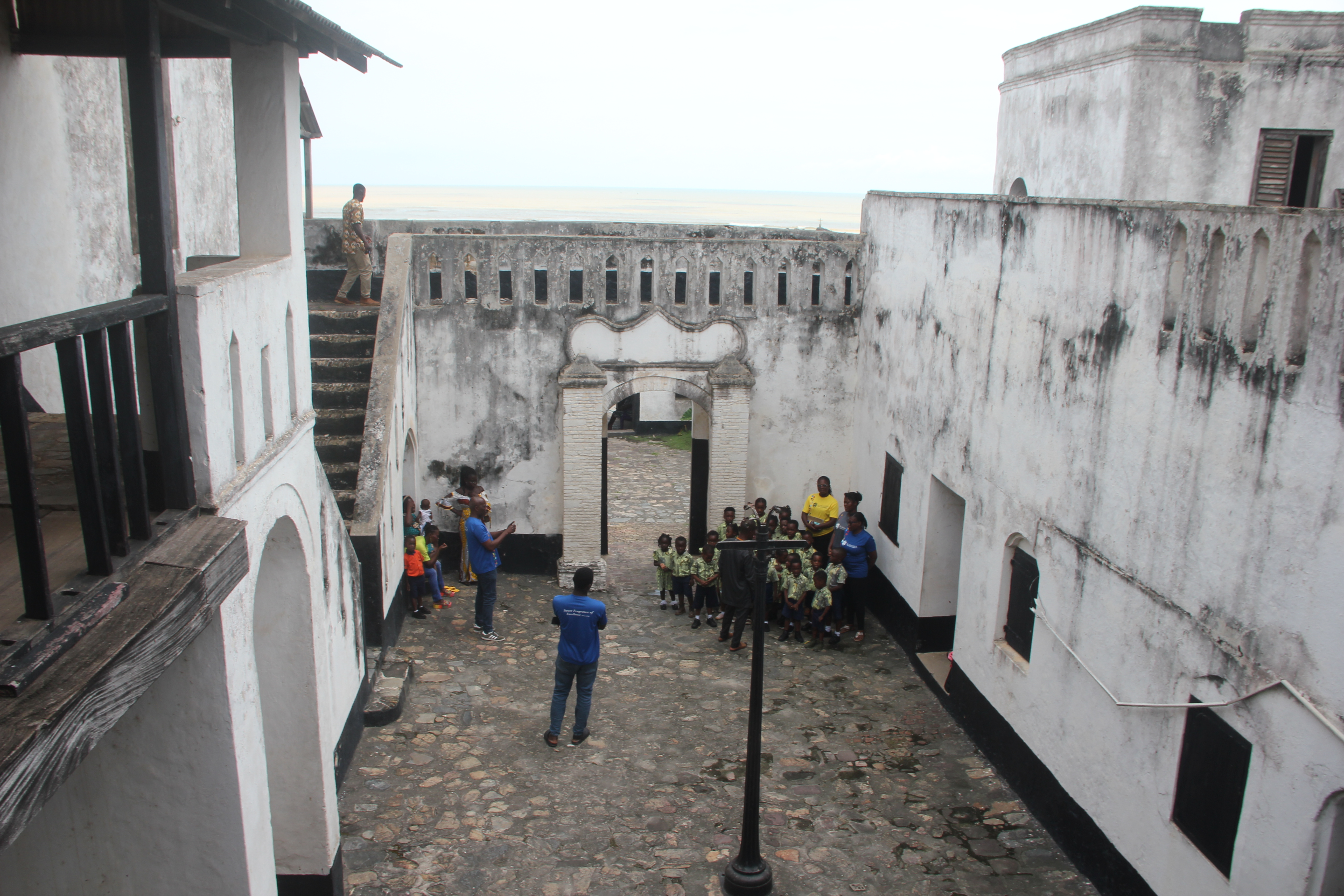
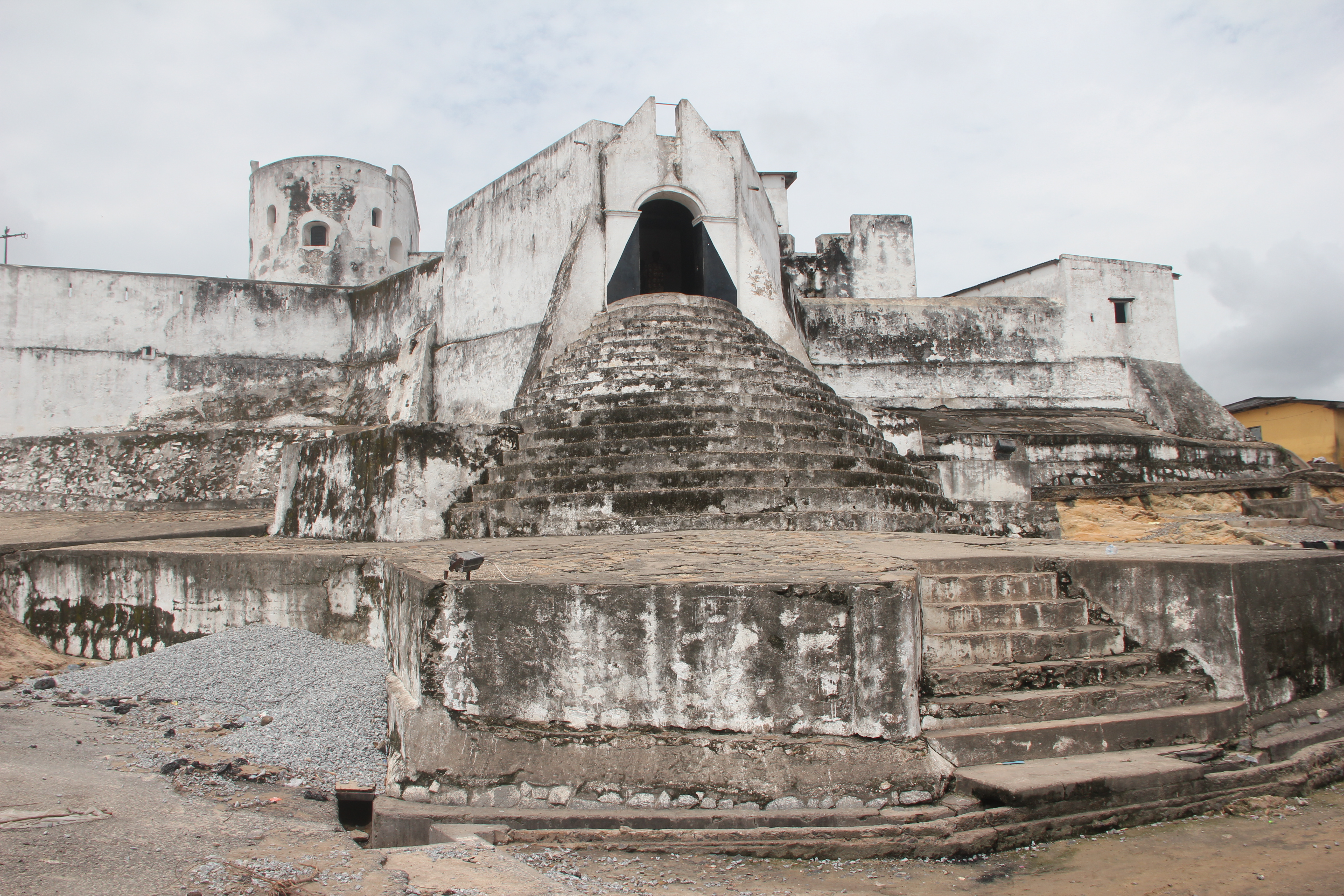
Not recommended if you have difficulty with stairs. The climb up is steep and so is the way down, and there are no handrails. Wear shoes with grip, take your time, and keep a hand free.
The view
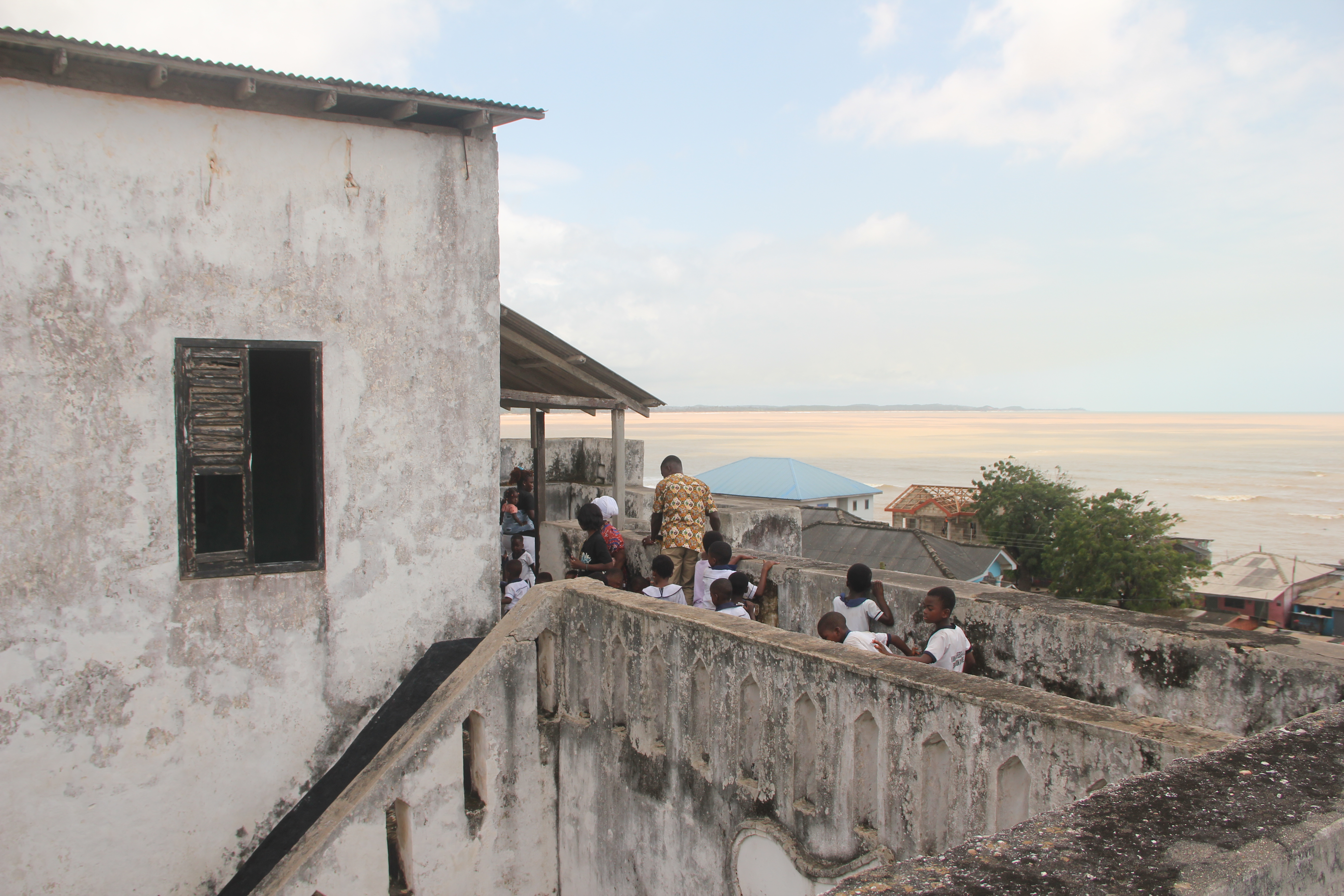
Once you are up, it is worth it: the Pra estuary, the fishing canoes, the town and the long line of the western coast. Go early or late in the day for softer light and less heat.
Condition: the fort needs maintenance. It is standing and it can be visited, but it is not being looked after the way a World Heritage site should be. Do not expect a restored museum like Cape Coast Castle.
Swimming: do not. Apart from the currents that make this whole coast dangerous, the sea off Shama was brown with galamsey run-off from the Pra when we were there.
More photographs, from every part of the fort, are on our dedicated site: fortsansebastian.ghanamuseums.com.
Getting there, and the town
Shama lies east of Sekondi-Takoradi, off the coastal road toward Cape Coast. On a map it looks close. In practice the journey takes a while: allow more time than the distance suggests, and do not squeeze it between other plans.
The drive is part of the reward. Along the way are several colonial-era buildings, and one in particular: an old church at a road fork, beautifully kept in its nineteenth-century form, left as it was built and still in active use. Stop for it.
Shama itself needs investment. The town is run down. That is no surprise: the government has done practically nothing in this area. A World Heritage site, a historic river mouth and a working fishing town sit side by side here, and none of it is being developed for the people who live there or the visitors who could come.
Why the official information is wrong
The Ghana Museums and Monuments Board, the body responsible for this fort, still states that it houses a post office, a magistrate's court and offices of the Electoral Commission. When we visited in January 2026, none of these were in the fort.
It is a small thing, and it is not. If the official custodian of a UNESCO site cannot keep one paragraph about it current, visitors cannot rely on anything else it publishes about opening times, facilities or condition. That is why we check in person, and why we put a date on what we write.
The honest verdict
Go, if you are interested in the history of this coast, can manage steep stairs without a rail, and are within reach of Takoradi. You will have a five-hundred-year-old fort almost to yourself, a guide who knows it, and a view you will remember.
Skip it if stairs are difficult for you, or if you are expecting the polished museum experience of Cape Coast. And go knowing what you will also see: a fort that needs care, a town that needs investment, and a river mouth turned brown by galamsey.
That is the truth about Shama in 2026. It deserves better than it is getting, and so do the people who live there.
Tours on this coast
Shama is rarely on organised itineraries. The easiest way to include it is on a private western-coast tour, or with a driver from Takoradi or Cape Coast.
Nearby, and connected
- Fort San Sebastian — our dedicated site, with the full photo documentation.
- Forts & Castles of Ghana — every fort on the coast, and which ones are worth your time.
- Fort Orange, Sekondi — the Dutch fort above Sekondi harbour, now a lighthouse.
- Fort Batenstein, Butre — Dutch hilltop fort further west.
- Fort Metal Cross, Dixcove — the English fort that became Dutch for four years.
- Beaches of Ghana — including where galamsey makes the western coast unsafe to swim.
- Kakum National Park — and our galamsey coverage.
- GhanaMuseums.com — field reports on Ghana's heritage sites.
Sources
- Ghana Museums and Monuments Board — Fort San Sebastian, Shama (1526), citing J. Kwesi Anquandah, Castles and Forts of Ghana (1999)
- UNESCO World Heritage Centre — Forts and Castles, Volta, Greater Accra, Central and Western Regions
- Zamani Project — 3D documentation of Fort Saint Sebastian, 2013
- Fort São Sebastião de Xama — overview and dates
- Site visit, entry fees, access, condition and current use: Remo Kurka, January 2026.
Updated and fact-checked: 17 September 2026. On-site observations date from January 2026. Construction dates differ between sources (1520–1526 per GMMB; 1523 in other references); both are given. The GMMB statement on current use was found to be out of date at the time of our visit. Entry fees are those charged in January 2026 and may change.