
Ghanas Inspiring History Unveiled
Discover Ghanas rich history, from ancient kingdoms to modern democracy, through vibrant festivals, stunning…
Two of Ghana's textiles are writing systems. Your name here tells people which day you were born. And the coffins are shaped like whatever you loved. Culture is not an abstraction in this country — it is worn, spoken and carried.
A note on visiting. Much of what is on these pages is living practice, not heritage display. Naming ceremonies, funerals, shrines and durbars are real occasions in people's lives. Ask before photographing, dress appropriately, and go with someone local where you can.
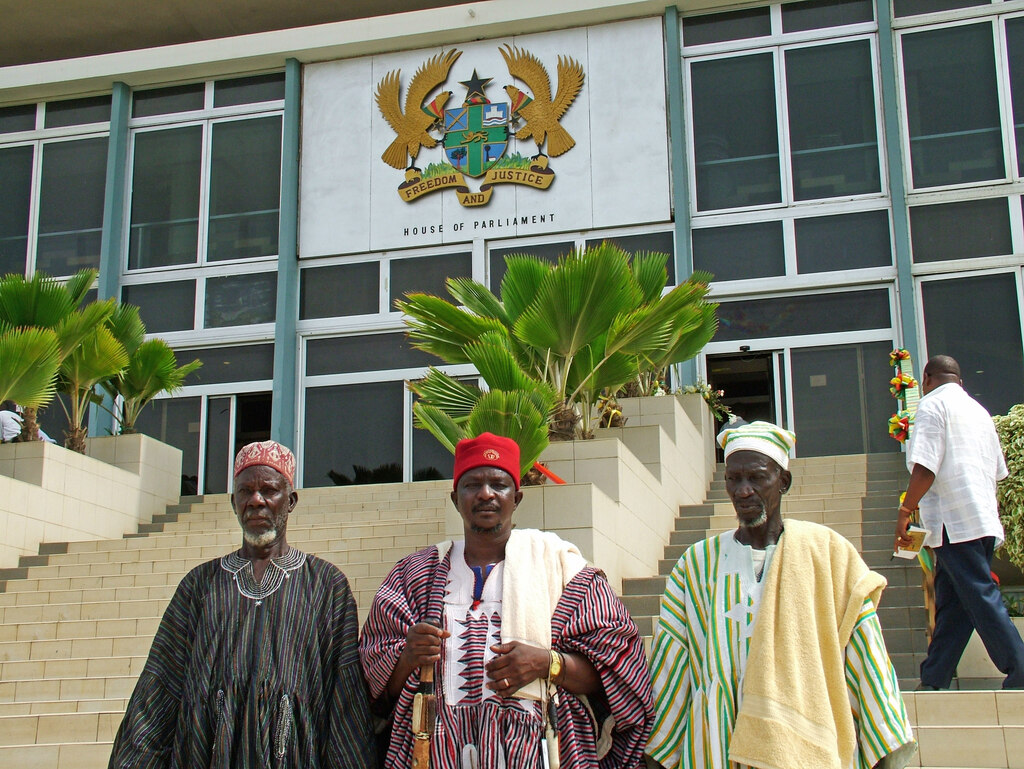
The Chief of Bongo (middle) Upper East region of Ghana in front of the Parliament of Ghana, wearing traditional clothing, Accra
"Remo Kurka - "To understand Ghana, you must first understand its people. Every region, language and tradition adds another chapter to the country's remarkable story."
Ghana is home to a rich diversity of peoples, languages and cultures that have shaped the country for centuries.
Although often recognised internationally for its political stability, hospitality and historic role in African independence, Ghana's greatest strength lies in its people.
Across forests, savannahs, coastal fishing communities and growing cities, more than one hundred ethnic communities contribute to the country's cultural identity.
Modern Ghana is united as one nation, while celebrating the traditions and histories of its many peoples.
Ghana's population reflects centuries of migration, trade, cooperation and cultural exchange.
Among the largest cultural groups are:
Each has its own history, traditions, festivals, music, cuisine and languages.
Together they form one of West Africa's richest cultural landscapes.
The Akan peoples form the largest cultural grouping in Ghana.
They include communities such as:
The Akan world is known for:
The historic Ashanti Kingdom remains one of Africa's best-known pre-colonial states.
Northern Ghana is home to several Mole-Dagbani-speaking communities, including:
Traditional kingdoms continue to play an important role in preserving history and cultural identity.
Northern Ghana is especially known for:
Living mainly in the Volta Region and neighbouring Togo, the Ewe have a rich cultural heritage.
They are known for:
The Volta Region combines cultural diversity with spectacular natural scenery.
The indigenous peoples of the Greater Accra area include the Ga and Dangme communities.
Their traditions remain central to life in the capital.
One of Ghana's best-known festivals, Homowo, celebrates resilience, harvest and community.
Fishing traditions continue to shape many coastal Ga communities today.
The Guan are among the oldest known cultural groups in Ghana.
Today they live across several regions and have contributed significantly to the country's cultural diversity.
Although smaller in number, their traditions remain an important part of Ghana's national heritage.
English is Ghana's official language, but everyday life is multilingual.
Widely spoken languages include:
Many Ghanaians comfortably speak two or three languages, switching naturally depending on where they are and whom they are speaking with.
Visitors often describe Ghanaians as among the friendliest people they have met.
Hospitality is deeply rooted in everyday life.
Greeting someone properly before asking a question is considered polite.
Sharing food, offering directions and taking time for conversation are common expressions of respect and community.
For many visitors, these small interactions become some of the most memorable parts of their journey.
Family relationships play an important role throughout Ghana.
Extended families often remain closely connected, even when members live in different cities or abroad.
Community events—including festivals, funerals, weddings and naming ceremonies—bring generations together and reinforce social ties.
Religion is an important part of daily life.
Christianity, Islam and traditional African religions all contribute to Ghana's cultural landscape.
Many families combine religious faith with long-standing cultural traditions, reflecting the country's rich historical heritage.
Respect for different beliefs is one of the strengths of Ghanaian society.
Music accompanies many aspects of life in Ghana.
Traditional drumming, highlife, gospel, hiplife and Afrobeat reflect both heritage and modern creativity.
Dance is an important part of festivals, celebrations and ceremonies, where communities gather to honour history, celebrate harvests and strengthen social bonds.
Meals are more than nourishment—they are opportunities to share time with family and friends.
Across Ghana, regional specialities reflect local ingredients and traditions.
Whether enjoying waakye in Accra, fufu in Kumasi, banku along the coast or tuo zaafi in the north, food tells the story of the people who prepare it.
Today's Ghana is both traditional and modern.
Young entrepreneurs build technology companies while artisans continue centuries-old crafts.
Traditional rulers work alongside democratic institutions.
Ancient festivals continue in cities filled with universities, businesses and growing industries.
Rather than replacing one another, tradition and modernity often exist side by side.
Millions of Ghanaians live, study and work abroad while maintaining close ties with home.
The Ghanaian diaspora has contributed to education, business, culture, science, sport and public life across the world.
These global connections continue to enrich the country while strengthening international friendships.
Visitors sometimes arrive expecting famous attractions to define their experience.
Instead, many leave remembering the conversations they had, the hospitality they received and the communities they encountered.
The castles, national parks and beaches are remarkable.
But it is the people who give Ghana its character.
Every country is shaped by its geography and history.
Ghana is shaped above all by its people.
Their languages, traditions, creativity, resilience and generosity have created a nation that is both proudly rooted in its heritage and confidently looking towards the future.
Take time to learn a greeting.
Visit a local market.
Attend a festival if you have the opportunity.
Listen to people's stories.
Because understanding the people of Ghana is the key to understanding Ghana itself.
Part of the Ghana-Net Knowledge Series — helping visitors discover, understand and explore Ghana since December 2000.