Remo Kurka - There are moments in Ghana that stay with you long after you’ve left. One of mine happened in Bonwire—a small weaving village near Kumasi, known for centuries as the heart of Kente craftsmanship. I remember sitting beneath a tree, the midday heat pressing down, while an elderly weaver worked quietly at a narrow wooden loom. His hands moved with such ease and certainty, it felt as though they weren’t thinking at all—as if weaving had long since become part of him.
What took shape between his fingers wasn’t just fabric. It was a conversation with history.
Kente is perhaps the most recognizable textile in Africa—displayed in museums, worn by world leaders, and present at weddings and celebrations across the globe. But to truly understand Kente, you have to come to Ghana. You have to sit in Bonwire, listen to the steady rhythm of the loom, and watch as each strip of cloth becomes a message woven from centuries of tradition.
The word Kente comes from the Akan term kenten, meaning “basket.” Early weavers used raffia fibers, creating patterns that resembled woven baskets—hence the original name Nenten Ntoma, or “basket cloth.” Among the Asante, the cloth was also known as Nsaduaso or Nwontoma, meaning “a handwoven cloth on a loom.”
While these traditional names are still used by elders and master weavers, Kente has become the widely recognized term both within Ghana and around the world.
As with many traditions in Ghana, the origins of Kente are told through stories—each carrying its own truth.
One account speaks of Otah Kraban, believed to be the first weaver of the Asante people. After traveling to the Bondoukou region in present-day Côte d’Ivoire, he is said to have returned to Bonwire with a loom—bringing with it the craft that would define his village forever.
Another story is more poetic. It tells of a man during the reign of the great Asante king Osei Tutu, who learned to weave by watching a spider spin its web. That spider is Anansi, a central figure in Akan folklore—symbolizing intelligence, creativity, and the ability to create something lasting from almost nothing.
That Kente is linked to Anansi is no coincidence. It reflects what the cloth truly represents: skill shaped by patience, knowledge, and imagination.
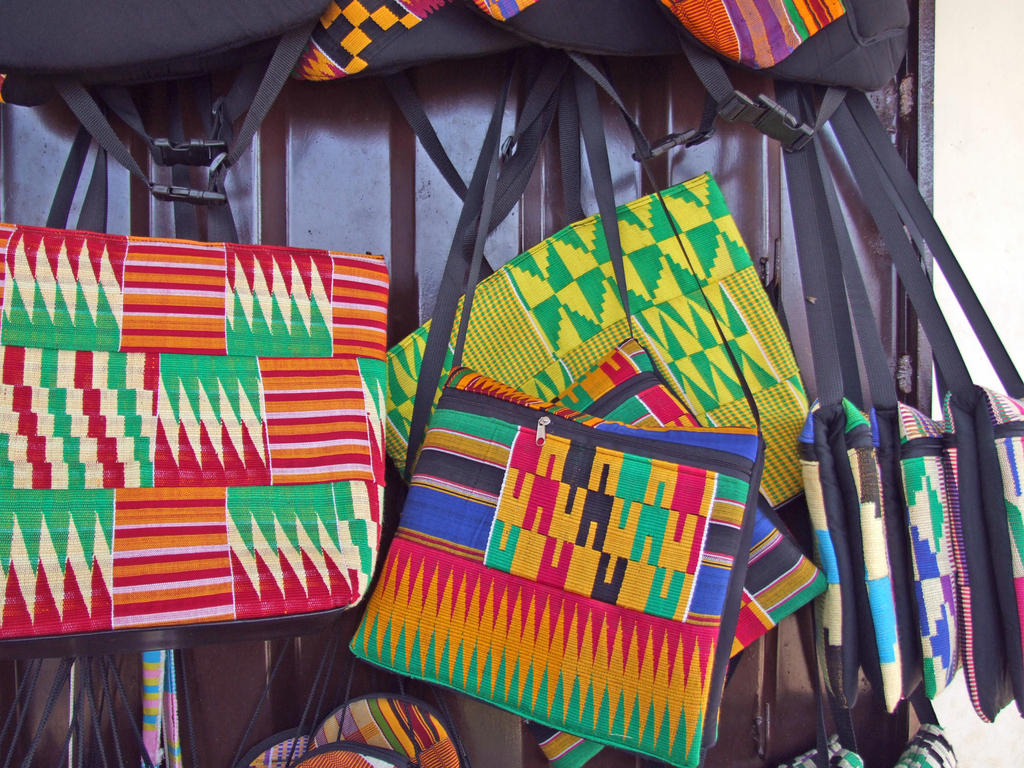
Its own language: KENTE: Bonwire—a small weaving village near Kumasi
In its earliest days, Kente was reserved exclusively for royalty. Only the Asante king—the Asantehene—and his court were permitted to wear it. The weavers themselves lived and worked in Bonwire, a village established for royal artisans. Alongside them were goldsmiths, stool carvers, umbrella makers, blacksmiths, and Adinkra dyers—each contributing to the cultural wealth of the Asante kingdom.
Originally woven from cotton, Kente later incorporated silk—much of it imported from Europe. These silk fabrics arrived via trans-Saharan trade routes or direct imports. In a remarkable display of craftsmanship, Asante weavers would carefully unravel the silk threads and reweave them into entirely new designs. The process was painstaking, but it elevated Kente to extraordinary levels of artistry.
Among the finest examples is Adwinasa, meaning “all motifs are used.” In this design, every inch of the cloth is filled with intricate patterns—no empty space, no idle thread. Creating such a piece can take weeks, sometimes months.
To appreciate Kente, it helps to understand how it is made. The cloth is woven on narrow looms, producing strips typically about 10 to 12 centimeters wide. These strips are later sewn together to form a complete garment—giving Kente its distinctive striped structure.
The patterns themselves are created using two main techniques. One involves weaving additional threads into the fabric that “float” across the surface, forming geometric shapes like diamonds, triangles, and lines. The other creates solid blocks of color that fully cover the underlying threads—made possible by a unique double-heddle system developed by weavers in southern Ghana.
Together, these methods produce the vibrant, rhythmic designs Kente is known for—sections of bold patterns framed by narrow bands called bankuo.
Kente is not just admired—it communicates.
Every pattern has a name, and every name carries meaning. Some designs are named after historical figures or queen mothers, such as Atta Birago or Afua Kobi. Others reference proverbs, events, or everyday objects.
Obaakofoo Mmu Man speaks to democratic leadership. Emaa Da represents creativity and the wisdom gained through experience. Sika Fre Mogya reminds one to share wealth with family. And Gye Nyame—also known from Adinkra symbolism—declares: “I fear none except God.”
When a Ghanaian elder wears Kente, they are saying something to the world—without speaking a single word.
What was once reserved for kings has become a symbol shared across generations and continents. Today, Kente is worn at weddings, engagements, national celebrations, and graduation ceremonies. Across the African diaspora, it represents pride, identity, and connection to heritage.
And in Bonwire, where it all began, the looms still echo. Young and old sit side by side, weaving patterns passed down through generations—or creating entirely new ones. The rhythm continues, unchanged and alive.
If you ever find yourself in Kumasi, take the time to visit Bonwire. Sit with the weavers. Watch closely. Buy directly from them. It is one of the most powerful cultural experiences Ghana has to offer—and that’s saying something.
Other websites - Not shown within our main site-map:
Find your roots and rise — Ghana3d.com Gateway Experience 360 is your ultimate guide to cultural, historic, and soul-stirring adventures. Whether you're returning to your ancestral land or exploring Ghana for the first time, we offer curated journeys that connect you deeply to the spirit of West Africa. From powerful walks through Cape Coast & Elmina slave castles to the vibrant rhythms of Accra’s nightlife. From sacred village ceremonies to awe-inspiring natural beauty — your journey starts here.
3 girls selling fruits and food at the road side. (c) Strictly by Remo Kurka (photography)
