Header photo showcasing the entrance of Osu Military Cemetery in Accra.
Welcome to Ghana-Net.com
Akwaaba!
Twi (Akan) · “Welcome”
Search our Network. Start here.
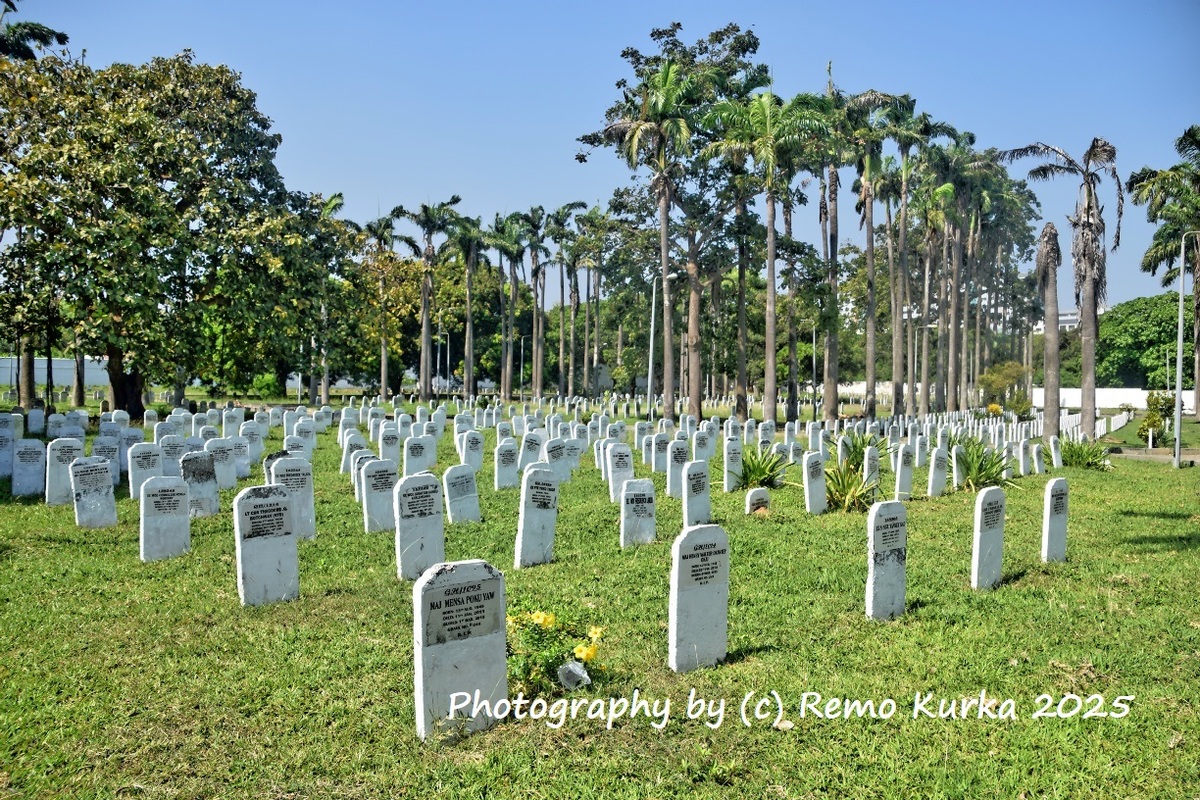
Osu Military Cemetery in Accra is both a site of remembrance and a site of erasure. Established in the colonial era, it holds the graves of soldiers, dependents, and civilians tied to the British military presence in the Gold Coast. Yet recent discoveries show that many names have been deliberately removed, leaving rows of blank stones where identities once stood.
The Osu Military Cemetery, located in North Ridge, Accra, was created during the colonial period as a burial ground for military personnel and their families. It became the final resting place for soldiers of the Royal West African Frontier Force (RWAFF), particularly the Gold Coast Regiment, which was formed in 1900 and later received royal recognition in 1928. The cemetery contains graves from World War I and World War II, alongside those of non‑combatants connected to the barracks.
The RWAFF was central to Britain’s control in West Africa. British officers and non‑commissioned officers trained African recruits, often drawn from the northern territories of the Gold Coast. By the 1950s, as independence approached, British NCOs were preparing Ghanaian officers to take over command. The cemetery thus became a symbolic space where empire, family, and mortality intersected.




Among the most poignant graves is that of Terrence George “Darling Terry” Flear, son of Staff Sergeant Scott Flear. Terry died in December 1954 at the age of 14 months, buried in Osu Military Cemetery because his father served in the Gold Coast Regiment. His stone reads: “Safe in the Arms of Jesus.”
Archival searches for the Flear family — through RWAFF rolls, Gold Coast censuses, UK obituaries, missionary logs, and National Archives files — yield almost nothing. Post‑independence coups in the 1960s destroyed many NCO records, while municipal logs were lost to floods. Families like the Flears became footnotes in the handover shuffle. Terry’s grave is one of the few that still bears a name; many around him do not.
Recent photographic evidence shows that nameplates and regimental badges were deliberately removed from dozens of graves. Each erased stone carries identical scars:
Four screw holes where brass plates were fastened
A circular recess where a badge once sat
A rectangular void where names used to be
This uniformity rules out weathering or random theft. It suggests systematic removal, likely by order, sometime after independence. The effect is chilling: rows of blank stones, identities stripped, silence manufactured.
Military cemeteries are meant to preserve memory. At Osu, however, the erasure of names means that families, clerks, riflemen, and children have been deliberately forgotten. Terry’s grave stands as an exception — a fragile survival of identity amid a landscape of absence.
The cemetery today is serene, shaded by mango trees, minutes from Parliament House. Visitors sense respect and gratitude, but beneath the greenery lies a troubling truth: the empire buried soldiers and their children side by side, but independence buried their names.
The Osu Military Cemetery is historically significant, but it is also a site of contested memory. It reminds us of the Gold Coast Regiment’s role in colonial wars, the families who lived in barracks during the transition to independence, and the deliberate erasure of identities after 1957. Terry’s stone, with its surviving inscription, is proof that remembrance can resist silence.
The erased are finally speaking — through scars in stone, through photographs, through the persistence of memory.
