Ghana-Net.com · Accra · Osu · UNESCO World Heritage
The lower courtyard is a burial ground. More than three hundred enslaved people lie beside the well — recorded, in Danish, as having been put there to manure the ground. No names, no stones, no plaque. The ceremonial red path runs within a couple of metres of them, and the Governor's quarters stood directly above. In 1698 a governor wrote that the salt water here was the prime reason people died. The tank went up fifty-five years later, with his successor's name on it.
A good deal of what follows is not on the official signage, not on the Ghana Museums and Monuments Board page, and not in the UNESCO citation. It is not secret. It is simply not repeated.
Ole Justesen's Danish Sources for the History of Ghana, 1657–1754 collects 461 documents across two volumes — fort diaries, official reports, correspondence. The governors wrote a great deal down, in their own hand, about what was happening here.
The Christiansborg Archaeological Heritage Project has excavated the site and its surroundings since 2014, combining excavation with oral history taken from the families and community around the castle.
Inscriptions, monograms and dates on the walls and structures — including the plaque on the well, which is legible and which we read directly.
First-hand observation, and what guides say when you ask. We mark clearly throughout which is documented and which is ours.
We keep a dedicated site for this monument at osucastle.ghana-net.com, with fuller photographic documentation than fits on one page.
Almost every published description of this castle gets the layout wrong, so start here. There are two separate spaces, and only one of them is a courtyard.
Hold that geography, because everything on the rest of this page depends on it. What is photographed at ceremonies is the forecourt. What matters is through the second gate.
Beneath the flagstones of the lower courtyard, beside the well, lie the remains of more than three hundred enslaved Africans.
They were not shipped out. They were castle slaves — Northerners, Ewe and others — kept here to scrub the cannons, haul the rations, mend the walls and serve the men who ran the place. By 1793 Christiansborg's permanent African workforce numbered 442 people, women and children among them.
Disease took them fast. Malaria, dysentery, fevers.
The Danish records describe the disposal of their bodies in shallow pits as putting them there "to manure the ground."
No names. No stones. Just earth, and afterwards the boots of governors on top of it.
Research on mortuary practice in the Accra and Osu area records that intramural burial was widespread — beneath the floor of a room, within a compound, in the courtyard, around the house. The Danish observer Ludewig Ferdinand Rømer, who arrived at Christiansborg in 1739, recorded the practice directly.
The same research notes that Europeans at the forts were initially buried inside the castle precincts, until cemeteries were established outside. Burials in this ground are exactly what the documentary record would lead you to expect.
These are not the dungeon captives. Tens of thousands passed through Christiansborg's dungeons before 1803, held for days, weeks or months before shipping. The people under this courtyard lived here. Different population, different fate, same ground.
No plaque. No memorial. No line in the guide's script unless you ask. Visitors take photographs beside the well, unaware of what is under them.
The red path runs past them. The ceremonial route through the lower courtyard — painted directly onto the ground, not a carpet — passes within a couple of metres of the spot. Heads of state and their guests have walked it. Nothing on that route indicates what lies beside it.
The domed structure in the lower courtyard, with its finial and its iron grille, is the water tank commonly called the Engmann cistern. It carries a Danish inscription, repainted so often that the lettering has degraded — but the essentials are still legible.
DENNE VANDBANK … ER BEGYNDT UDI AAR 1753 DEN 25 MARTS OG ENDT DEN 31 MAI … CARL
ENGMANN
This water tank … was begun in the year 1753 on 25 March and ended on 31 May … Carl
Engmann. The plaque also gives dimensions — a depth of 23 feet, a length of 23 feet — and
places the tank between two quarters, one of them the Governor's.
Ten weeks, by the governor's own account.
A guide will tell you the well took ten years to build, and that the enslaved people who dug it died doing so and were buried where they fell. We cannot verify the ten years, and we are not going to print it as though we could. What we can do is put the documentary record beside the plaque, because it tells a harder story than either version.
Fifty-five years before that plaque was carved, the governor of Christiansborg wrote to Copenhagen. The fort urgently needed a water tank, he said, because the available water was naturally salty — and this was the prime reason why people here die off. He proposed a tank to collect rainwater.
The deaths in this courtyard were not caused by building the tank. They were the reason it was requested — and then people went on dying here for another fifty-five years while nothing was built.
What happened in that gap we do not know. Earlier attempts, abandoned works, preparatory digging — none of it would appear on a plaque bearing a governor's name, because such plaques commemorate the man who finished a thing. The Justesen volumes run to 1754 and cover precisely that window. Somebody should read them.
What is not in doubt is that the water and the dying at this castle were connected in the governors' own words, in 1698, and that the memorial in that courtyard commemorates neither the dead nor the diggers. It records a name, two dates and the measurements of a tank.
The dungeons where captives were held. Sealed. You cannot enter, and the published literature stops here.
There are dungeons on the right as well. Used for storage in the Danish period, and used for storage again during the years the castle was the seat of government. These are part of the tour.
One dungeon is genuinely dark — not dim — because the church sits directly on top of it and takes the light. A chapel built over a holding cell, blocking what little would otherwise reach the people inside.
The archaeological record indicates captives were confined for days, weeks or months before being put aboard ship. Tens of thousands passed through these cells between the construction of the fort and 1803.
The route down to the Door of No Return is a narrow staircase, and that is not an accident of construction.
The passage forced people to descend slowly, one by one — because at the bottom they were being counted. A staircase built to the width of a single body is a counting device. It made the tally accurate.
Walk it and you feel the walls on both sides. That is what it was for.
Beyond the door was the beach. The Danish transatlantic trade carried at least 100,000 captives to the Danish West Indies. The mortality on the crossing is documented voyage by voyage: the ship Christiansborg lost 43 of 304 captives in 1778, 85 of 457 in 1781. The Accra lost 265 of 592 on a single voyage — forty-five per cent. The sea off this coast is part of the same burial landscape as the courtyard.
At the Door of No Return, on the left-hand side, there is another door. It leads into a tunnel running toward the Richter property.
The Christiansborg Archaeological Heritage Project has documented the underground passage beneath the castle running toward the Richter compound, and describes its purpose plainly: moving captives from the private slave-trading compound directly toward the ships, reducing the chance of escape and avoiding the attention of neighbours.
Substantial parts of it survive. It is blocked roughly halfway along.
Heinrich Richter (1785–1849) was a Euro-African merchant of Osu — Ga and Danish — who inherited his father's commercial network and became one of the most powerful traders on this coast.
Sewah was thirteen. Somebody wrote her name down. That is more than we have for the three hundred in the courtyard.
Denmark prohibited the transatlantic slave trade in 1792, with effect from 1803. Christiansborg remained Danish until 1850.
The archaeological project's oral-history work is explicit on what happened in between: family and community members who preserved the story told the archaeologists that private trading continued after abolition.
Richter's four hundred were being held in the 1830s and 1840s — three decades after the trade was outlawed.
Transatlantic export, internal slavery and trafficking, and illegal attempts to export people overseas are three different things. The record after 1803 involves all three, and conflating them makes the history easier to dismiss. We keep them separate.
Richter died in July 1849. The Danish government appointed a commission to deal with his affairs. The file survives in the Danish National Archives as Protokol for Behandling af de Richterske Affairer ved den i den Anledning nedsatte Commission, 1849.
The auction of his possessions recorded 1,059 movable items valued at roughly $18,138. If the commission accounted for his property that carefully, the question is what it recorded about the several hundred people attached to his household and business.
Four hundred enslaved people in 1836. Richter dies 1849. A Danish commission investigates. Denmark hands Christiansborg to Britain in 1850. That is an exceptionally narrow gap, and the paperwork exists.
We have not seen that file. As far as we can establish, nobody has published what is in it. We intend to ask.
The open ground opposite the castle gate is called the gardens. It used to be a neighbourhood.
In 1852 the British imposed a poll tax on the Gold Coast — one shilling per man, woman and child. Labadi, Osu, Teshie and other Ga towns refused to pay it. They were also resisting British attempts to turn land into something bought and sold.
On 13 September 1854, those towns were bombarded by the British warship HMS Scourge — commissioned that April under Commander John Adams RN for the West Coast of Africa as flagship of the squadron.
They shelled the towns during Homowo — the Ga harvest festival, the most important thing in the Ga year.
Afterwards the British demolished the houses standing close to the castle. It was presented as a security measure: buildings that near the fort could give cover or elevation to anyone attacking the garrison. The Richter family's large stone house, which overlooked the castle, was among the buildings destroyed.
Then the ground was fenced, to keep local people away from the walls.
A tax refused. A festival shelled. A neighbourhood demolished. The ground fenced. What remained is the open space where visiting presidents are now photographed.
Five years after Heinrich Richter's death, the British destroyed his family's stone house — with guns firing from the castle his tunnel ran into. Both ends of that operation removed within a decade.
These events are frequently confused. 1854 was the bombardment and demolition of the surrounding town. 1862 was the earthquake that badly damaged the castle itself. Two different events, eight years apart.
The courtyard buildings on the north side were demolished in 1912. The castle you see is a patchwork of what survived each clearance — Danish, British, and twentieth-century, in the same walls.
And in 1960, the old Danish graveyard beside the castle was demolished by the Kwame Nkrumah government — reportedly to create a car park. Three clearances of burial and dwelling ground on this site: by the British in 1854, by a Ghanaian government in 1960, and the continuing absence of any marker over the courtyard today.
The castle is partly open, and what is presented tells you how Ghana would prefer this building to be understood.
Part of the castle now houses an international maritime coordination centre, with signage in English and French serving the Gulf of Guinea. Air-conditioning units are bolted to the walls of the lower courtyard. This is not a museum with a caretaker. It is an operating government facility that admits visitors.
Getting a photograph. Photographing from outside the inner gate is a challenge — expect to be questioned or stopped. Once through and inside, photography is largely unproblematic. The sensitivity is at the threshold rather than within, which is itself informative about what is being protected.
Our view, stated as ours: because the tidy version is more useful.
For most of the independence era this was the seat of government. Heads of state were received here. A building where the President of the Republic welcomes visiting presidents cannot comfortably be described as standing on an unmarked mass grave — so the courtyard becomes a courtyard with an interesting stairway, and the well becomes a water tank with a governor's name on it.
Ghana has been prominent in the international push for reparations for the transatlantic slave trade and has hosted major conferences on it in Accra. The case is serious and the historical claim is sound.
A state that presents the atrocity abroad while declining to mark it in its own courtyard is making the argument selectively. If those dead matter enough to cite in a conference hall, they matter enough for a plaque twenty metres from where officials entertain guests.
A working seat of government has real reasons not to turn its forecourt into a memorial — security, protocol, the practical business of statecraft. No government anywhere marks every difficult thing beneath its own buildings.
The presidency left over a decade ago and the site is now a Presidential Museum. The practical objection has expired. The courtyard is still unmarked.
When President Barack Obama visited Accra in July 2009, President Mills was governing from Osu Castle. The photographs from that visit were taken in the forecourt, in front of the gate. We are aware of no photograph of him in the lower courtyard.
Obama did visit Cape Coast Castle on that trip, with his family, and spoke there at length about the trade. That visit is extensively documented. The contrast between the two stops is available to anyone who looks at the pictures. We draw no conclusion about protocol decisions taken by anybody's staff.
Asameni, an Akwamu royal and trader, took Christiansborg from the Danes without a siege. Accounts differ on the method — some say he and his men posed as traders wanting to buy guns and ammunition and turned those weapons on the garrison; others that he infiltrated as a cook. Either way he got through the gate by being somebody the Danes thought they understood.
He ran the castle for about a year, then sold it back. He kept the keys, and they are held in Akwamu today as royal regalia — never returned, for more than three hundred years.
The castle's image appears on the Coat of Arms of the Republic of Ghana and on Ghanaian currency. A Danish slave castle on the national emblem — which some read as a scandal and others as a claim of repossession, in the same spirit as Asameni keeping the keys. Both readings are honest. Neither is discussed on any official page.
GMMB states the castle is open daily, 9.00 a.m. to 4.30 p.m. Visit Ghana states Fridays only, 9.00 a.m. to 4.00 p.m., and adds it may be closed as the area remains a security zone. Two government bodies, two answers.
Ghana Museums and Monuments Board, 2 Barnes Road, Adabraka, Accra.
+233 302 221633 or +233 302 221635.
Ask about Osu Castle specifically, for the day you intend to come.
There is almost no interpretation on the walls. Ask about the ground beside the well, about the dungeon under the church, and about the door beside the Door of No Return. Some guides know all of it and tell it well.
Expect difficulty outside the inner gate and few problems once inside. Never photograph security personnel or arrangements.
If you are coming from the diaspora: Cape Coast and Elmina are prepared for this journey, with trained staff and proper interpretation. Osu is not, and the absence of any acknowledgement in that courtyard can land harder than a guided narrative would. Consider doing it after them, and not alone.
Details last verified . Documented in published sources: the 1661 acquisition from Ga Paramount Chief Okaikoi for 3,200 gold florins; the naming after Christian IV; the 1659 Danish stone fort replacing a Swedish lodge obtained by Heinrich Carloff; the 1679 mutiny and Portuguese occupation as Fort São Francisco Xavier; Danish administrative headquarters from 1685; the remortgage to Britain 1685–1689; Danish ducats bearing the castle's image 1688–1747; Asameni's seizure in 1693 and the retention of the keys as Akwamu royal regalia; Danish abolition effective 1803; the 1850 sale to Britain; the 1852 poll tax and the bombardment of Osu, Labadi and Teshie by HMS Scourge on 13 September 1854 during Homowo; the 1862 earthquake; British governors from 1876; abandonment 1890–1901 with use as a constabulary mess and psychiatric asylum; restoration as seat of government in 1902; demolition of the north-side courtyard buildings in 1912; renaming as Government House in 1957; Nkrumah's occupancy from 1960 and the demolition of the old Danish graveyard in the same year; UNESCO inscription 1979; archaeological investigation from 2014; conversion to a Presidential Museum in 2017. Danish documentary material, including the 1698 governor's report on salt water as the prime cause of deaths and the record of 442 African personnel in 1793, derives from Ole Justesen's Danish Sources for the History of Ghana, 1657–1754 and related scholarship. Rømer's 1739 observations on burial practice, and the finding that intramural burial was widespread in the Accra and Osu area, are from University of Ghana research on mortuary practice. The tunnel toward the Richter property, its stated purpose, and the oral-history finding that private trading continued after abolition are as published by the Christiansborg Archaeological Heritage Project. Wulff Joseph Wulff's 1836 statement that Richter had 400 slaves, and the 1849 commission file Protokol for Behandling af de Richterske Affairer, are as cited in published scholarship; we have not examined the commission file and make no claim about its contents. Voyage mortality figures for the ships Christiansborg and Accra are from Danish shipping records. First-hand and not published in the official literature: the burial ground beside the well in the lower courtyard and its description in the Danish records as burial "to manure the ground"; the dungeons on the right-hand side and their use for storage in both periods; the dungeon darkened by the church above it; the narrow staircase used to count captives; the door beside the Door of No Return; the layout of forecourt, steps, inner gate and lower courtyard; the rooms shown and not shown to visitors; the maritime coordination centre now housed in the castle; and photography conditions at the inner gate. The claim that the well took ten years to build is repeated by guides at the site; the inscription on the structure itself records construction between 25 March and 31 May 1753, and we present both rather than choosing. Observations regarding the July 2009 visit of President Barack Obama are reported as observed; no conclusion is drawn as to any protocol decision by any person or government, and no allegation is made against any individual. Opening arrangements are reported differently by different official bodies — telephone GMMB on +233 302 221633 or 221635 before travelling. All photography © Remo Kurka. Usage strictly by prior authorisation only.
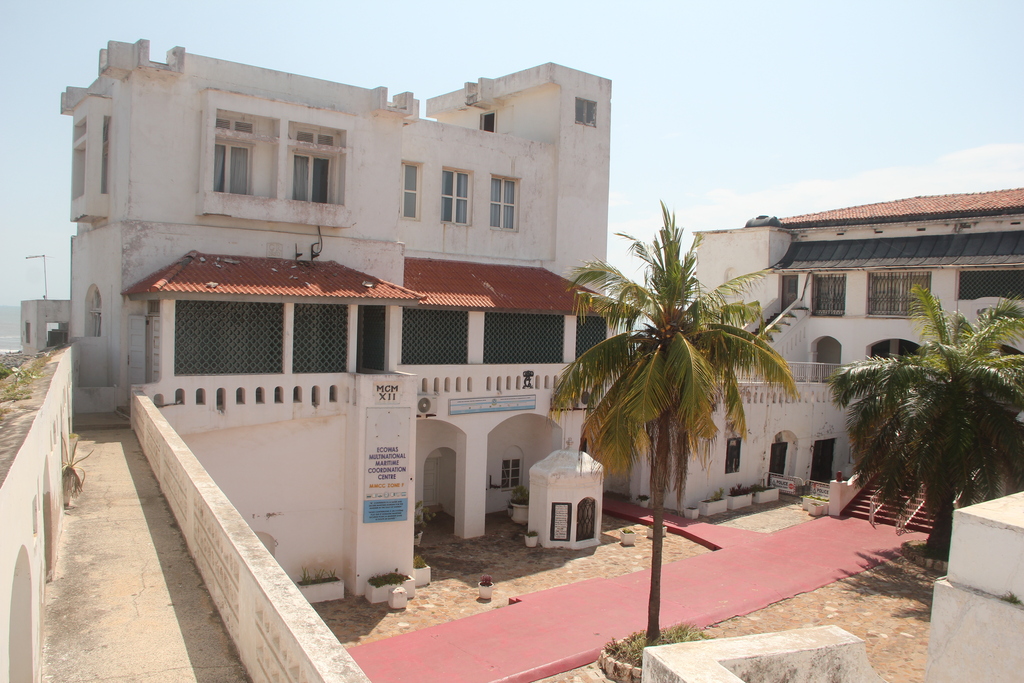
Court yard and Well. Osu Castle’s architecture is a blend of European colonial design and local adaptations. The whitewashed walls, cannons, and fortified towers (c) Remo Kurka, Accra, Ghana
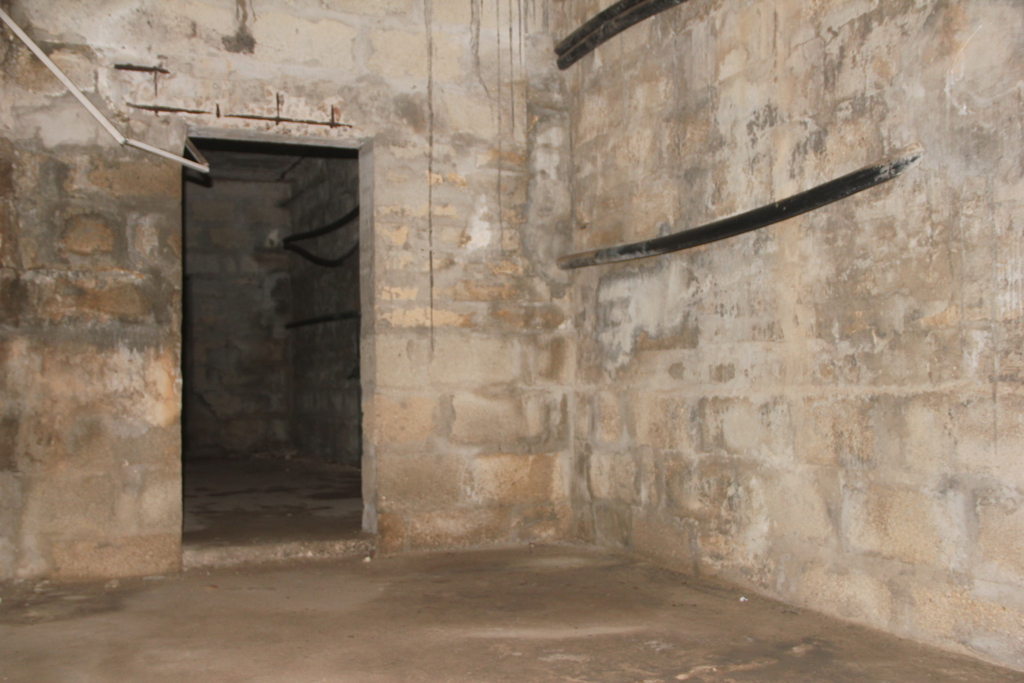
Richter Fort tunnel, Heinrich Richter 400 slaves, Danish slave trade Ghana by Remo Kurka at Osu Castle, Ghana
