Ghana-Net.com · Accra · Ghana Broadcasting Corporation
Ghana's national broadcaster, on air since 1935 — and the first building seized in every attempt to take the country. In 1966 soldiers captured it before dawn and announced Nkrumah's overthrow from its studios. In 1967 a lieutenant took it, made his announcement, played a pop song, then drove off to ask his girlfriend whether she had recognised his voice. He was executed three weeks later.
Between 1966 and 1981 Ghana had coups, attempted coups and counter-coups, and every one of them opened with the same move.
Take the radio station.
Before the barracks, before the palace, before arresting anybody — take the transmitter. In 1966 a country of six million found out what had happened to it from a voice on the radio at dawn, and whoever was holding that microphone at six in the morning was, for the next several hours, the government.
The building still stands and still broadcasts. It is a short distance from the presidential palace, it is inside a restricted security perimeter, and almost nobody visiting Accra has any idea what happened inside it.
On 31 July 1935 a crowd gathered outside the West End Cinema Palladium in Accra. Loudspeakers had been wired up in the street, running back to a small bungalow on 9th Road near the Ridge Police Station.
Gramophone records played — martial music, light music — while people waited to find out what this was.
The broadcaster Ben Gadzekpo, who joined the service as a vernacular announcer in 1943, later described the moment: at exactly 5.45 p.m. the music stopped, and the silence after the deafening music was complete. People wondered what would follow.
What followed was the British national anthem, and then the voice of Sir Arnold Hodson, Governor of the Gold Coast, speaking from the studio in that bungalow about the wonders of radio.
The station was code-named ZOY. A wired relay for the BBC, engineered with the help of a British radio engineer, F. A. W. Byron, and staffed by eight technicians. Hodson — nicknamed the Sunshine Governor — is credited as the man behind it.
Roughly three hundred colonial residents and a small number of privileged Ghanaians. It existed to inform expatriates and colonial administrators, and was extended in time to Kumasi, Sekondi, Koforidua and Cape Coast.
Historians of Ghanaian radio are direct about the second purpose: alongside information and entertainment, British radio provided a means of countering the anticolonial campaigns of the nationalist press. The station was built partly as an answer to Ghanaian journalism.
Broadcasting began in Fante, Twi, Ga and Ewe, with Hausa added later. Part-time staff translated and read the news in those languages until 1943, when full-time staff were finally appointed.
A colonial government that wished to speak to Ghanaians had to do it in Ghanaian languages — and had to employ Ghanaians to do the speaking. Some of the men who learned the craft in that bungalow were still at the microphone when the country became independent.
The Gold Coast Broadcasting System came into being in the 1950s, and after independence in 1957 the service became the Ghana Broadcasting Corporation.
For Nkrumah, radio was not a utility. It was infrastructure of the same order as the Akosombo Dam or Tema Harbour. A country of many languages, low literacy and enormous distances could be addressed all at once only by radio — and a government pursuing pan-Africanism needed a transmitter that reached beyond its own borders.
GBC provided two domestic services: Radio 1 in Akan, Ga, Ewe, Nzema, Dagbani, Hausa and English; Radio 2 in English.
On 31 July 1965 — thirty years to the day after Hodson's first broadcast — Kwame Nkrumah inaugurated the television service. A feasibility study had begun in 1959, a training agreement with Canada followed in 1961, and Ghanaian staff were trained from 1963 under supervision from the Canadian Broadcasting Corporation.
Seven months later, the television service he founded was announcing his overthrow.
Nkrumah had left Accra on 21 February, bound for Peking and then Hanoi, on a mission to broker peace in the Vietnam War. He travelled with an entourage of seventy-one.
In the early hours of 24 February, units of the Ghanaian Army occupied key installations in Accra and in the principal towns.
The soldiers had been told they were mobilising over the situation in Rhodesia. On reaching Accra they were told Nkrumah was meeting Ho Chi Minh to arrange the deployment of Ghanaian troops to Vietnam. They were then divided into groups and directed to capture specific buildings.
The State Broadcasting House and the international communications buildings were captured quickly. The heaviest fighting of the day was at Flagstaff House, the presidential residence, where the Presidential Guard resisted — many surrendering by eleven in the morning, others fighting on into the following day. General Charles Barwah, the ranking officer with the Chief of Defence Staff abroad, was shot dead when he refused to cooperate.
The coup leaders informed the public of the change of government over the radio at dawn.
Colonel E. K. Kotoka, identified as the leader of the revolt, broadcast that the ten-thousand-man army had taken over the government, dissolved Parliament and dismissed the President. The line Ghanaians still quote from that broadcast is his declaration that the myth surrounding Kwame Nkrumah had been broken.
The broadcasting house fell easily. The palace did not. Yet it was the broadcast, not the palace, that ended the First Republic — because until the announcement went out, nobody in the country knew anything had happened.
An eight-member National Liberation Council — four army officers and four police — chaired by Lieutenant-General Joseph Arthur Ankrah. The Convention People's Party and Parliament were dissolved and the constitution suspended.
On 25 February, Nkrumah's statue outside Old Parliament House was pulled down and broken up. Its head was missing for forty-three years.
He was received as President of Ghana by his Chinese hosts and went on speaking of African liberation. He never returned to Ghana.
Fourteen months later, three junior officers tried the same thing against the men who had done it first. Their coup is remembered for what they put on the turntable.
Lieutenant Samuel Arthur, Lieutenant Moses Yeboah and Second Lieutenant Ebenezer Osei-Poku, aged twenty-two, moved on Accra with the support of Warrant Officer George Ofosu and 119 soldiers of the 2nd Reconnaissance Regiment.
They took Broadcasting House. Arthur made the coup announcement from its studios.
And then they played "Guitar Boy", the hit by the Nigerian musician Sir Victor Uwaifo — a song in which the water goddess Mami Wata gives the singer a guitar and asks him to make good music. The record is why the operation is remembered by that name. After the coup failed, the NLC banned the song from Ghanaian radio.
Kotoka — by then Lieutenant-General, Chief of the Defence Staff and a member of the NLC he had helped install — was shot and killed by Lt Yeboah at Ghana International Airport. Captain Avevor, Quartermaster at the armoury of the 1st Recce Regiment, was killed when he refused to hand over the keys.
Having seized the national broadcaster and told the country he had taken power, Arthur got into a Ferret armoured reconnaissance car and drove to his girlfriend's house.
He wanted to know whether she had recognised his voice on the announcement.
By the time he reached Burma Camp, officers had already gathered in the mess to work out what was happening — and had assembled expecting instructions from a commander who was not there. That account is recorded by the Edward A. Ulzen Memorial Foundation and is repeated widely in Ghana. Whether it is the whole explanation or has grown in the retelling, the operational fact is not in dispute: the man who had taken the radio station left it, and the coup collapsed within hours.
Broadcasting House still stands and GBC still broadcasts from it. It is a working national broadcaster rather than a monument — which is why nothing on the outside tells you what happened in those studios twice in fourteen months.
Like a great many of Accra's institutional buildings, it is British colonial-era construction. The service began in a bungalow on 9th Road in 1935 and grew into the complex standing now — built by the same administration, in the same period and to the same pattern as the ministries, the courts and the police headquarters around it.
Where it is. Broadcasting House sits on the right-hand side of the presidential palace as you look at it from the main road. That proximity is not an accident — a colonial administration put its transmitter beside its seat of government, and every government since has kept it there. It is also why you cannot get close: the building lies within the restricted security perimeter around Jubilee House.
Formally established by law in 1968 with a triple mandate — state broadcaster, public service broadcaster and commercial broadcaster. Seven television channels and thirty-three radio frequencies in around twenty-five languages, funded through government grants, advertising and licence fees.
The television service Nkrumah opened on 31 July 1965 as GBC TV is now GTV, Ghana's national public television channel — and one of very few African broadcasters that can trace an unbroken line back to 1935.
Ghana's Supreme Court ruled that GBC is obliged to provide equal opportunities in political broadcasting. That judgment matters precisely because of everything on this page: a state broadcaster in a country with this history needed the point settled in law rather than left to custom.
You cannot visit. Secured government installation, restricted approach, no visitor provision, no tour, no plaque. Do not photograph the perimeter or any security arrangement. If you are told to move along, move along without discussion.
What you can do instead is listen. GBC's services stream online, so the station Sir Arnold Hodson opened for three hundred colonial residents in 1935 can now be heard anywhere in the world, free. Try it on our Ghana live radio page, which carries GBC alongside every Ghanaian station with a working stream, sorted by region.
You will not get inside anything here. But this stretch of road is worth ten seconds of attention as you pass, because four different Ghanas are visible at once.
The road-facing walls of those blocks have long been Accra's largest advertising surface. Commercial hoardings most of the time, and something quite different when the state has a visitor to impress.
July 2009. When President Barack Obama came to Accra — his first visit to sub-Saharan Africa as President, and a choice of destination Ghana understood perfectly well as a compliment to its democratic record — those walls carried enormous welcome banners. They went up before he arrived and stayed up for some time after he left.
Which is the whole street in one glance: a colonial radio station beside a colonial palace, a neglected war memorial across from both, ordinary flats from the independence decade, and whatever message the government of the day wants painted where the motorcade and the cameras will pass. Nothing about that arrangement is accidental, and all of it is legible from a car window in ten seconds if you know what you are looking at.
Broadcasting House sits in central Accra's government quarter, within reach of almost every building that features in the same history.
Details last verified . Broadcasting began in the Gold Coast on 31 July 1935 as Station ZOY, a wired relay for the BBC established under Governor Sir Arnold Hodson with the British radio engineer F. A. W. Byron, housed in a bungalow on 9th Road near the Ridge Police Station and staffed by eight technicians; the account of the first broadcast outside the West End Cinema Palladium is that of the broadcaster Ben Gadzekpo, who joined the service in 1943. Language services, the extension to Kumasi, Sekondi, Koforidua and Cape Coast, and the station's role in countering the nationalist press are as recorded in published histories of Ghanaian radio. The television service was inaugurated by Kwame Nkrumah on 31 July 1965, following a 1959 feasibility study, a 1961 training agreement with Canada and training from 1963 under Canadian Broadcasting Corporation supervision. GBC was formally established by law in 1968. For 24 February 1966: the capture of the State Broadcasting House and international communications buildings, the fighting at Flagstaff House, the death of General Charles Barwah and the dawn radio announcement are as documented; Colonel E. K. Kotoka's broadcast is reported in contemporaneous international press coverage of 25 February 1966. For 17 April 1967: the participation of Lt Samuel Arthur, Lt Moses Yeboah, 2nd Lt Ebenezer Osei-Poku, Warrant Officer George Ofosu and 119 soldiers of the 2nd Recce Regiment, the seizure of Broadcasting House, the playing of Victor Uwaifo's "Guitar Boy" and its subsequent banning, the deaths of Lt-Gen Kotoka and Capt Avevor, the convictions and sentences of 5 May 1967 and the executions at Teshie Range on 9 May 1967 are as recorded. The account of Lt Arthur leaving Broadcasting House to visit his girlfriend is as reported by the Edward A. Ulzen Memorial Foundation and widely repeated in Ghana; we present it as reported rather than as established fact. Broadcasting House remains GBC's operating headquarters, stands on the right-hand side of the presidential palace as seen from the main road, and lies within a restricted security perimeter with no visitor provision. Descriptions of the military memorial, the residential blocks opposite and their use as advertising hoardings — including the welcome banners displayed around President Barack Obama's visit to Accra in July 2009 — are from first-hand observation. Access arrangements at government installations change without notice — verify locally, and tell us if you find otherwise. All photography © Remo Kurka. Usage strictly by prior authorisation only.
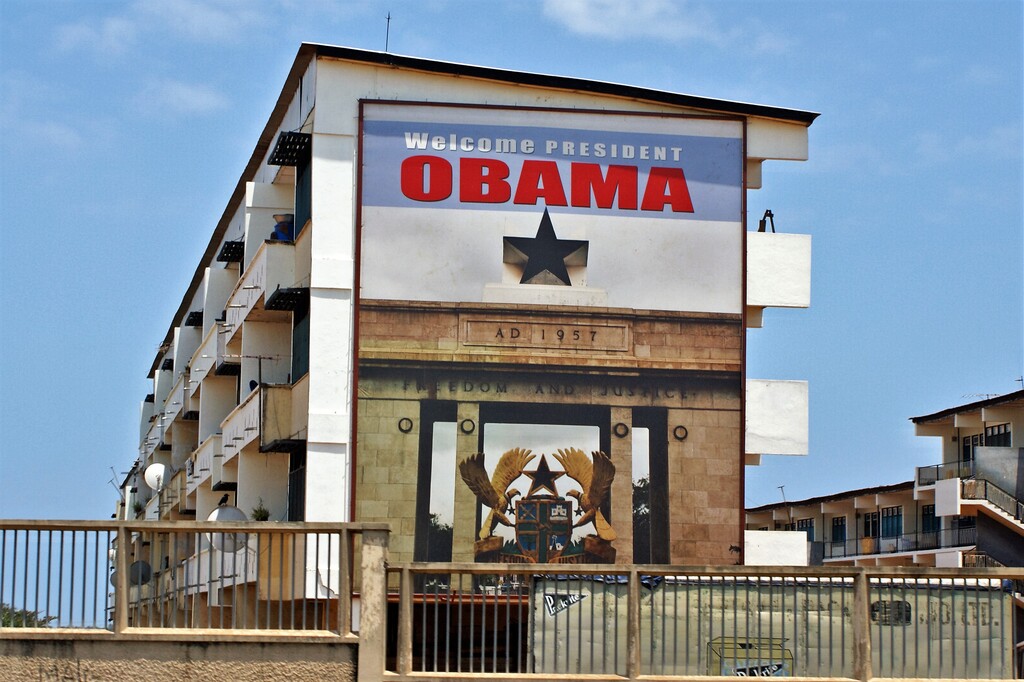
Welcome to Ghana, President Obama, 2009 billboard opposite Flagstaff House (c) Kemo Kurka, Accra
