Ghana-Net.com · Greater Accra · Tema · Ashaiman
Nkrumah built West Africa's first purpose-built city here — a grid, street lights, parks, an artificial harbour, every metre of it designed by Ghana's first architect. Ten minutes inland, the people who worked in it built Ashaiman with no plan at all. It now holds more than two hundred thousand. Two visions of independence, side by side, and almost nobody visits either.
Before any of it, there were fishing villages on this shore, settled by Ga people known as the Kpeshies. Together they were called Torman.
The name means a town of gourds. Settlers had brought gourd seeds with them, the plants took to the ground and spread, and the place was named for the thing that grew well here.
Torman became Tema.
People fished from this beach for generations, launching surf boats through the swell of the Gulf of Guinea. A government publication of 1963 described them in the language of its moment — gallant fishermen braving the restless tropical surf to feed their families.
By the time that was written, they were no longer living where their grandparents had.
In 1951 the colonial administration chose Tema for a new deepwater harbour. The site characteristics were right and it was close to Accra. Ghana's south-east had needed a port for a long time, and the Volta River Project would need somewhere to land equipment and ship out aluminium.
Construction began in 1954, engineered by the British firm Sir William Halcrow and Partners. Two breakwaters were built to enclose a basin. The bill came to around eighteen million pounds.
Independence in 1957 turned a port project into something far larger. Nkrumah wanted a city.
It was designed by Theodore S. Clerk — Ghana's first architect and an award-winning city planner. Not a foreign consultancy. A Ghanaian, laying out the first purpose-built modern city in West Africa, in the first years of the first independent country in sub-Saharan Africa. That fact alone is worth the journey.
What he drew was deliberate in every respect: a road layout with landscaping and street lighting, residential communities numbered and zoned, recreational centres and social amenities that were, at the time, rare anywhere in urban Africa.
Nkrumah opened the harbour on 10 February 1962. The first tanker, the M/V Avacus, berthed on 18 June that year and discharged 17,500 tonnes of crude oil through the pipelines. The Accra–Tema Motorway followed in November 1965.
Then the industry came — more than 150 new enterprises in the years after independence. An oil refinery. Aluminium. Chemicals. Textiles. Everything a country that intended to make its own things would need.
Building a planned city on an inhabited coast requires the inhabitants to go somewhere else.
In 1961 the people of Torman were relocated to a new township, Tema Manhean — new Tema — as compensation for the land the government acquired.
The academic record of the period is blunt about how that went. Among the problems that beset the development, alongside the absence of a single authority to coordinate harbour and city planning, was the resistance of the original Tema villagers to a government scheme for their resettlement.
They did not want to go. They went.
A planning document of the period proposed that the lagoon simply be filled in, on the grounds that it was inconsequential as a fishing ground and a possible health menace. A lagoon that had fed people for generations, assessed as inconsequential by men with drawings.
The chiefs and people of Tema Manhean recently returned to the frontage of their ancestral home — the ground they were moved from — for the first time in fifty-five years. What stands there now is a dilapidated hotel building.
No single authority integrated the planning of the harbour area and the city proper. The commitment to industrial growth was uncertain. Population projections were revised constantly. The city was built anyway, around questions nobody had answered.
Every displacement in this story was carried out by a Ghanaian government, for Ghanaian development, with the best intentions of the age. That does not make it painless, and the people it happened to are still here to say so.
Ashaiman was already there. It began in the seventeenth century as a modest farming settlement, a few kilometres inland, going about its business while the coast fished.
Then Tema was built, and everything changed.
A harbour and a hundred and fifty factories need workers. Workers came — from rural Ghana, from the north, from everywhere. And the planned city had a problem its planners had not solved: limited formal housing. Tema was designed for a projected population, the projections were revised repeatedly, and the housing never kept pace with the labour the industry actually required.
So the workers settled where they could. Which was Ashaiman.
Academic study traces it precisely: Ashaiman's growth is linked directly to the construction of Tema in the 1950s as Ghana's industrial and port city, and to the government's acquisition of land and resettlement of the people who owned it. Between the late 1940s and the early 1990s it became one of the largest squatter settlements in urban West Africa.
Today it has a population of roughly 208,000, its own Municipal Assembly, and an energy anyone who has been there recognises immediately. Markets, highlife, workshops, churches, traffic, noise — everything happening at once and none of it on a drawing.
Tema is what independence was supposed to look like. Ashaiman is what independence actually did.
And it is worth being careful here, because Ashaiman is routinely written about as a problem — a slum, a failure, an embarrassment beside the model city. That framing belongs to the planners. Ashaiman is where the people who built and ran Ghana's industrial capital lived, because the industrial capital did not build them houses. They housed themselves. Two hundred thousand people organised their own city, and it works, after a fashion, having never once been designed.
Neither is what it was meant to be, and honesty requires saying so.
The bones are still there — the grid, the numbered communities, the working harbour, the refinery, the factories. But decades of infrastructure decay have followed, attributed to chronic underinvestment, inefficiency in state-owned enterprises and fiscal mismanagement. Walk it and you see a place built to a standard it has not been maintained to.
The opposite problem: energy without infrastructure, because it was never given any. Drainage, sanitation and roads have been retrofitted onto a settlement that grew without them, and the retrofitting is still not finished.
Ashaiman, Tema, Spintex, Sakumono, Teshie and Nungua all draw on the Kpong system. Ghana Water has reported that inspections of the Kpone–Tema transmission mains found leakage so extensive that only forty to sixty per cent of what is pumped reaches consumers, and the Teshie desalination plant has been out of service since October over a dispute with its owners.
Households here have gone months without a supply. If you are visiting, staying or — particularly — considering buying property in this corridor, ask about water before anything else: storage capacity, whether there is a borehole, how often tankers are needed. It varies street by street and nobody selling you anything will volunteer it.
This is not a monuments day out. It is a day for understanding a country, and the things worth seeing are working places rather than sites.
Do not photograph the port. It is a secured national installation and a camera pointed at it will get you stopped. The fishing harbour, the markets and the streets are fine, with the usual courtesy of asking people first.
The verdict. Nobody comes to Ghana to see Tema and Ashaiman, and no operator will suggest it. If you have four days and want castles and canopy walks, go west and enjoy yourself. But if you have been to Ghana before, or you are from here and returning, spend a morning in these two towns. In one you will see what Ghana's first government believed the future would look like — drawn by a Ghanaian architect, built on a fishing village, opened by Nkrumah himself. Ten minutes inland you will see what the people who made that future actually got. Both are still standing, both are still working, and the distance between them is the whole story of the last seventy years, laid out on the ground where anyone can walk it.
Practical details last verified . The origin of the name Torman, the Kpeshie Ga settlement and the 1961 relocation of the original inhabitants to Tema Manhean are as recorded in published histories of the Tema Metropolitan area. Harbour construction dates, the contractor Sir William Halcrow and Partners, the approximate £18 million cost, the two breakwaters, the opening by Kwame Nkrumah on 10 February 1962 and the berthing of the M/V Avacus on 18 June 1962 are as documented. The city plan is attributed to Theodore S. Clerk, Ghana's first architect. The resistance of the original villagers to the resettlement scheme, the absence of a single coordinating planning authority and the proposal to fill in the lagoon are recorded in E. C. Kirchherr's 1968 study of Tema's first twelve years, published in Urban Studies. Ashaiman's growth as a squatter settlement linked to Tema's construction and the associated land acquisition is documented in Thomas Owusu's 1999 study in The Arab World Geographer. Harbour throughput, administrative status and the account of infrastructure decay are as published. Water supply conditions — the Kpong system, leakage on the Kpone–Tema transmission mains and the closure of the Teshie desalination plant — are as stated publicly by Ghana Water Limited in 2026. Population figures are from the 2021 Population and Housing Census. Conditions, transport and access change — confirm locally. All photography © Remo Kurka. Usage strictly by prior authorisation only.
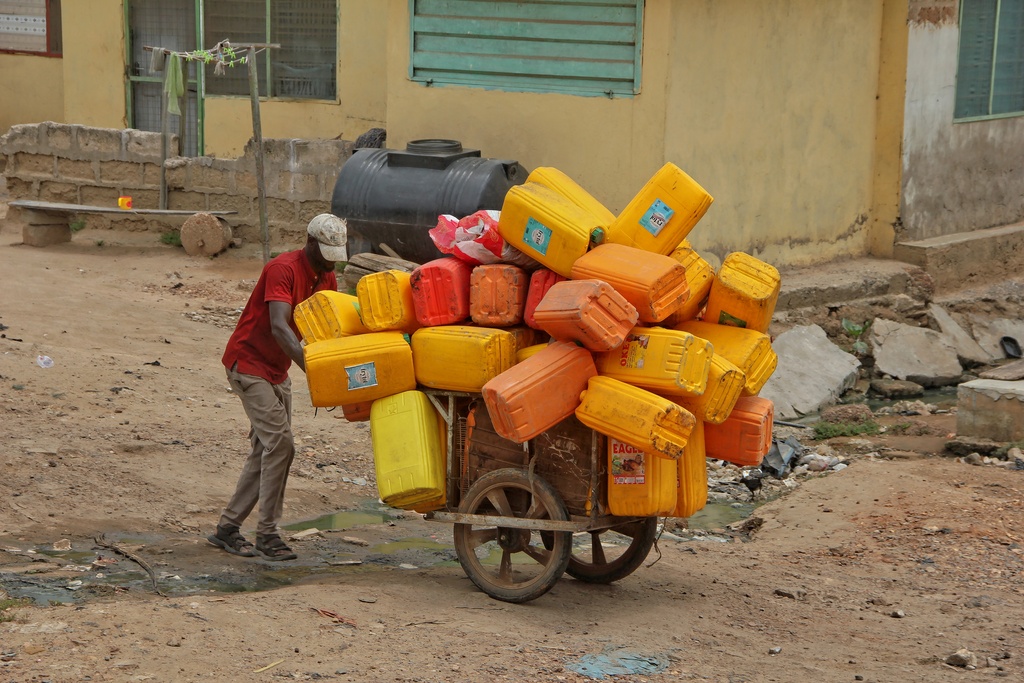
Ashaiman in 2026
