Accra · City centre
Makola Market: Loud, Hot, Crowded, and the Commercial Heart of Ghana
Nobody enjoys Makola. That is not a criticism — it is a working market, not an attraction, and it was never built to charm anybody. But it is where Accra actually does business, it has been blown up by its own government once already, and as you read this there is a fight going on over whether parts of it get demolished again.
On this page
What Makola actually is
The first thing to understand is that Makola is not one market. It is a district of markets, sprawled across the Central Business District of Accra, and the name is used loosely for the whole thing by nearly everybody including Ghanaians.
The formal components carry different names, different ownership and different histories. The 31st December Makola Market, usually split into sections A and B, is the one the news is about. Makola No. 2 is a separate market on separate land with its own trader body and its own disputes. Around and between them run the pavement traders, the container shops, the head-porters and the wholesale operations that spill out towards Rawlings Park, the Cocoa Marketing Board area and the Kantamanto corridor.
Functionally, this is the wholesale and retail nerve centre of the whole country. Goods land at Tema, clear customs, and a great many of them pass through here before scattering to markets in Kumasi, Tamale, Ho and every district capital. When Ghanaian traders talk about prices, they are frequently talking about Makola prices. When the cedi moves, it shows up here within days.
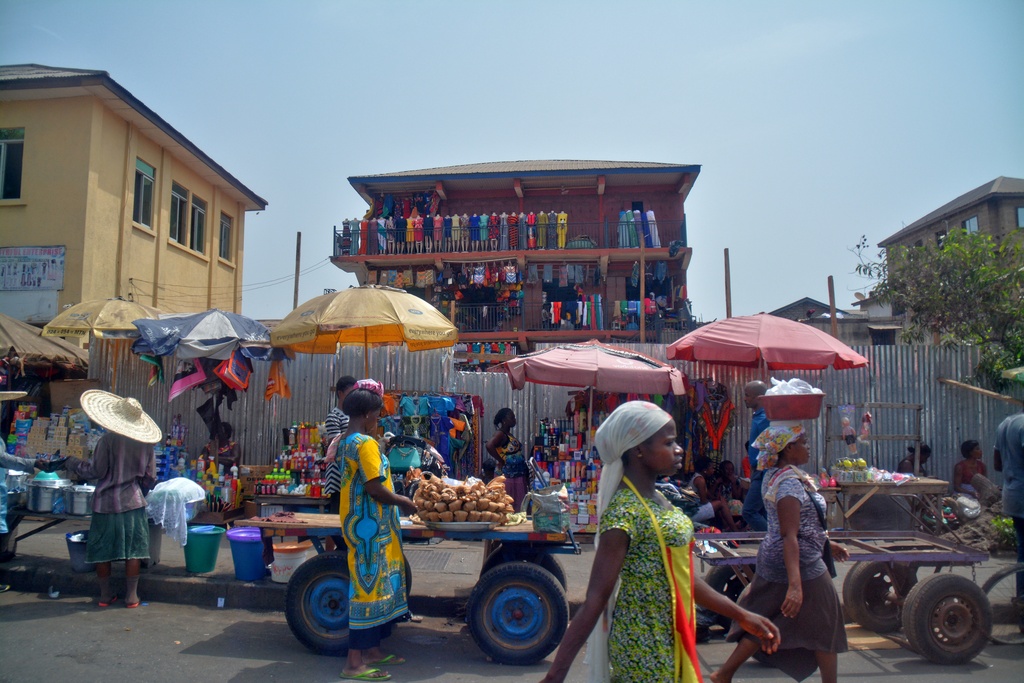
What it is like to walk into
Honestly? Overwhelming, and it stays overwhelming. Anyone telling you that you will find it exhilarating within ten minutes is selling a tour.
The passages between stalls are narrow enough that two people cannot pass without contact, and there is a constant flow in both directions. Head-porters — usually young women, many from the north, carrying loads on enamel pans — move faster than everyone else and will not stop for you. Vehicles push through spaces that look impossible. Traders call out continuously. Generators run. The heat sits in the passages with nowhere to go, and the smell shifts every few metres from dried fish to soap powder to raw meat to fabric.
Underfoot is uneven, frequently wet, and drains are open in places. Wear closed shoes with a decent sole. Sandals are a mistake here and flip-flops are a serious one.
This is not a market that has been arranged for you to enjoy. It is a market that is busy earning a living, and you are in the way.
Which, once you accept it, is exactly what makes it worth seeing. Nearly everything sold to tourists in Accra is a performance of Ghana. Makola is not performing anything.
Handling it — the practical rules
Go with someone, at least the first time
Not for safety in the dramatic sense — violent crime here is not the issue. It is that Makola has no logic visible from outside, and a Ghanaian companion turns forty frustrating minutes into ten productive ones. If you are staying anywhere with staff, ask. People are generally pleased to be asked.
Photography: ask, and accept no
This is the single thing visitors get wrong most often, and it causes real anger. Market women have well-founded objections to being photographed by strangers — they have seen their images used to illustrate poverty, chaos and squalor in foreign media for decades, and nobody ever asked or paid them.
So ask before every photograph of a person or a stall. Accept a refusal without negotiating. If someone asks for money afterwards, that is a fair transaction and not a scam — pay a small amount or do not take the picture. And never photograph anyone’s goods for price comparison without permission; that reads as competitor behaviour, not tourism.
Carry your valuables properly
Pickpocketing is opportunistic and the crowding makes it easy. Front pockets, a zipped bag worn across the body and in front of you, phone out of sight when not in use. Do not carry a passport into Makola; a photocopy is fine. Do not carry more cash than the day requires, and do not count it in the open.
Haggle, but understand the range first
Prices for produce and household goods are usually close to fixed and there is little room in them. Fabric, craft items and anything sold to an obvious foreigner has more give. Ask two or three sellers before you commit to a first price anywhere, and be aware that walking away is a normal part of the conversation rather than an insult.
Time it
Early morning, from around seven, is the most bearable it gets — cooler, and the wholesale trade is more interesting than the retail. Midday is punishing. Late afternoon is the fullest. Sunday is much quieter, but many stalls are closed and you will not see the market working.
The year the government dynamited it
In 1979, soldiers destroyed Makola.
The context was Ghana’s economic collapse and the Armed Forces Revolutionary Council that took power in June of that year. Shortages were severe, prices were beyond most people’s reach, and a word entered Ghanaian usage that has never left it: kalabule — profiteering, hoarding, selling above the controlled price. The market women of Makola were publicly blamed for it.
What followed was not a policy. Soldiers went into the markets. Traders were beaten and publicly humiliated. And Makola No. 1 — the main market building — was demolished outright, with explosives and heavy plant, in front of the people whose entire capital was inside it.
It did not lower prices. It could not have, because the market women were a symptom of a currency and supply crisis rather than its cause. What it did was destroy the working capital of thousands of families, most of them women, many of whom never recovered it.
The name is the part nobody explains. The market that stands today is called the 31st December Makola Market. That date is the anniversary of the 31 December 1981 coup — the second seizure of power by the same man whose first government had levelled the place two years earlier. A market destroyed by a revolution, rebuilt, and named after the next one. You will not find that on the signage, and most traders under fifty will not raise it, but it is the reason older Ghanaians say the name with a particular flatness.
Understanding 1979 is not optional background. It explains, more than anything else, why the current generation of Makola traders react to the word “demolition” the way they do.
The fight happening right now
If you visit in 2026 you may find parts of the market closed, fenced, or occupied by traders who have refused to move. Here is what is going on, with both sides put fairly.
The Accra Metropolitan Assembly convenes a stakeholder meeting with occupants of the one-storey material stores at the 31st December Makola Market, and communicates a decision to redevelop. The Assembly says an album of tenants, container owners and operators will be compiled to ensure fairness in future allocation.
The plan is confirmed: replace the existing one-storey material stores with a modern four-storey market facility, creating space for petty traders currently working on roadsides and pavements. It forms part of Mayor Michael Kpakpo Allotey’s “Red Line” decongestion policy.
The start date, originally set for late 2025, is extended to 12 January 2026 after traders appeal to trade through the Christmas season.
Traders protest. The interim market manager says more than 240 traders work in the affected space, many of them elderly and entirely dependent on daily sales. Traders petition President Mahama directly. Injunction applications are filed; an earlier one is dismissed by the High Court.
The Minister for Gender, Children and Social Protection, Agnes Naa Momo Lartey, visits the market and announces the demolition is suspended pending further consultation. The First Lady, Lordina Mahama, sends assurances that livelihoods will be protected.
The President of the Greater Accra Market Association, Mercy Naa Afrowa NeeDjan, urges traders to move, saying the old structure is dilapidated and temporary spaces have been allocated at the Accra Community Centre and Rawlings Park.
The Assembly’s case is straightforward and not unreasonable: the building is a dilapidated one-storey structure, a four-storey replacement creates far more trading space, and the traders currently working on pavements and in the road need somewhere to go. It says consultations ran for roughly a year and that a verified register of 306 traders was compiled precisely so that allocation in the new building would be transparent.
The traders’ case is equally clear: they were not adequately engaged, no adequate alternative was ready when they were told to leave, and many of them are elderly people whose entire income is daily. Some of the resistance, the Assembly itself has acknowledged, comes from third-party occupants who fear losing space once original allottees are reinstated — which is a real complication in a market where subletting has gone on for decades.
The pattern here is not unique to Makola. Across Ghana in 2026, District and Municipal Assemblies have been clearing markets, shops and in one case a primary school for new market developments, and the recurring complaint has not been opposition to the projects but exclusion from them — structures removed first, compensation and relocation addressed afterwards. What is different at Makola is that the traders had the numbers, the location and the political attention to stop it, at least for now. Most did not.
Where this stands when you read it, we cannot tell you. Check current Ghanaian reporting before assuming any particular section is open.
What is actually worth buying
Be honest with yourself about what you are here for. If you want souvenirs, the Arts Centre is easier, calmer and designed for it. Makola is worth your time for things Ghanaians actually buy.
Fabric
The strongest reason to come. Wax prints, real and imitation, sold by the half-piece and full piece rather than the metre. Learn the difference between genuine Ghanaian wax and cheaper imports before you spend serious money — or bring someone who knows.
Beads
Ghanaian glass beads, including recycled-glass work from Krobo country. Sold loose and strung, and vastly cheaper than anywhere aimed at visitors.
Shea butter and black soap
Unrefined, in bulk, at a fraction of what the packaged export version costs. Bring a container or accept a plastic bag.
Spices and dried goods
Grains of paradise, dawadawa, dried pepper, smoked fish, groundnut paste. Check what your own country permits before you pack any of it.
Kitchenware
Earthenware asanka bowls and wooden grinders, enamelware, cooking pots. Heavy, awkward to fly with, and genuinely better than the versions sold to tourists.
Accra city tours including Makola
Most half-day Accra city tours take in Makola alongside Jamestown, Independence Square and the Nkrumah Memorial Park. For a first visit that is a reasonable way to do it — a guide who knows the passages, handles the introductions and gets you back out again is worth more here than at any other stop in the city. Check the itinerary: some operators only drive past the edge of the market, which is not the same thing at all.
Bookings through this widget earn us a commission at no extra cost to you. We have no arrangement with any individual operator and no operator has paid to appear on this page.
The verdict
Makola is not pleasant and we are not going to pretend otherwise. It is loud, it is hot, it is crowded past the point of comfort, and you will leave sweating and slightly rattled. If your Ghana trip is short and you want to enjoy every hour of it, skip it without guilt.
But if you want to understand how this country actually works — where the prices come from, what the cedi means in practice, who really runs Ghanaian commerce — then an hour in Makola will teach you more than a week of anything else in Accra. Go early, go with someone, buy fabric, ask before you photograph anybody, and treat the women trading there as the businesspeople they are. They have survived worse than a visitor.
Connected reading on ghana-net.com
Verified: 22 August 2026.
The 2025–2026 redevelopment timeline is compiled from Ghanaian reporting including Citi News, GhanaWeb, MyJoyOnline, Adom, Graphic Online, Class FM and Rainbow Radio, covering the August 2025 stakeholder meeting, the January 2026 extended deadline, the May 2026 protests and suspension, and the June 2026 relocation appeal. Statements by the Accra Metropolitan Assembly, by trader representatives and by the Greater Accra Market Association are reported as their stated positions, not as findings of this publication. The status of the redevelopment changes frequently; check current reporting before travelling. The 1979 destruction of Makola No. 1 is described from the documented historical record of the Armed Forces Revolutionary Council period. Practical advice is based on first-hand visits and reflects conditions as observed; market layouts, opening sections and access change constantly.