
Ghanas Inspiring History Unveiled
Discover Ghanas rich history, from ancient kingdoms to modern democracy, through vibrant festivals, stunning…
Welcome to Ghana-Net.com
Akwaaba!
Twi (Akan) · “Welcome”
Search our Network. Start here.
Ghana-Net.com · Beaches & Coast
550 kilometres of Atlantic coastline, and a straight answer about it: Ghana is not a beach-holiday country. It has some genuinely beautiful beaches, some seriously polluted water, and a sea that catches people out every year. Here is where to swim, where not to, and why.
Every tourism page about Ghana's coast describes golden sands and warm Atlantic waters. That is not false, exactly. It just leaves out everything you need in order to make good decisions — so here is the short version, and the four regional guides below give you the detail.
This is open Atlantic with no reef and no shelter. The bottom drops away fast in most places, rip currents are common, and there are effectively no lifeguards anywhere on the Ghanaian coast. The tide decides everything — most beaches are swimmable at low tide and dangerous at high.
From genuinely clean at Ada, to variable around Accra, to mining waste discharged into the sea along parts of the Western coast. It is not consistent, and it is not visible at every state of the tide. Where you stand matters.
Public toilets are close to non-existent. ATMs are absent along most of the coast. Where there is a guesthouse, that is usually the entire infrastructure. Bring cash and plan around it.
No beach in Accra is free, and most elsewhere charge too. Weekend rates rise — at Labadi they can double or more. Fees change often enough that any published figure, including ours, should be treated as a guide rather than a quote.
If a beach holiday is the whole point of the trip, we would honestly send you elsewhere. Ghana's coast is worth travelling for its forts, its fishing towns and its history — not for resort beaches, because it does not really have them. For a proper West African beach holiday, Guinea and the Conakry coast does it considerably better. We would rather say that than sell you something that is not here.
Ghana's coastline is not one thing. It divides into four stretches with genuinely different water, different risks and different reasons to go. Each guide below is written from the ground, not from a brochure.
People drown on this coast every year, including visitors and including strong swimmers. Almost no Ghana travel page says so. These are the rules that matter.
The single most useful rule on this page. At low tide the water is calmer, shallower and cleaner. At high tide the same beach can produce strong surf and currents that pull away from shore. Check the tide before you leave.
Do not swim against it. Swim parallel to the shore until you are clear, then come in at an angle. Most drownings in rip currents are people who tried to swim straight back and exhausted themselves.
There is no lifeguard coming. Watch what local swimmers are doing before you go in, stay where you can stand, and if the water looks wrong, treat it as a walking day. That is a perfectly good day.
Lagoons, rivers and Lake Volta carry schistosomiasis, which enters through the skin — you do not need to swallow anything. Nobody in the tourism business mentions this. Stay out of slow-moving fresh and brackish water.
This is what makes Ghana's coast worth travelling, and it is something no other West African coastline offers. You can swim in the morning and walk into a three-hundred-year-old European fort in the afternoon, and do it again the next day somewhere else.
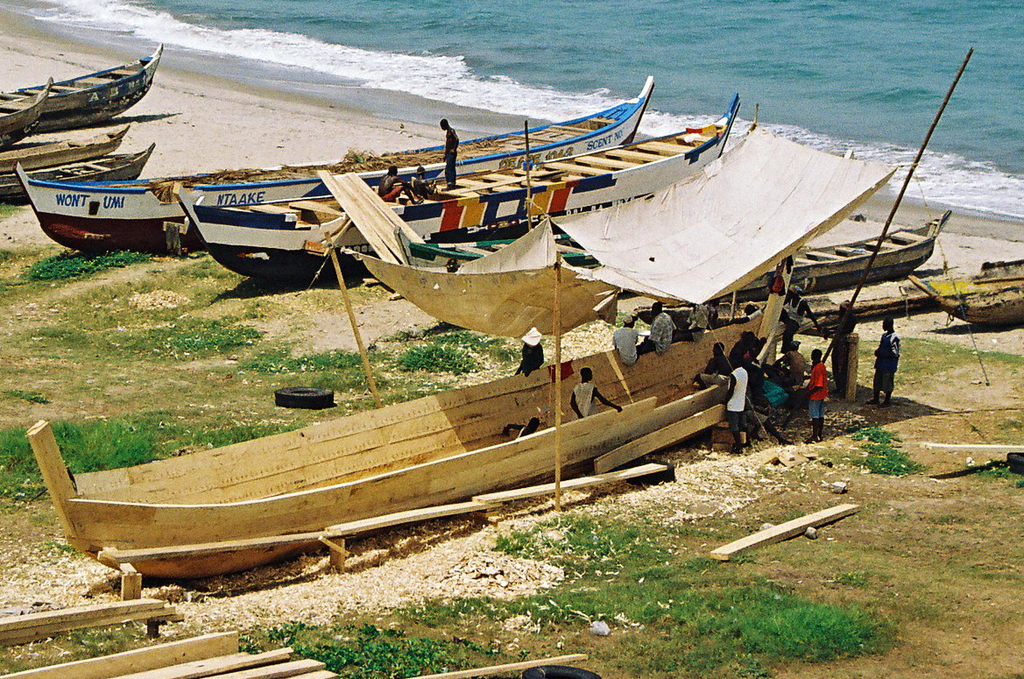
Beach and fishing boats at Elmina,
Western region of Ghana
"The coastline of Ghana is not only a place of beauty. It is a place of history, livelihood and community — a landscape that deserves to be enjoyed and protected."
— Remo Kurka
Ghana’s coastline stretches for more than 500 kilometres along the Atlantic Ocean.
For many visitors, the image of Ghana’s coast is one of golden sand, palm trees, fishing boats and warm ocean breezes.
And those images are real.
There are beautiful coastal landscapes in Ghana, from quiet beaches surrounded by nature to historic coastal towns where generations of communities have lived alongside the sea.
But Ghana’s coastline is also a living environment.
It is not a collection of untouched holiday postcards.
The coast supports fishing communities, traders, tourism businesses, wildlife habitats and millions of people whose daily lives depend on the ocean.
Like many coastal areas around the world, Ghana’s beaches face challenges.
Some areas are affected by plastic waste, inadequate waste management, coastal erosion and pollution from urban development.
Parts of the western coastline have also experienced the effects of illegal mining, known locally as galamsey, where polluted rivers carrying sediment and mining-related contamination eventually reach coastal waters.
Accra’s coastline faces its own pressures from rapid urban growth, drainage problems and waste management challenges.
Understanding both the beauty and the reality of Ghana’s beaches allows visitors to experience the coast more responsibly and appreciate the places that are working to protect it.
A beach in Ghana is rarely just a beach.
The coastline tells stories about:
For centuries, fishing communities have depended on the Atlantic Ocean.
Early morning fishing boats returning with the day’s catch remain one of the most recognisable scenes along Ghana’s coast.
The sea provides food, employment and cultural identity.
Many coastal festivals, traditions and celebrations are connected to the ocean and the communities that live beside it.
This relationship between people and the sea is one of the defining features of Ghana’s coastal regions.
One of the biggest mistakes visitors can make is assuming that all Ghanaian beaches are the same.
They are not.
The coastline changes dramatically from region to region.
Some beaches are:
A traveller looking for a peaceful natural beach experience may have a very different idea of the perfect beach compared with someone looking for music, restaurants and nightlife.
Knowing the difference makes the experience much better.
Western Ghana contains some of the country’s most naturally impressive coastal areas.
The coastline around places such as Busua, Axim and Cape Three Points offers dramatic scenery, fishing villages and stretches of coastline that still feel far removed from major urban centres.
This region has enormous tourism potential.
However, it is also an area where environmental pressures have become increasingly visible.
Busua is one of Ghana’s best-known beach destinations.
With its wide sandy shoreline, relaxed atmosphere and strong connection to surfing culture, Busua has become popular with both international visitors and Ghanaian travellers.
The area offers:
Unlike some highly developed beach destinations, Busua still maintains a strong community atmosphere.
Visitors can enjoy the beach while experiencing everyday coastal Ghanaian life.
Further west, the area around Axim offers beautiful coastal scenery, historic connections and a quieter atmosphere.
The region contains some of Ghana’s most attractive natural landscapes, including beaches backed by vegetation and coastal areas near important conservation zones.
However, visitors should also understand that the western coastline has faced serious environmental pressures.
Illegal mining activities inland have affected several rivers that flow towards the coast.
The consequences include:
The issue is complex and connected to wider economic and environmental challenges.
For visitors, the important message is that Ghana’s natural beauty exists alongside real conservation struggles.
The area around Cape Three Points represents one of Ghana’s most beautiful coastal landscapes.
Here, tropical forest reaches towards the Atlantic, creating a rare combination of rainforest and coastline.
The region is valued for:
It demonstrates the importance of protecting coastal environments where land and ocean ecosystems meet.
Ghana’s Central Region combines some of the country’s most important historical sites with coastal landscapes.
Visitors coming to see:
often also discover the beaches nearby.
The coast here is shaped by both history and everyday life.
Fishing communities continue to operate alongside tourism.
The challenge is balancing the needs of local communities with the protection of coastal environments.
The coastline around Accra is the most accessible for many visitors.
It is also the coastline facing some of the greatest urban pressures.
Accra has grown rapidly, and the relationship between a large city and the ocean creates difficult challenges.
These include:
Recent flooding events have highlighted weaknesses in urban drainage systems and the connection between city planning and environmental conditions.
Water quality can vary greatly depending on location, season and local conditions.
Visitors should not assume that every beach near a major city offers the same experience.
Labadi Beach is probably Ghana’s most internationally recognised beach.
It is famous for:
However, Labadi should be understood for what it is.
It is primarily an entertainment beach.
For visitors looking for a lively atmosphere and a place to experience Ghanaian beach culture, it can be enjoyable.
For travellers searching for a quiet, natural coastal escape, it may not be the ideal choice.
The beach experience is shaped by crowds, events, noise and the challenges of an urban coastline.
Kokrobite has long attracted visitors looking for a more relaxed beach atmosphere close to Accra.
Known for:
Kokrobite has a strong creative identity.
Like many beaches near large cities, conditions can vary, and visitors should choose areas carefully.
The attraction is not only the sand and sea but also the community atmosphere.
The eastern coastline around Ada offers a different experience.
Where the Volta River meets the Atlantic, the landscape changes.
Visitors can discover:
The area has strong potential for eco-tourism because it combines coastal landscapes with inland waterways.
It is especially attractive for travellers interested in nature and quieter experiences.
One important thing visitors should understand:
Not every Ghanaian beach is automatically suitable for swimming.
The Atlantic Ocean can have:
Many beaches do not have lifeguards.
Visitors should:
Local knowledge is extremely valuable.
The ocean is beautiful, but it should always be respected.
Like many coastal countries, Ghana faces increasing coastal erosion.
Some communities have seen beaches disappear as waves gradually reshape the shoreline.
Causes include:
Coastal erosion affects:
Protecting Ghana’s coastline will require long-term planning and cooperation.
Visitors can play a role in protecting Ghana’s beaches.
Simple choices make a difference:
Choosing smaller, community-based tourism experiences can also help ensure that tourism benefits local people.
The future of Ghana’s beaches depends not only on government action but also on how visitors and communities treat these environments.
Different travellers will find different beaches that suit them.
For:
Surfing and relaxed coastal culture
Nature and quiet landscapes
Entertainment and nightlife
History combined with coastline
The best beach experience is not always the most famous one.
Often, the most memorable moments come from discovering smaller coastal communities and experiencing the relationship between Ghana and the ocean.
Ghana’s beaches reveal much more than scenery.
They reveal the relationship between people and nature.
They show the importance of fishing communities.
They preserve memories of historic trade and cultural exchange.
They demonstrate both the beauty of Ghana’s environment and the challenges facing it.
A responsible visitor does not only ask:
"Where is the most beautiful beach?"
They also ask:
"How can this place be protected for future generations?"
Because Ghana’s coastline is not only a destination.
It is a living part of the country.
Ghana’s beaches are among the country’s most attractive natural treasures.
The sound of waves, fishing boats returning at sunrise, palm-lined shores and coastal communities create experiences that many visitors remember for years.
But Ghana’s coastline should be experienced honestly.
Some beaches are beautiful.
Some are lively.
Some are struggling with pollution and environmental pressure.
The reality does not make Ghana’s coast less valuable.
It makes protecting it more important.
The best coastal experiences come from understanding the places you visit — appreciating their beauty, respecting their communities and recognising the challenges they face.
Take a walk along the shore.
Talk with local people.
Visit a fishing village.
Enjoy the ocean responsibly.
Because Ghana’s coast is not just where land meets sea.
It is where history, culture, nature and everyday life come together.
Part of the Ghana-Net Knowledge Series — helping visitors discover, understand and explore Ghana since December 2000.