
Ghanas Inspiring History Unveiled
Discover Ghanas rich history, from ancient kingdoms to modern democracy, through vibrant festivals, stunning…
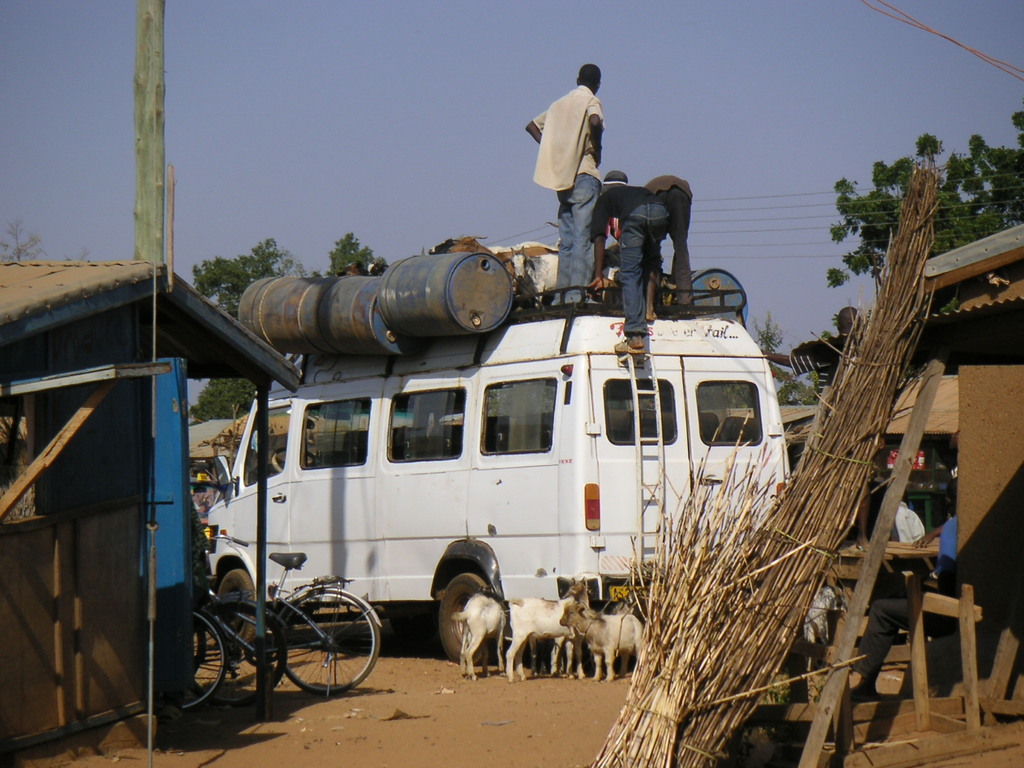
This is what you find at many small towns and villages, across Ghana. A TroTro loaded to the top end. As here a photo of Upper East.
Ghana-Net.com · Getting Around
Ghana moves on minibuses. There is a railway again — three short lines, a handful of departures, no Sunday service — and a bus rapid transit scheme that mostly did not happen. This page tells you how the country actually gets around, what it costs, what it risks, and where Ghana sits against the rest of the continent. Which is further back than anyone in Accra enjoys hearing.
Most travel sites describe Ghanaian transport as vibrant, colourful and an adventure. That is one true thing said in place of several others. Here is the fuller version.
Ghana has almost no scheduled public transport. There is no metro, no tram, no functioning city bus network you can plan a day around, and no published timetable for the vehicles that carry the overwhelming majority of journeys. What Ghana has instead is one of West Africa's most efficient informal systems: privately owned minibuses that leave when full, run fixed routes, cost very little, and are coordinated by unions rather than by any authority. It works. It has worked for fifty years. It works the way a market works, not the way a network works.
The formal alternatives are thin. The rail network runs three short commuter lines with roughly two departures a day and nothing on Sundays. The bus rapid transit system launched in 2016 has largely collapsed. Neither carries a meaningful share of the country's journeys.
None of this makes Ghana hard to travel. It makes it cheap, sociable and unpredictable. You will get where you are going. You will not know in advance when you will arrive, and if you need to know, you should be paying for a car.
A trotro is a minibus, usually a well-travelled Mercedes Sprinter or Nissan Urvan, running a fixed route with a driver and a mate — the conductor who hangs from the sliding door, calls the destination, collects fares and decides, by a logic no passenger has ever fully understood, exactly how many more people will fit.
Trotros do not run to a timetable. They fill and go. At a station they wait until every seat is occupied; on the road they stop wherever someone raises a hand. Routes are named after their destination, and the mate shouts it continuously — "Circle Circle Circle", "Kaneshie", "Madina" — which is your route map. There is also a hand-signal system: a finger pointed downward means you want a local stop, a circling finger means Circle, a flat hand pushed forward means straight on to the terminus. Learn two of these and you have learned the network.
Fares are fixed by the transport unions, not negotiated, and are posted publicly whenever they change — which is often, because they track fuel prices. Short hops within a city cost a few cedis. You pay the mate during the journey, not on boarding, and you will get change, eventually, usually at the moment you had given up on it. If you are being asked to agree a price before you board, that is not a trotro, that is a charter.
Circle (Kwame Nkrumah Interchange) is the central knot, and everything eventually passes through it. Kaneshie serves the west and the Cape Coast road. Tudu serves the east and Volta. Achimota and Madina serve the north of the city and the Aburi road. Stations are chaotic, safe enough in daylight, and best entered with your bag in front of you rather than behind.
No air conditioning. Windows that may or may not open. A vehicle older than some of its passengers. Gospel, highlife or a preacher at volume. Legroom calculated for someone shorter than you. And, in most cases, a driver who knows the road better than any satellite navigation system, because he has driven the same twelve kilometres four times a day for nine years.
Ghana's shared taxis run fixed short routes like small trotros, four passengers at a time, for a fixed fare. They are faster than a trotro and marginally more expensive. Flag one at a taxi rank and say your destination; if it is on the route, you get in.
"Dropping" means chartering the whole taxi to a specific address. There is no meter anywhere in Ghana. You agree the price before you get in, and if you agree it after, you have already lost. Ask a Ghanaian what a route should cost before you negotiate — the gap between the local price and the first price offered to a foreigner is not malice, it is a completely rational opening bid, and it closes if you make a counter-offer without apologising for it.
Uber, Bolt and Yango all operate in Accra and Kumasi, and between them they have done more for transparent pricing in Ghana than any regulator. The app price is the price. Two things visitors should know: drivers will sometimes call and ask you to cancel and pay cash at a higher rate, which you are free to decline; and in heavy traffic a driver may simply not come, because the fare does not justify the hour. In Accra traffic, an app car is not always faster than a trotro. It is only more comfortable.
Okada is a motorcycle taxi. Pragya — also aboboyaa — is the three-wheeled tricycle version. Both are everywhere, both are the fastest way through Accra gridlock, and both carry a risk profile that most travel writing about Ghana declines to mention.
National Road Safety Authority figures record around 6,548 motorcycles and tricycles involved in crashes in a single annual reporting window, of which roughly 72% were okada and 25% tricycles. Helmets for passengers are frequently not provided. Riders are overwhelmingly young, often uninsured, and the economics of the job reward speed.
This is not a reason to lecture anyone. Millions of Ghanaians use okada daily because the alternative is an hour of their working day, and that trade is theirs to make. But as a visitor with a choice, you should make the trade knowingly rather than treat it as local colour. If you take one: insist on a helmet, agree the fare first, and do not take one at night on an unlit road.
For journeys between cities, Ghana's formal bus operators are genuinely good, and this is the part of the system most visitors underuse because nobody tells them it exists.
State Transport Company. The oldest operator, government-owned, covering the main intercity corridors. Fixed departure times, reserved seats, luggage handled properly. Reliability has swung with the company's finances over the decades — check current schedules rather than assuming.
Privately run coaches from dedicated terminals, generally newer and more frequent than STC, running Accra–Kumasi, Accra–Takoradi, Accra–Tamale and the northern routes. VIP terminals are around Circle in Accra. Most sell tickets only at the terminal, in person, on the day or the day before. Some routes still leave when full rather than on the hour, so ask which kind you have bought.
The cheapest option, subsidised, serving smaller towns and rural routes that private operators will not touch. Slow, crowded, and for many communities the only affordable link to a regional capital. If you want to understand how most Ghanaians move between towns rather than within cities, this is the vehicle to sit on.
Overnight coaches run to the north and they save a day. They also mean travelling at speed on unlit roads, which is when Ghana's crash statistics are at their worst. Daytime departures cost you daylight hours. That is a real trade-off and we are not going to pretend it is not.
Ghana's railway is genuinely back, and it is genuinely tiny. Both halves of that sentence matter, because Ghanaian coverage tends to publish the first half at inauguration and never return for the second.
Tema–Mpakadan. A new 96.7 km standard-gauge line from Tema Harbour to Mpakadan, near Akosombo on the Volta. Inaugurated in November 2024 and running commercial passenger service from October 2025. It stops at Tema Industrial Area, Ashaiman, Afienya and on up the eastern corridor. Built primarily for freight and for the long-planned link towards Burkina Faso; passengers are, in engineering terms, a useful side effect.
Accra–Tema. A short commuter link on the older alignment, which has been launched, suspended, restored and suspended again more than once since 2019. When running, it connects Accra Central with Tema via Ashaiman and links into the Mpakadan service.
Kojokrom–Sekondi–Takoradi. A 15 km shuttle in the Western Region, passenger service resumed in April 2026 after rehabilitation. Monday to Friday.
Fares are paid with the contactless Tap n' Go card, bought and topped up at station counters — not on the train. Services are limited, often around two a day per line, and they leave on time, which after a week of trotros is genuinely disorienting. There is no Sunday service on any line. Arrive at least ten minutes before departure.
Check before you plan around it. As this page was written, Ghana Railway Company's own website carried a notice that the Takoradi shuttles were operational and Accra services were waiting. That start–stop pattern has been the defining feature of Ghanaian passenger rail for two decades, and no visitor should build an itinerary on a line without confirming it is running that week.
What is under construction or announced — a standard-gauge line from Nsawam through Kumasi to Paga, suburban studies for Kasoa, Winneba and Madina, a Tema–Kumasi electrification — is at various distances from existing. Announcements in this sector have historically outnumbered opened lines by a wide margin. We will update this page when track carries passengers, not when a minister cuts a ribbon.
This is the section other Ghanaian travel sites do not write, and it is the reason this page exists. Ghana is one of West Africa's most stable, most educated and most internationally connected countries. On urban public transport it has been comprehensively overtaken, including by countries with a fraction of its political stability.
Addis Ababa opened a light rail system in 2015 — the first in sub-Saharan Africa outside South Africa. Lagos, a city routinely used in Ghana as a byword for chaos, has opened urban rail lines this decade and runs a BRT that, whatever its shortcomings, moves people every day. Dar es Salaam has run a functioning BRT for years. Dakar went from groundbreaking to an operating electric BRT in roughly four years, between 2020 and 2024, and researchers credit it with putting some 180,000 additional jobs within reach of low-income residents who previously could not afford the time cost of commuting. Casablanca and Rabat have trams. Cairo has had a metro since 1987.
Accra has Aayalolo. The name is Ga for "still moving on", which has aged into one of the better unintentional jokes in African infrastructure.
Launched with considerable fanfare in 2016, Accra's system was designed to move 12,000 passengers an hour. It was conceived with dedicated bus lanes; the lanes were never built, so it was quietly renamed a Quality Bus System, which is a polite way of saying a bus stuck in the same traffic as everything else. Reporting in 2026 found that fewer than half of the original fleet of 245 buses remained operational, with investigative accounts pointing to some $61 million spent. Academic work on African transit now cites Accra as a case study in BRT collapse alongside Dakar's as a case study in success. Two West African capitals, the same decade, opposite outcomes.
The diagnosis in the research literature is consistent and it is not about money. It is about governance: overlapping institutions with unclear responsibility, and no managed settlement with the existing trotro operators, whose unions were treated as an obstacle to be routed around rather than a constituency to be brought inside the new system. Dakar did the political work first. Accra bought buses first.
Why this matters to a visitor. It explains something you will otherwise find inexplicable: why a modern, English-speaking, well-connected capital of over five million people has no way of moving you across itself except a private minibus or a car in traffic. It is not that nobody tried. It is that the trying went wrong in a documented and specific way.
Ghana's roads kill roughly 26 people per 100,000 population per year. The WHO African regional average is about 19. The global average is about 15. Road deaths in Ghana rose 65% between 2016 and 2021, to an annual toll approaching 3,000.
The National Road Safety Authority recorded 1,009 people killed on Ghanaian roads between January and April 2026 alone. Pedestrian deaths have been climbing rather than falling — 590 in 2024, 704 in 2025, and 181 in the first four months of 2026. Speeding is the dominant recorded cause, and hit-and-run is common enough to have its own body of academic literature, with fatal outcomes concentrated on unlit roads at night.
Ghana's parliament adopted an amended road traffic act and new vehicle safety standards in December 2025, in force from early 2026, bringing the country broadly into line with WHO legal recommendations. It is a real step and it deserves recognition. Whether it changes the numbers depends entirely on enforcement, and the answer to that will be visible in the 2027 figures, not in the press releases.
Inside Accra: ride-hailing app for anything with a deadline, trotro for everything else, and accept that both will sit in the same traffic.
Accra to Kumasi, Takoradi or Cape Coast: a formal coach from a terminal, booked in person the day before, leaving in the morning.
Accra to Tamale and the north: fly if the budget allows, and if not, take the daytime coach rather than the overnight one.
Tema, Ashaiman and the Volta corridor: take the train if it is running that week. It is cheap, punctual, and the only part of Ghanaian transport where you will arrive when you expected to.
Anywhere rural: the trotro from the nearest lorry park, early, because the last one back leaves sooner than you think and "there is always another one" stops being true at about four in the afternoon.
Ghana's transport system is not broken. It is informal — which means it is resilient, cheap and impossible to plan around, and that the state has spent thirty years trying and failing to replace it with something schedulable. Every other visitor guide will tell you the trotro is an experience. It is. It is also the consequence of a policy failure that other African capitals have solved and Accra has not, and you are entitled to know both things before you raise your hand at the roadside.
Practical details on this page last verified . Casualty figures: National Road Safety Authority and WHO. Rail status: Ghana Railway Company Limited and Ghana Railway Development Authority. BRT analysis: peer-reviewed transport research and Ghanaian investigative reporting. Rail services and union fares change frequently — confirm at the station.