Fort Metal Cross stands on a rocky promontory above the fishing village of Infuma, in Dixcove on Ghana's Western coast. It was built by the English, it was not originally called Fort Metal Cross, and the gold it was built to capture never materialised.
That last fact shaped everything the fort became.
| Original name | Dixcove Fort |
| Built by | The English |
| Construction | Begun 1683, completed 1691–97 |
| Renamed | Metalen Kruis by the Dutch, 1868 |
| Returned to Britain | 1872 |
| Location | Dixcove, Ahanta West, Western Region |
| UNESCO status | World Heritage Site since 1979, ref. 34-008 |
| Opening hours | Various, but every day, at least 9 till 5pm) |
| Entry fee | [Entrance foreigners 40 Cedis and Ghanaians from 5 to 20 Cedis as a nominal fee 2026] |
In 1683 the English began work on a fort at Dick's Cove — the name that eventually wore down into "Dixcove". They had two motives, and neither was sentimental.
The first was gold. The English believed the hinterland behind this stretch of coast held significant deposits, the same calculation that led the Dutch to build Fort Batenstein at Butre a short distance east.
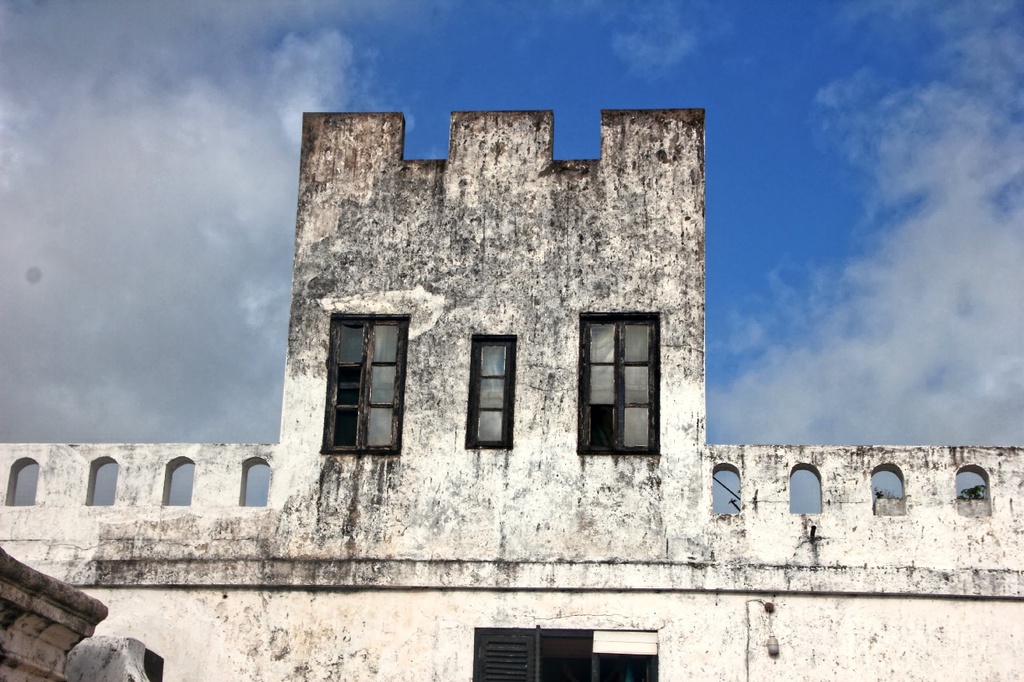
Fort Metal Cross in Dixcove, built by the English from 1683 as Dixcove Fort. Its real history, the Dutch name, what survives, and how to get there.
The second was competition. Brandenburg-Prussia had started Fort Groß Friedrichsburg roughly fifteen kilometres west at what is now Princes Town, also in 1683, and English captains had begun trading there. A fort at Dixcove was a way to pull that business back.
Construction dragged for well over a decade.
The people of Infuma, whose two chiefs shifted their allegiance between the English and the Dutch, besieged the site repeatedly on the Dutch side and stalled the work. The fort was not completed until somewhere between 1691 and 1697.
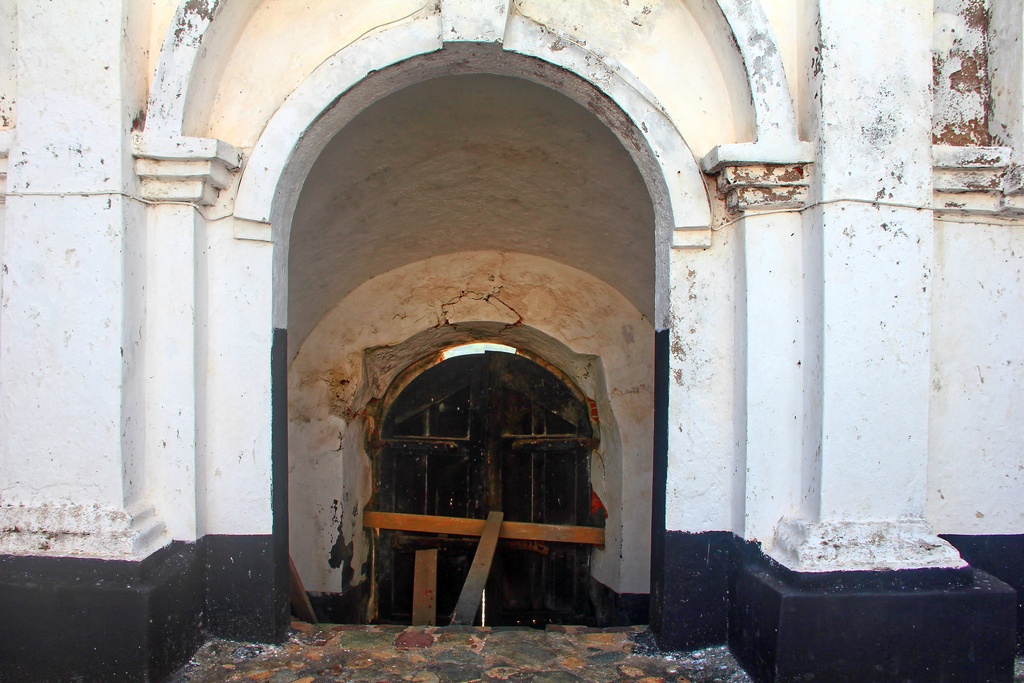
Door of no return of Fort Dixcove, Ghana (Photography by Remo Kurka)
The gold never came. What the English extracted from the hinterland was largely impure, and the fort acquired a reputation to match — the Dutch writer Willem Bosman dismissed it as "The fake mint of the Gold Coast"
So the fort adapted, and what it adapted into is the harder part of its history.
It became a service station: a place to repair ships and take on timber from the surrounding forest. And during the era of the transatlantic slave trade, it became a slave prison. The Door of No Return still stands at Dixcove, locked.
By 1750 the fort was equipped to carry as many as twenty-five cannon.
Read our wider account of the trade this fort served in British colonial rule and the West African slave trade.
Fort Metal Cross is a Dutch name, and a recent one.
Under the Anglo-Dutch exchange agreement of 1867, the fort passed to the Netherlands in 1868. The Dutch renamed it Metalen Kruis, after one of their gunboats.
The handover went badly. The people of the area had not been consulted about being traded between European powers, and their anger was such that the Dutch had to call for military reinforcement to restore order across their newly acquired territory.
Dutch control lasted four years. In 1872 the fort returned to Britain — which kept the Dutch name. It has been Fort Metal Cross ever since.
You will find sources online claiming the name comes from a metal cross erected by the Portuguese in the fifteenth century. The Ghana Museums and Monuments Board attributes it to the gunboat.
The fort's later history is a sequence of disuse and revival. The English abandoned it in 1826 and reoccupied it in 1830. It was restored in 1954–56.
After the colonial period ended it took on the ordinary municipal lives that many Ghanaian forts did — police station, post office, prison, and a gathering place for the community and local church congregations.
In 1979 it was inscribed on the UNESCO World Heritage list as part of Forts and Castles, Volta, Greater Accra, Central and Western Regions, under criterion (vi): its association with events of outstanding universal significance.
Getting there from Accra. Takoradi is roughly four hours by road, or about 45 minutes by air. From Takoradi take the Takoradi–Tarkwa road to Agona Junction, then follow the signage to Dixcove. Public transport to Agona Junction runs from Takoradi. [VERIFY current air routes — Tro-Tro1s on this route have changed, du to bad road conditions, or you just hire a taxi. Prices need to be agreed on upfront!]
When to go. November to March, the dry season. The coastal sun is strong year-round.
What you will see. The ramparts, the cannon positions, the cells, and a commanding view over the cove — quiet water suited to canoes and small boats, with larger vessels anchoring about two kilometres offshore.
Practicalities. Wear closed shoes; the stonework is uneven. Bring water and cash. If you want a guided tour rather than a self-directed walk, please speak to the caretaker. There are also very close overnight stay options and a resataurant.
A note on the town. Dixcove has long been divided into Upper and Lower quarters, historically Ntwarkro and Daazikessie. Land disputes between the two have produced episodes of violence in recent years. Visitors are not the target of any of this, but it is reasonable to ask locally about the current situation before you go.
Who built Fort Metal Cross?
The English, from 1683. It was originally called Dixcove Fort.
Was it really built in 1632?
No. That date circulates online but is not supported by the Ghana Museums and Monuments Board or the UNESCO record. Construction began in 1683.
Why does an English fort have a Dutch name?
The Dutch held it briefly from 1868 and renamed it after their gunboat Metalen Kruis. Britain took it back in 1872 and kept the name.
Is Fort Metal Cross a UNESCO site?
Yes, inscribed in 1979 as part of the Forts and Castles group listing.
How does it compare with Cape Coast Castle?
It is far smaller and far quieter. Cape Coast was an administrative capital; Dixcove was a provincial outpost that never delivered what its builders wanted. For visitors, that means fewer crowds and a more intimate site.
Can I visit Fort Batenstein on the same trip?
Yes. Butre is close, and the two forts — one English, one Dutch, built for the same gold that neither found — make sense as a pair.
