Updated 11 September 2026 - There are places in Ghana that you visit, take a few photographs, and move on. Then there is Kakum National Park — a place that deserves time.
Deep in Ghana’s Central Region, not far from Cape Coast, Kakum is one of the country’s most spectacular natural attractions: a vast tropical rainforest filled with birds, butterflies, ancient trees and elusive wildlife, crowned by its famous canopy walkway. The park covers roughly 375 square kilometres, and its forest is home to an extraordinary variety of mammals, birds and other species.
And here is my first piece of advice: do not try to squeeze Kakum into a rushed one-day excursion from Accra.
It can be done technically, but I would not recommend it.
For many visitors, the highlight is the spectacular canopy walkway — a series of seven suspension bridges stretching hundreds of metres through the treetops.
Walking above the rainforest, with the forest floor far below and enormous trees surrounding you, is an experience that is difficult to describe until you have done it yourself. The official Ghana tourism information describes the walkway as approximately 350 metres long and suspended up to 30 metres above the forest floor. Other Forestry Commission material gives a longer measurement depending on how the walkway is measured. Either way, it is high enough to give you a completely different perspective of the rainforest.
But reaching the walkway is not simply a matter of getting out of the car and stepping onto a bridge.
There is a short but sometimes demanding uphill hike before you reach the canopy. This is why comfortable walking shoes are strongly recommended. Good physical condition also helps, particularly for anyone who is not accustomed to walking uphill in hot and humid conditions.
And once you are on the bridges, you will want both hands available to hold the ropes. Leave the heavy luggage behind and take only what you really need. Ghana Tourism Authority guidance specifically recommends good shoes and carrying a small backpack or waist bag rather than heavy items in your hands.
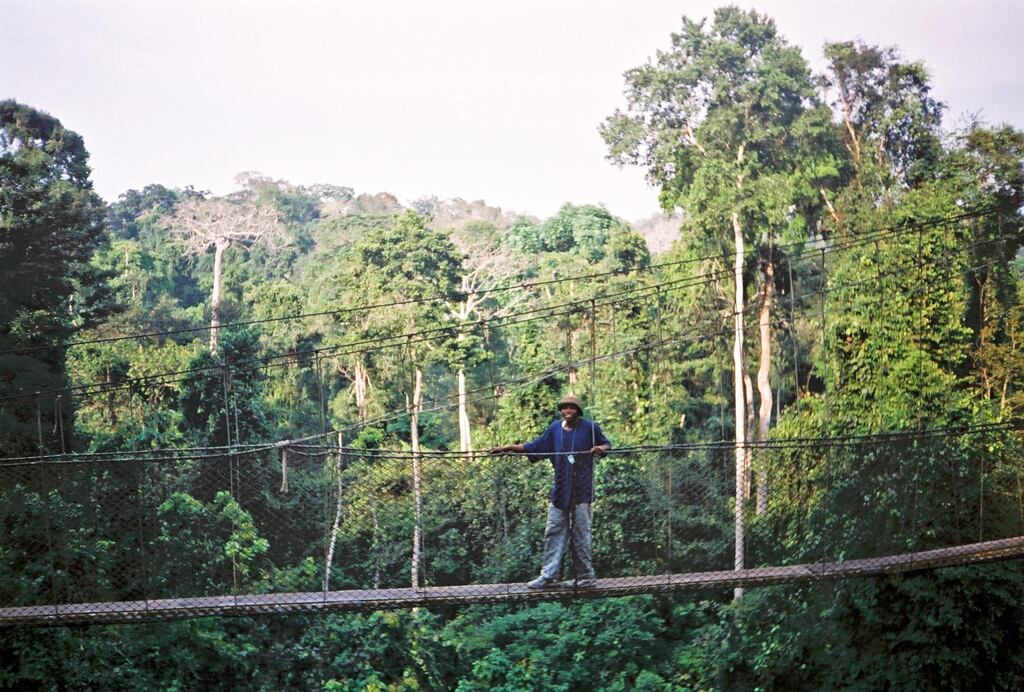
Kakum National Park, Central region, near Cape Coast
If you want to experience Kakum at its best, go early.
My preferred time would be around 6:00 to 7:00 a.m., when the forest is waking up and the temperatures are more comfortable. And with a little luck, you may encounter monkeys before the larger groups of visitors arrive.
Wildlife sightings in a rainforest can never be guaranteed — Kakum is not a conventional safari park where animals are waiting in open grassland for visitors. The forest is dense, and many of its inhabitants are shy and difficult to spot.
That is precisely what makes the experience so exciting.
You may hear something moving in the trees before you see it. A bird may suddenly fly across the canopy. Monkeys may appear briefly among the branches. Butterflies can be everywhere, while the enormous forest itself becomes the main attraction.
Kakum is particularly important for birdwatchers, with hundreds of bird species recorded, while hundreds of butterfly species have also been documented. Mammals include forest elephants, bongos, bushbucks and several primate species.
And remember: early morning is not only about wildlife. It is also about avoiding the busiest period on the walkway. Ghana's tourism materials have long recommended early morning or later afternoon visits because the canopy walk can become crowded around midday.
From Accra, the usual road journey takes you west along the coastal highway towards Kasoa, Winneba, Mankessim and Cape Coast, before continuing inland towards Kakum National Park.
Ghana Tourism Authority information puts the drive from Accra to Kakum at approximately four hours under normal conditions, and recommends arranging reliable transport in advance.
However, there is an important warning for travellers in September 2026:
Major road construction is currently taking place along the Accra–Cape Coast corridor.
The Winneba Junction Interchange construction has been causing congestion, diversions, dust and slow-moving traffic. Recent reports from August 2026 describe vehicles moving slowly through diverted sections while construction machinery operates around the interchange.
There is also ongoing dualisation work on the Winneba–Mankessim/Cape Coast corridor. The Ministry of Roads and Highways says the Winneba–Cape Coast project is intended to improve traffic flow and shorten journey times, but the work is still underway, with completion extending into 2027.
Further west, the Cape Coast–Takoradi highway is also undergoing major dualisation works, with excavation, drainage and culvert construction continuing in sections.
In practical terms, this means traffic can be slow in either direction, depending on the construction zone, time of day, weather and traffic volume.
So if you are travelling from Accra, do not plan your journey around a perfectly predictable four-hour drive. Give yourself plenty of extra time.
And this is another reason why I strongly recommend staying overnight rather than attempting Kakum as a day trip from Accra.
Imagine leaving Accra very early, spending several hours on the road, arriving at Kakum, hiking up to the canopy, doing the walkway, driving back to Cape Coast and then beginning the long journey back to Accra.
With the current road construction, that could turn into an exhausting day of driving with relatively little time to actually enjoy the destination.
Kakum should not be treated as a box to tick.
Stay in the area. Wake up early. Have breakfast. Enter the forest while it is still cool and quiet. Take your time. Then explore the historic coast.
For me, three full days is the ideal minimum.
One of the nicest practical choices for a Kakum visit is Rainforest Lodge, situated along the road towards Kakum, in the Akrofrom/Jukwa area.
It is only around a 10–15 minute drive from the park, making it particularly convenient for an early-morning visit. Current accommodation information confirms the lodge's proximity to Kakum, as well as facilities including a swimming pool, restaurant, Wi-Fi and breakfast.
And the price can be remarkably attractive.
For a traveller wanting to explore Kakum without spending a fortune, this is a very convenient base.
After a hot and humid morning in the rainforest, there is something particularly appealing about returning to a comfortable room, enjoying a meal and relaxing beside the swimming pool.
The real magic of this journey is that Kakum can be combined with some of Ghana's most important historical sites.
Travelling from Accra, I would actually recommend making a few historical stops before reaching Cape Coast.
One excellent stop is Fort Amsterdam at Abandze, a historic fort overlooking the coast. The Ghana Museums and Monuments Board describes the fort as having originally been established by the English before being captured by the Dutch and renamed Fort Amsterdam. It was restored in the twentieth century and is open to visitors.
A little further along the coast is Fort William at Anomabu, one of Ghana's remarkable historic forts. The present fort was constructed by the British in the eighteenth century and became an important centre of trade along the Gold Coast. Today it remains a powerful historical site and a reminder of the complex and painful history of the Atlantic slave trade.
I highly recommend both.
They make the journey from Accra much more interesting because the trip becomes a journey through Ghana's natural and historical heritage rather than simply a drive to a national park.
Of course, Cape Coast Castle should not be missed.
Neither should Elmina Castle.
These sites are among the most important historical landmarks in Ghana and provide an essential context for understanding the history of the Gold Coast, the transatlantic slave trade and Ghana's place in that history.
Kakum and the castles make an extraordinarily powerful combination: one day immersed in Ghana's ancient rainforest, another confronting the country's difficult and deeply significant history.
That combination is one of the reasons I recommend staying for at least three full days rather than rushing back to Accra.
Kakum is more than just the canopy walkway.
The visitor centre has exhibitions and displays, and there is a restaurant where visitors can have a meal after their forest adventure. Ghana Tourism Authority information also mentions cafés, snacks, drinks and local dishes such as fufu and goat light soup, as well as jollof rice.
There are also guided forest walks and opportunities for birdwatching. For those who want something completely different, guided night walks can reveal another side of the rainforest, when nocturnal creatures become active.
And don't forget to look for local products.
Local honey is available at the park, and as of September 2026 you can expect to pay roughly GH₵80–100, depending on the size and seller.
It makes a lovely souvenir — and unlike another plastic souvenir that sits on a shelf, it is something you can actually enjoy later.
For visitors planning their budget, the rates currently applicable around September 2026 are approximately:
The GH₵35 gate fee is described as a fee for accessing the park facilities, while the canopy/visitor charges are separate. Current online pricing information also confirms the GH₵35 gate fee and GH₵40 Ghanaian adult and GH₵130 non-Ghanaian adult rates.
Because tourism fees can change, it is wise to confirm the current tariff before travelling.
Kakum is rainforest, not a city park.
Wear:
Most importantly, wear proper shoes.
The climb to the canopy walkway and the rainforest terrain are much easier when you have good footwear. Ghana Tourism Authority guidance also warns visitors that rain can arrive at any time and recommends trainers/good shoes.
People with limited mobility, heart or respiratory problems, or significant difficulty walking uphill should consider their physical condition before attempting the canopy experience.
Leave Accra early.
Allow plenty of time for the road because of the ongoing construction.
Along the way, stop at Fort Amsterdam and Fort William at Anomabu. Continue towards Cape Coast and spend the evening relaxing.
If you stay at Rainforest Lodge, you can enjoy the pool, dinner and an early night.
Wake up early.
Have breakfast and head to Kakum at around 6:00–7:00 a.m.
Spend the morning exploring the rainforest and canopy walkway. Take your time and listen carefully — sometimes the forest reveals itself through sounds before you see anything.
Afterwards, enjoy lunch, visit the exhibitions and perhaps buy some local honey.
Return to the lodge for a relaxing afternoon and perhaps a swim.
If you have the energy and the park offers the appropriate guided experience, consider a later forest or night walk.
Visit Cape Coast Castle and then continue to Elmina Castle.
Allow enough time at both sites. These are places to listen, reflect and learn, not simply photograph.
If time allows, explore Elmina itself before beginning your return journey.
This itinerary transforms what could have been a rushed excursion into a genuine Ghanaian experience combining rainforest, wildlife, history, culture and the Atlantic coast.
Absolutely.
In fact, I would go further: if you are travelling around Ghana, Kakum deserves to be high on your list.
The famous canopy walkway is certainly the attraction that brings many people through the gates, but Kakum is much more than a suspension bridge.
It is the sound of the rainforest in the early morning.
It is the possibility of seeing monkeys moving through the trees.
It is the feeling of standing beneath enormous Accra with time on your side. Expect delays from the current road construction. Stop at the historic forts. Spend the night near Kakum. ancient trees.
It is birds calling somewhere high above you.
It is the excitement of walking above the forest canopy.
It is buying a jar of locally produced honey afterwards.
And then, only a short journey away, it is the history of Cape Coast, Elmina, Anomabu and the forts along Ghana's coast.
That is why I would not rush Kakum.
Leave Accra with time on your side. Expect delays from the current road construction. Stop at the historic forts. Spend the night near Kakum. Wake up early. Walk into the rainforest while it is still cool and quiet. Then give Cape Coast and Elmina the time they deserve.
Three full days is not too much. If anything, it may leave you wishing you had stayed longer.
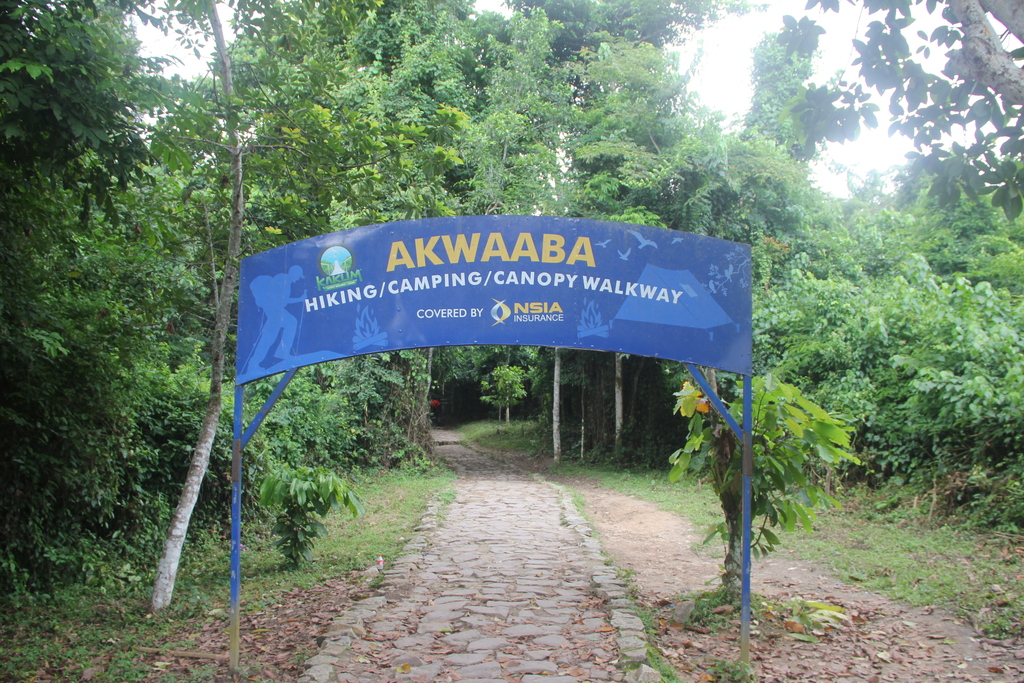
Kakum National Park, Park Entrance Sign, and the walk way up (c) Remo Kurka
