
Ghanas Inspiring History Unveiled
Discover Ghanas rich history, from ancient kingdoms to modern democracy, through vibrant festivals, stunning…
Ghana-Net.com · Greater Accra · Burma Camp · Photos from the 2009 inauguration
For half a century, Ghana's Ministry of Defence ran the country's armed forces from a barracks-style building designed after the First World War. In December 2009 it moved into a new four-storey complex of granite, marble and glass at Burma Camp, designed in Beijing, built by a Chinese company and paid for largely by a Chinese grant. One government began it, another opened it, and the plaque at the door still carries the name of the first. I was there on inauguration day.
The idea belonged to Dr Kwame Addo-Kufuor, Defence Minister in the government of his brother, President John Agyekum Kufuor. He had already overseen Chinese-funded work for the armed forces, among them the rebuilt Burma Hall and a facelift of 37 Military Hospital. A new ministry building was the next step.
Chinese and Ghanaian officials cut the sod for the complex in Accra under the Kufuor government. At the time, the Chinese government was reported to be providing a grant of US$5 million and Ghana US$1.75 million, with completion due in 18 months.
In January 2009, after the December 2008 elections, power passed from Kufuor's NPP to John Evans Atta Mills and the NDC. The building was still unfinished. In Ghana, that moment is often where projects die, abandoned by the new government because the old one would get the credit.
The Mills government completed it. On a Wednesday in late December 2009, Vice President John Dramani Mahama commissioned the building. He publicly praised Addo-Kufuor and the previous administration for starting it, and promised to continue projects begun by earlier governments.
The inauguration plaque bears the name of President John Agyekum Kufuor. The man who cut the ribbon was his successor's Vice President. Few buildings in Accra show the hand-over of power between two rival parties quite so plainly.
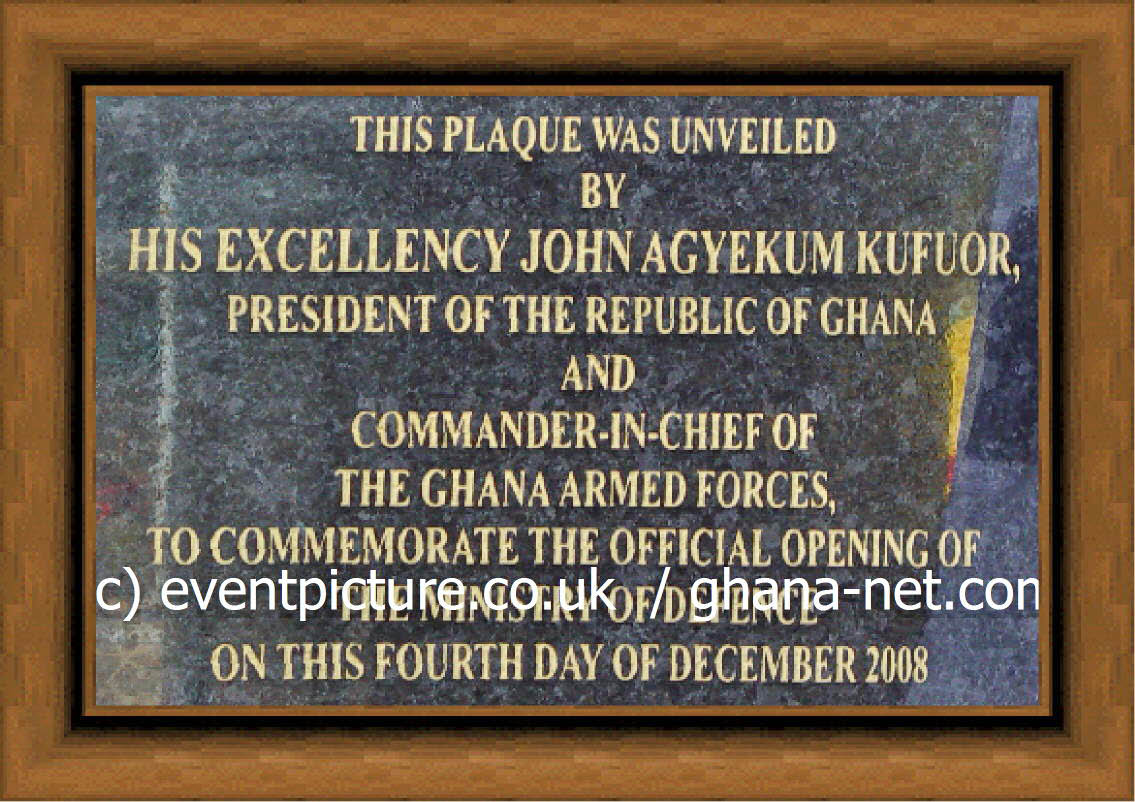
The inauguration plaque, inscribed with the name of President John Agyekum Kufuor. Photo: Remo Kurka, 2009.
Honest note on the money. The figures don't add up. At the sod-cutting, the Chinese grant was reported as US$5 million plus US$1.75 million from Ghana; an earlier report spoke of US$2.5 million towards a US$5 million building. At the commissioning in 2009, the press reported a "50 million dollar" building. That is ten times the earlier figure and may be a misprint, or it may include costs never published. We have not found an official final account.
I photographed the ceremony. It was a very Ghanaian event: uniforms pressed to perfection, the military band playing, speeches that ran long, and a row of Chinese engineers and contractors who looked happy that their work was finally done.
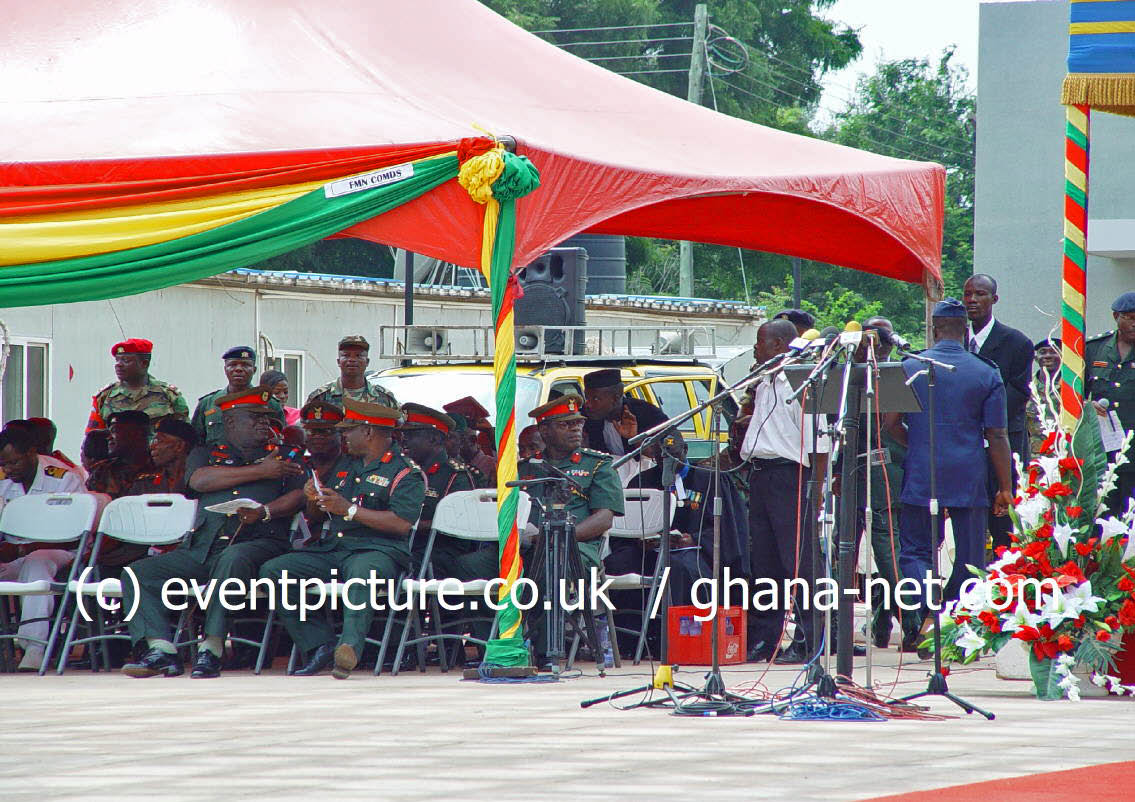
The army music corps at the inauguration. Photo: Remo Kurka, 2009.
Vice President Mahama called the building a testimony to the friendship between Ghana and China, set in stone, concrete, marble and granite. He also spoke of new security tasks: protecting the young oil industry, fighting drug trafficking, and supporting an African standby force.
Defence Minister Lt Gen Joseph Henry Smith said that for the past 50 years the ministry had worked out of a barracks-style building meant for far fewer people, and that the new building alone would lift morale. He thanked the Beijing Architectural Design and Research Institute for the design.
Former defence ministers and long-serving staff were honoured, Addo-Kufuor among them. So was a retired secretary who had served the ministry for 33 years, a touch that says a lot about how Ghana's institutions see themselves.
The Chinese ambassador, Yu Wenzhe, spoke of the long relationship between the two countries. The building was constructed by Qingdao Construction and Development Ltd of China and took 18 months.
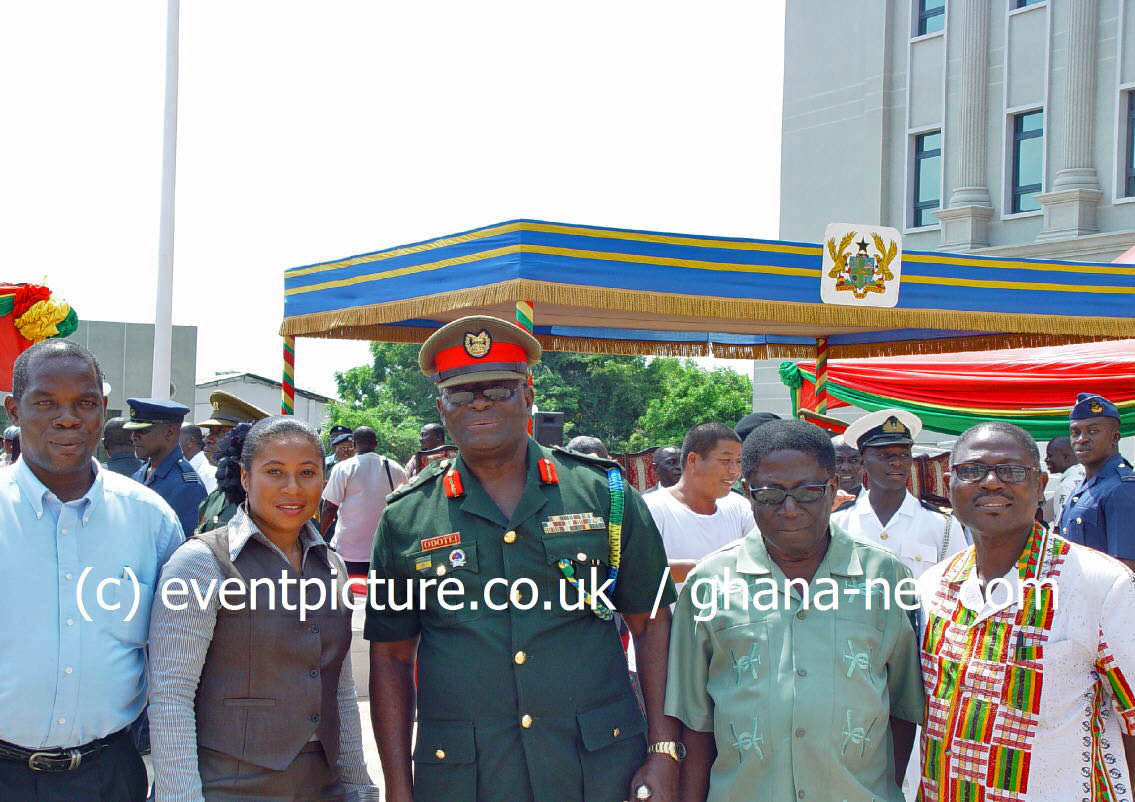
Photo opportunity: Ministry of Defence ranks with the Chinese contractors. Photo: Remo Kurka, 2009.
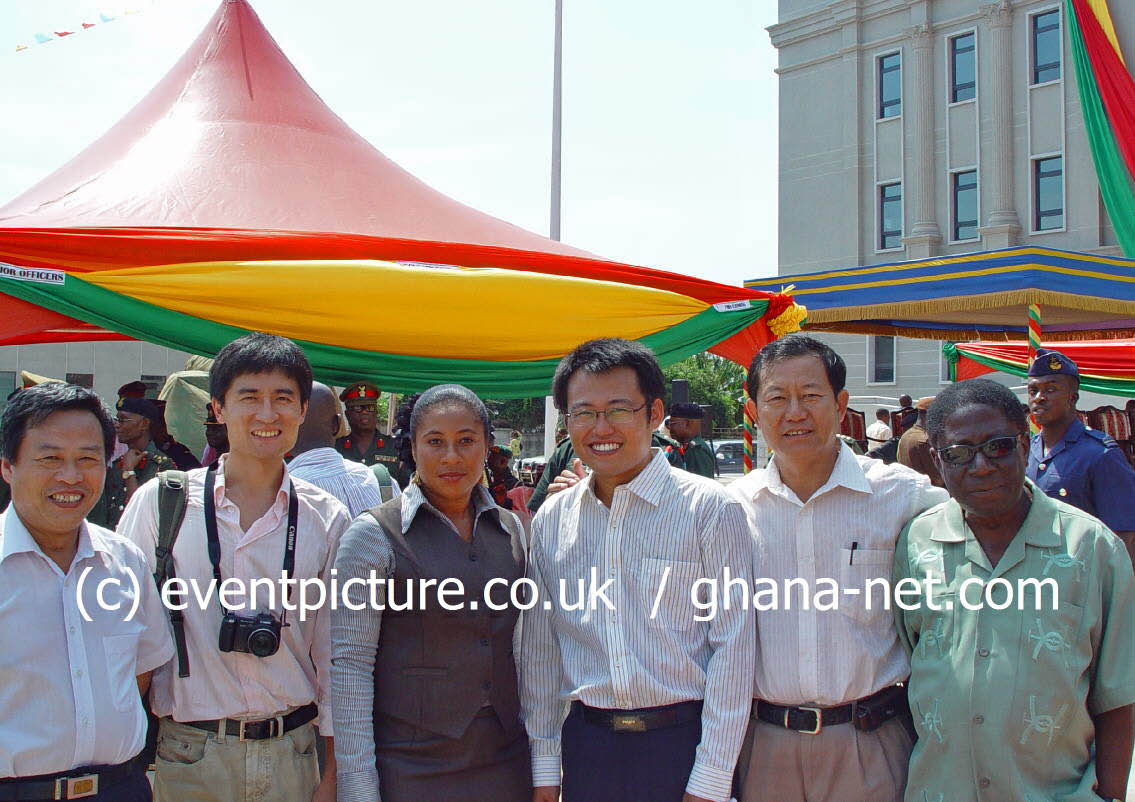
The Chinese builders on their day. Photo: Remo Kurka, 2009.
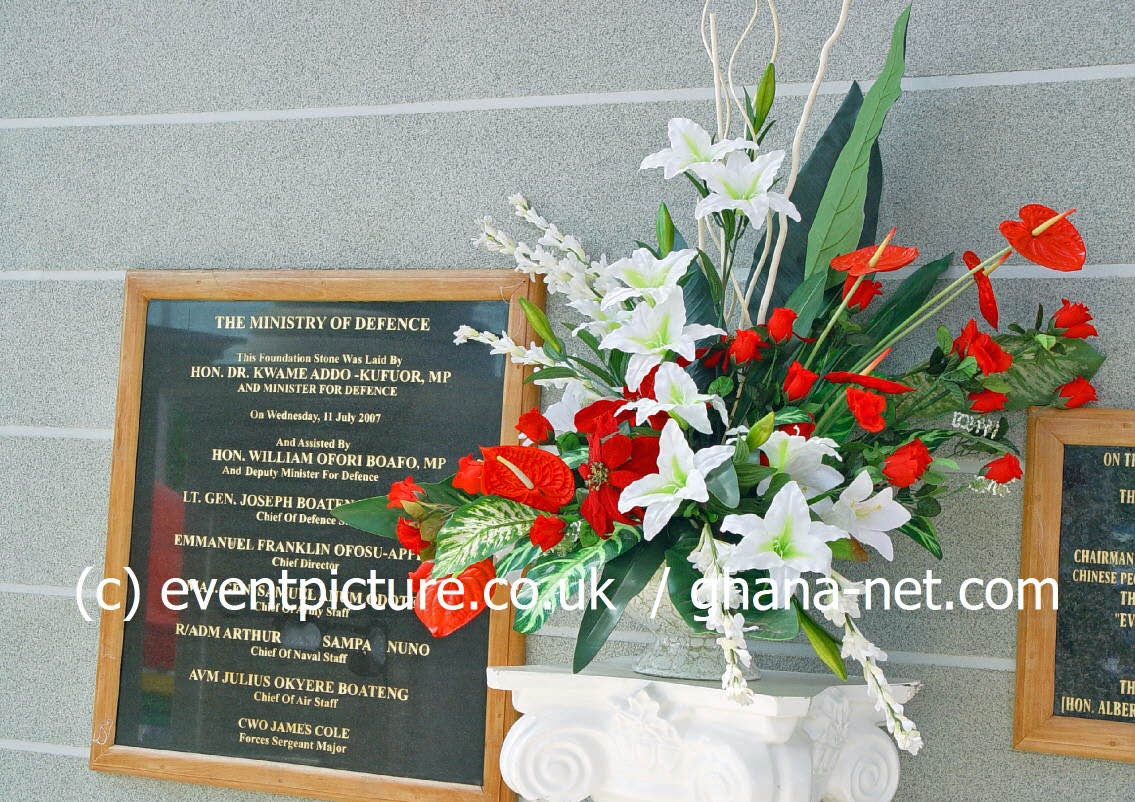
The plaque, dressed in flowers for the ceremony. Photo: Remo Kurka, 2009.
The Ministry of Defence is one stone in a much larger wall. Since the 1990s, China has built, funded or co-funded a long list of Ghana's public buildings, and the armed forces have been among the biggest beneficiaries.
Before the ministry, Chinese aid had already paid for the new Burma Hall, barracks, Dongfeng trucks for the army, and K-8 jet trainers for the air force. China later also supplied furniture for the new complex. In recent years, Chinese firms have built much of the new accommodation and office space at Burma Camp.
The National Theatre of 1992 was the first great Chinese landmark in Accra, and Mahama named it in his speech. Others followed: stadiums, roads, hospitals, government offices, and the new fishing harbour at Jamestown.
Goodwill, contracts for Chinese companies, access to resources, and influence. A defence ministry built by a foreign power is not a neutral gift. Ghanaians across the political divide have asked what such buildings mean for security and sovereignty, and those questions remain fair.
Ghana collects buildings from foreign friends. Turkey built the National Mosque at Kawukudi. Each one is a gift, and each one carries a message.
The complex was planned as four storeys to house the Defence Minister and deputy, the Chief of the Defence Staff, the service chiefs and their staff. It has about 120 rooms. Columns, stone cladding and polished floors give it the formal, slightly monumental style of Chinese-built government buildings across Africa.
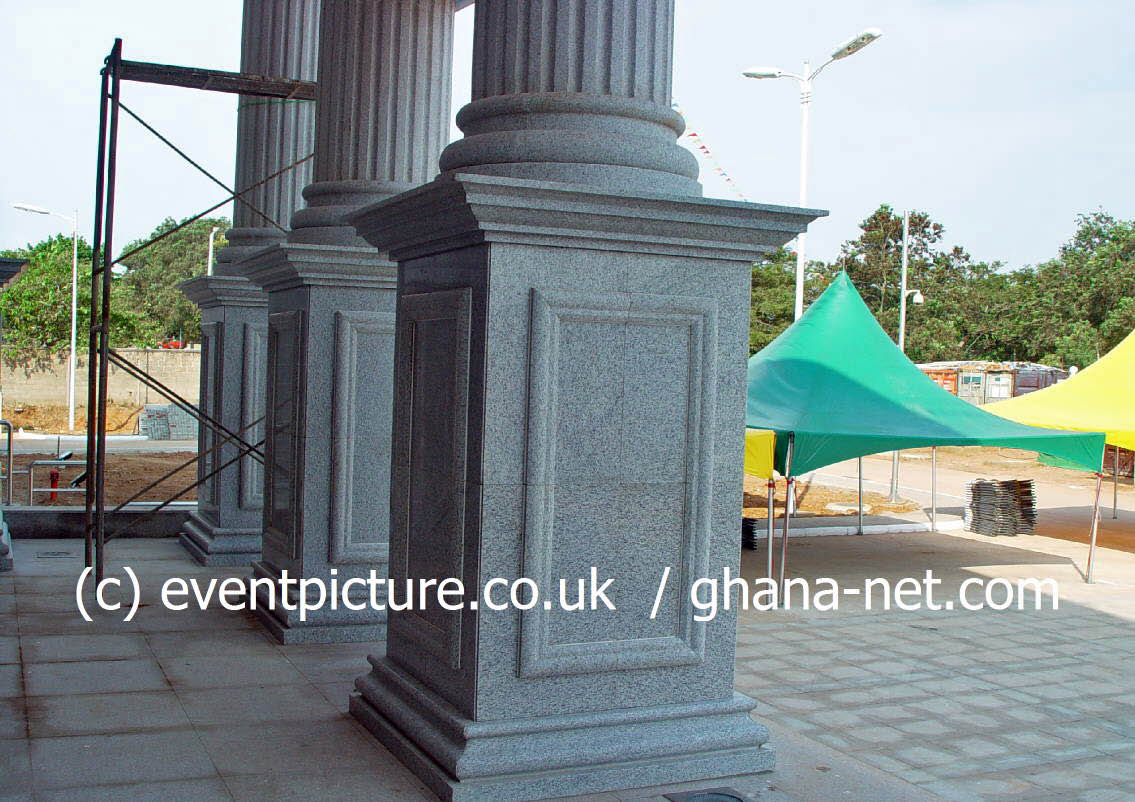
The pillars of the main entrance. Photo: Remo Kurka, 2009.
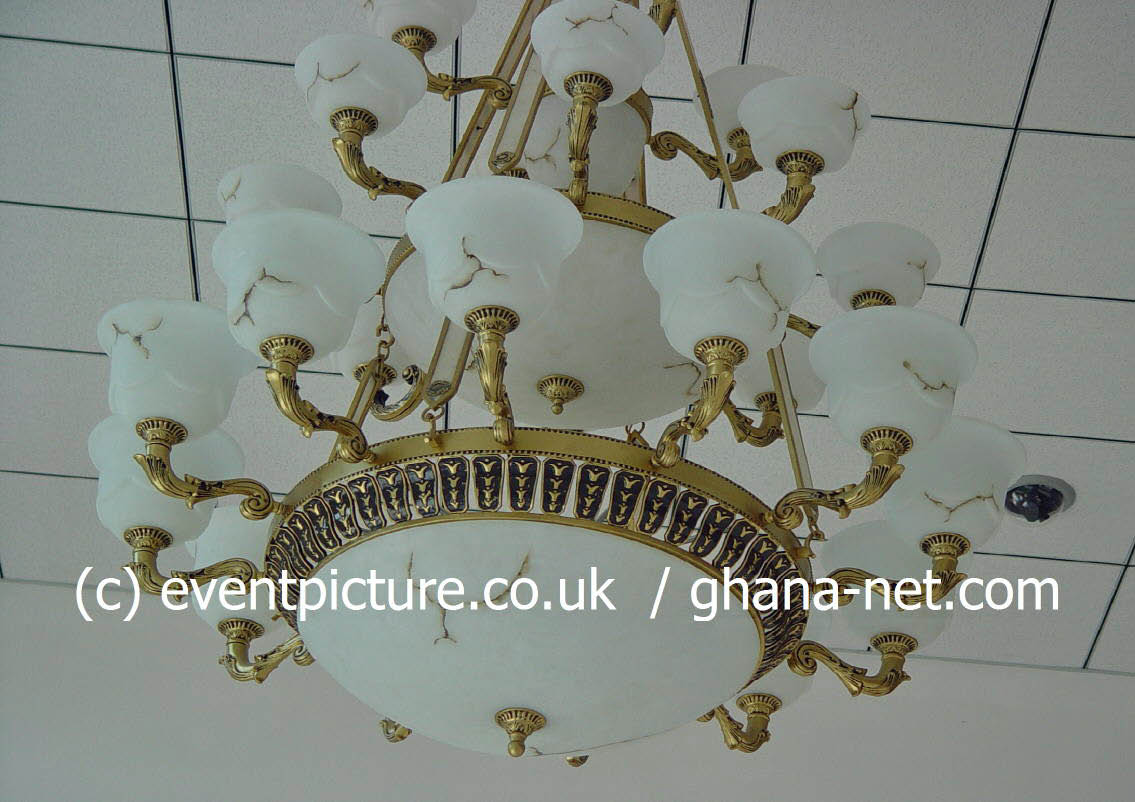
Inside: the ceiling lighting, seen on the one day the doors were open to guests. Photo: Remo Kurka, 2009.
A rare view. These photographs were taken during the official inauguration. Since then the building has been a working military headquarters, closed to the public. Pictures from inside are rarely seen.
Burma Camp, the headquarters of the Ghana Armed Forces in east Accra, is named after the Burma campaign of the Second World War. Thousands of soldiers from the Gold Coast fought there for Britain against Japan in the West African divisions.
When those veterans came home, the pensions and jobs they had been promised did not come. Their march in February 1948 ended in the shooting at the Christiansborg crossroads, one of the sparks of the independence movement. Read The 1948 Christiansborg crossroads shooting.
Burma Camp has also been the stage of Ghana's coups. Soldiers based here helped decide who ruled the country more than once between 1966 and 1981. Read Ghana's coups, 1966–1983.
You cannot visit the Ministry of Defence. It sits within a military area at Burma Camp, in east Accra near Cantonments and La. There are no tours, and there is no visitor entrance.
Photographing military installations, soldiers on duty and security buildings in Ghana can get your camera taken and you questioned, even from the road. If a soldier tells you to put the phone away, do so, without discussion.
If you have official business, a taxi or ride-hail from Osu or the Airport area takes 15–30 minutes depending on traffic. Expect checkpoints at the camp entrances, and carry ID. Without an appointment you will be turned back.
Much of the history of Ghana's state can be seen from the outside: Jubilee House, Black Star Square, Old Parliament House and the Osu Military Cemetery.
A city tour is the easiest way to see Accra's landmarks without getting into trouble at the wrong gate. Entrance fees are included in tour prices; tips are not included but are always welcome.
Updated and fact-checked: 14 October 2026. Sources: Ghana News Agency and Ghanaian Times reports on the sod-cutting and the December 2009 commissioning, the Daily Graphic, AidData records of Chinese assistance to the Ghana Armed Forces, and the author's own presence and photographs at the inauguration. Reported cost figures differ between sources, as noted above.