There are buildings in Accra that you visit because of what happened there.
And then there are buildings that are attractions in their own right.
The National Theatre of Ghana belongs to the second category.
You can see it from the road before you have fully worked out what you are looking at.
It resembles a giant ship.
From another angle, it looks like enormous sails caught by the wind.
Its curved white structure rises above South Liberia Road, close to the centre of Accra, and it is one of the most distinctive pieces of modern architecture in the city.
But the National Theatre is more than an unusual building.
It is one of the country's principal cultural institutions.
It was created to give Ghana a major national home for theatre, music and dance, and it remains closely connected to the country's performing-arts tradition.
For visitors, it offers something particularly valuable: a chance to see Ghanaian culture being performed rather than simply displayed behind glass.
The National Theatre did not appear out of nowhere.
Ghana had already developed an important theatre tradition before the present building was constructed.
The Ministry of Tourism, Culture and Creative Arts traces part of the modern story to Efua Sutherland and the development of Ghanaian theatre and drama after independence.
The Ghana government eventually decided to establish a National Theatre as a major institution for the performing arts.
The agreement with China for construction of the National Theatre complex was signed on 5 July 1989.
Construction began on 8 March 1990.
The National Theatre was completed in December 1992 and formally handed over on 30 December 1992.
That gives the building a surprisingly interesting place in Ghana's modern history.
It was conceived not simply as another auditorium.
It was intended to help develop and promote Ghanaian performing arts.
The first thing most visitors notice is the architecture.
The National Theatre is difficult to confuse with anything else in Accra.
The Architects Registration Council describes the building as being shaped like a ship, while noting that from a distance it can resemble a gigantic ship or a seagull spreading its wings.
The official National Theatre history gives some impressive numbers.
The building covers approximately 11,896 square metres.
Its main structure uses reinforced concrete and burnt bricks.
The lower exterior sections are finished with polished granite, while the upper curved portions are decorated with mosaic tiles.
At the front is a three-tier water fountain, which also serves as a reservoir for the theatre's internal fire-hydrant system.
The surrounding grounds include African artworks displayed around the lawns.
It is therefore worth looking at the building before you even enter.
The architecture is part of the attraction.
There is something fitting about the design.
A theatre is supposed to suggest movement, performance and imagination.
The National Theatre's sweeping curves give the building a sense of motion even when it is standing completely still.
The Ministry of Tourism, Culture and Creative Arts describes the design as resembling sails caught in the wind.
It is a particularly appropriate image for a national cultural institution: Ghanaian performance, music and dance being carried outward rather than kept inside a single tradition.
Whether you find the building beautiful, strange or slightly futuristic, it certainly does not look like an ordinary government office.
And that is one reason it has become one of Accra's recognisable landmarks.
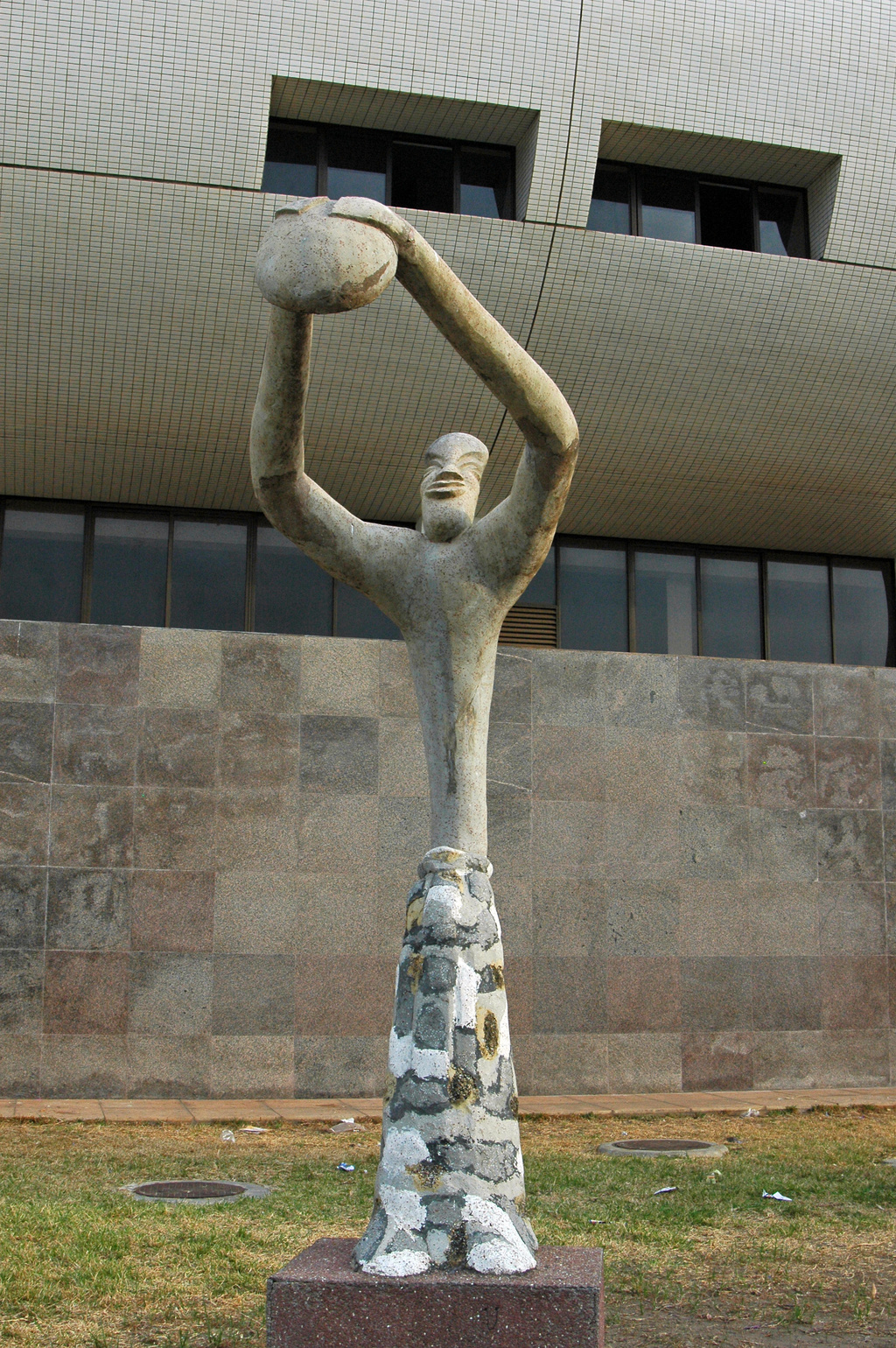
National Theatre of Ghana, Accra, statue at the left side from main entrance (c) Remo Kurka
The National Theatre is home to three principal resident performing groups.
They represent:
Drama — Abibigromma
Dance — Ghana Dance Ensemble
Music — National Symphony Orchestra
The three groups were central to the Theatre's opening activities in 1992, when performances by the resident groups formed part of the initial programme.
This is important for a visitor.
The National Theatre is not simply a building rented out for conferences.
Its own official FAQ makes the distinction quite clearly: the institution describes itself as the heart and soul of the nation's performing arts rather than simply an event centre.
That difference is worth remembering.
If you come here only to photograph the exterior, you have seen the building.
If you attend a performance, you have experienced the institution.
The National Theatre was designed as a multifunctional cultural venue.
Its role includes concerts, dance, drama, music, exhibitions, screen plays and special events.
There are also facilities used for rehearsals, exhibitions, educational programmes and other cultural activities.
The Theatre's own reports describe guided educational visits in which visitors and schoolchildren have been taken through areas including the main auditorium, rehearsal halls, Chinese Garden, amphitheatre and art galleries.
For tourists, that opens up an interesting possibility.
You do not necessarily have to be a serious theatre enthusiast to enjoy the place.
The building itself is interesting.
The art collection is interesting.
The architecture is interesting.
And, if the programme works with your visit, seeing a Ghanaian performance can turn the whole experience into something considerably more memorable.
This is perhaps the most important difference between the National Theatre and a museum.
A museum preserves culture in objects.
A theatre preserves and develops culture through performance.
A drum can be displayed.
A costume can be displayed.
A sculpture can be displayed.
But music, dance, drama and storytelling need people.
They need performers.
They need an audience.
That makes the National Theatre a living cultural attraction.
Its stated mission has traditionally centred on using the performing arts for the preservation, presentation, promotion and development of Ghanaian culture.
For a foreign visitor, that is an excellent reason to pay attention to what is actually on the programme during your stay.
The National Theatre has been involved in a wide range of Ghanaian performance traditions.
The country's concert-party tradition is particularly important.
Concert party combines music, comedy, drama and popular storytelling and has played a major role in Ghana's entertainment history.
In 2026, the National Theatre was involved in efforts to revive the Concert Party tradition through public programming, including a Mother's Day event featuring music, comedy, drama and cultural performances.
For visitors, this is a useful reminder that Ghanaian theatre is not simply Shakespeare performed in an African building.
There is a substantial local performance tradition here.
And the National Theatre is one of the institutions through which that tradition continues to find a stage.
The building is used by schools and educational groups as well as ordinary theatre audiences.
Recent educational tours have introduced students to the history of the theatre, its architecture and its resident performing groups.
Visitors have also been shown parts of the building and collections of Ghanaian art.
That makes the Theatre particularly suitable for families travelling with older children and teenagers.
A child who is bored by another historical building may be considerably more interested in a theatre where there is music, dance, costumes, performers and a stage.
And that is exactly the point.
Culture becomes easier to understand when it is alive.
The National Theatre opened in 1992.
That means it is now itself part of Ghana's modern cultural heritage.
The building has been standing for more than three decades.
Its history includes not only performances but the many people who have worked there: actors, dancers, musicians, directors, technicians, costume designers, sound engineers, administrators and countless others.
The Theatre's official information lists an unusually wide range of professions connected with its operation, from performers and technical staff to carpenters, estate officers, journalists and marketers.
That is worth remembering when looking at the building.
A theatre is never just the stage.
It is an entire working ecosystem.
The institution is now looking towards another stage in its history.
The National Theatre announced that government had plans for a major renovation, with the stated aim of bringing the facility up to modern standards and strengthening its role in Ghana's creative economy.
The Theatre's current strategic direction also places considerable emphasis on sustainability, digital access, audience development, international collaboration and skills development.
Its stated objectives include becoming more economically, environmentally and socially sustainable, attracting strong artistic collaborators, expanding audiences through digital innovation and inspiring creativity among young people.
That is important because the National Theatre is no longer simply an institution looking backwards.
It is trying to decide what a national theatre should mean in the twenty-first century.
Yes — but there is an important distinction.
The National Theatre is a functioning cultural institution rather than a conventional museum that you simply enter at any time and walk around independently.
The Theatre publishes information about performances and events, and its facilities can also be booked.
Its current visitor information lists administrative working hours as 8:30am to 4:30pm, with the Theatre located on South Liberia Road.
For a tourist, the best strategy is therefore to check what is happening during your visit rather than simply arriving and expecting a fixed sightseeing tour.
If there is a performance you can attend, that is likely to be the most rewarding experience.
If there is an educational or guided visit available, even better.
And if neither is possible, the building is still worth seeing from outside.
Do not make the mistake of treating the National Theatre as another generic event centre.
It is one of Ghana's major cultural institutions.
If you are interested in Ghanaian music, dance, drama or modern architecture, put it on your Accra list.
But check the current programme before going.
The Theatre's official website is the best place to look for current events, performances and booking information.
And remember that event schedules can change.
A performance listed somewhere on an old travel website is not necessarily a performance taking place during your visit.
That is a particularly important distinction in Ghana, where online information about cultural events can remain visible long after the event itself has disappeared from the calendar.
For the architecture alone: yes, if you like unusual modern buildings.
For Ghanaian culture: definitely.
For a theatre performance: absolutely, provided you find something suitable during your stay.
For someone with only one day in Accra: that depends on your interests.
If this is your first visit to Ghana, the National Theatre will probably not replace the major historical sights.
But it can add something that those places cannot.
It shows you Ghana not only as a country with a fascinating past, but as a country that continues to create, perform and reinvent its culture.
The National Theatre of Ghana is one of those Accra attractions that can easily be underestimated.
From the outside, it is an extraordinary building.
Inside, it is something more important: a national cultural institution.
Its history reaches back to the development of Ghanaian theatre after independence.
Its present includes drama, dance, music, exhibitions, educational programmes and cultural events.
Its future involves renovation, digital access, sustainability and the attempt to bring performing arts to new audiences.
For tourists, the best way to experience it is not to tick “National Theatre” off a list.
Look at the architecture.
Find out what is being performed.
If there is a performance that interests you, buy a ticket.
Sit down.
Watch Ghanaian performers take the stage.
That is when the building makes sense.
A theatre is not really alive when it is empty.
It comes alive when the lights go down, the audience becomes quiet and somebody walks onto the stage.
And in Accra, there are few better places to experience that than the National Theatre of Ghana.
Location: South Liberia Road, Accra.
Opened: 30 December 1992.
Construction: Began in March 1990 following a 1989 Ghana-China agreement.
What it is: Ghana's national performing-arts institution and a multifunctional cultural venue.
Resident groups: Abibigromma, Ghana Dance Ensemble and the National Symphony Orchestra.
Architecture: Approximately 11,896 square metres, with the distinctive ship/sail-like form, reinforced concrete, burnt brick, granite and mosaic finishes.
Current visitor information: Administrative hours are listed as 8:30am–4:30pm; performances and other programmes vary.
Best for: Theatre, music, dance, architecture, Ghanaian culture, families and visitors looking for a living cultural experience.
You can photograph the National Theatre in five minutes.
You should not necessarily leave it at that.
The building is one of Accra's most recognisable pieces of modern architecture, but its real purpose is much more interesting.
It is a place where Ghanaian culture is performed.
And for the traveller, that distinction matters.
You have not really experienced Ghanaian theatre by looking at the building.
You experience it when the curtain rises.
