
Ghanas Inspiring History Unveiled
Discover Ghanas rich history, from ancient kingdoms to modern democracy, through vibrant festivals, stunning…
Ghana-Net.com · Northern Region · Colonial History
On 3 and 4 December 1896, the Kingdom of Dagbon fought the German Empire on a hillside ten kilometres south of Yendi. Dagbon had thousands of men. Germany had four officers, ninety-one soldiers and rifles that killed at three hundred metres. The kingdom lost, its capital was burned, its palace looted, and four years later the Germans chose its next king. The objects taken that week are still in Berlin and Leipzig.
Almost everything written about this battle in English is either a paragraph in a colonial report or a paragraph on a heritage blog, and the two contradict each other. Here is what we can establish, and what we cannot.
The expedition was 372 men, of whom four were European. Everyone else — the soldiers, the armed carriers, the transport column — was African. This was not a European army marching into Africa. It was a European command structure operating an African army against an African kingdom, which is how almost all of the conquest of this continent was actually done.
Dagbon had firearms, cavalry, a standing military hierarchy and centuries of state organisation. It had defeated the Gonja. It had a capital, a court, a Muslim scholarly community and a diplomatic record of refusing European treaties. Accounts that describe men with bows rushing a machine gun are wrong, and they are insulting.
Dagbon's guns were muzzle-loaders — effective at twenty to thirty metres, roughly one shot a minute. The German rifles were breech-loaders. Von Massow halted three hundred metres off and opened fire from a distance at which his opponents did not believe they could be hit. That is the entire battle in one sentence.
Dagbon's strength is given variously as 4,000 to 7,000. The figure from accounts traced to people present is about 2,500 gunmen, 130 horsemen and 2,000 archers. Casualties were never counted by anyone. German colonial reporting was censored at source. We give ranges and say so.
Adibo is where most accounts stop. The Germans came back in 1900 to install a king of their choosing, and killed men who had fled across the border into British territory to escape them. That episode tells you more about colonial power than the battle does.
The royal objects taken from Yendi are in German museums. In June 2026, Germany presented Ghana with a catalogue of objects it would return. Dagbon was not on it. See below.
Dagbon is one of the oldest continuously existing kingdoms in West Africa, founded by the Dagbamba on the plains of what is now Ghana's Northern Region. Its ruler carries the title Yaa Naa — king of the Dagbamba — and sits at Yendi on a skin rather than a throne. The succession has always rotated between royal houses, and that arrangement matters later in this story more than anything the Germans did with a rifle.
The capital was not always Yendi. It was moved east from Yani Dabari, near Diare, under pressure from Gonja attacks on western Dagbon — particularly at Daboya. Naa Luro won a later battle against the Gonja but could not sustain the war and relocated the court. It was Naa Zanjina who finally broke the Gonja advance, defeating them and killing their chief Kumpatia at Sang, near Yendi.
Zanjina is remembered as the first Muslim ruler of Dagbon and as the king who encouraged trade. A Muslim community formed around the Yaa Naa's palace at Yendi — Dyula of Mande origin under the Sabali-Yarna, and Hausa under the Kamshe Naa. By the nineteenth century Yendi was a court, a market and a centre of Islamic scholarship on the trans-Saharan trading network, not a village.
On the name. The battle is Adibo dali in Dagbani — the day of Adibo. That is what it is called in Dagbon, and it is what this page calls it. "The Battle of Adibo" is the German record's phrasing.
By the 1880s Dagbon was being approached from three directions at once. The Germans were pushing north from Togoland. The British were pushing north and east from the Gold Coast. The French were coming down from the Sahel.
In 1888, Britain and Germany agreed a neutral zone stretching from Yeji to Yendi — the Salaga area — explicitly to stop the two of them fighting each other over it. Neither power could formally annex the territory.
Understand what that meant on the ground. Dagbon now sat inside a zone two European powers had agreed not to take, which is precisely why both spent the next decade racing to establish facts inside it. The Berlin Conference of 1884–85 had made effective occupation the test of a valid claim. A treaty was worth nothing without soldiers standing on the land. The neutral zone did not protect Dagbon. It set a stopwatch.
The Yaa Naa understood this exactly. In 1894 he refused to sign a treaty, because he could see the partition coming, and asked the question that ought to be on a monument somewhere:
"Did you ever see two men riding one donkey?"
Then, in May 1896, Dr Hans Gruner attempted to enter Yendi. His stated reason was that he only wished to pass through to Sansanné-Mango. Yaa Naa Andani II — known as Andan Naanigoo — refused him passage through Dagbon.
The German governor of Togoland, August Köhler, responded by attaching a military officer, Lieutenant Valentin von Massow, to the next attempt.
A king declined a visitor. An empire sent an army.
The German colonial record logs the campaign against Dagomba as running from 29 September to 11 December 1896. It was not one battle. It was a ten-week march, and it burned towns on the way.
The man commanding the Dagbon army has been almost entirely written out of the English accounts, and he should not be.
Kanbon-nakpem Ziblim, chief of Gbungbaliga, known as Kanbon-nakpem Wohu, had promised the Yaa Naa that he would arrest any white man who set foot in Dagbon. He rode a white stallion. He carried two guns and a sword. Accounts of the battle describe him as physically imposing and as an inspiration to the men under him.
He had chosen good ground. Adibo sits on a low hill sloping south towards Nakpachie, and the Dagbon army held the crest. The Germans could only reach the bottom of the slope through a narrow passage, man by man, which is the sort of position that wins battles.
Von Massow got his column down without being attacked, formed his men into three platoons with the supply train behind them, and put Gruner in the rear with a fourth platoon of armed carriers. Then he halted about three hundred metres from the Dagbon line and stopped.
Because he needed Dagbon to charge. Uphill fighting against a larger force in prepared ground was a losing proposition. At noon, von Massow ordered volley fire from each of the three platoons — not to break the line, but to provoke one.
Kanbon-nakpem Wohu ordered his men forward and they surged down and around the German column, encircling it. This was the correct tactical response to being fired on, and in every previous war Dagbon had fought it would have worked.
Dagbon's guns were muzzle-loaders. One shot, then most of a minute to reload, effective at twenty to thirty metres. The men advancing did not expect to be hit at the range they were crossing, because in their experience nobody could be. They were wrong by a factor of ten.
The encirclement was exactly what the German commander wanted. It brought thousands of men inside the killing range of breech-loading rifles held by soldiers in formation. Dagbon did not lose because it was outnumbered or unprepared. It lost because it was drawn into a distance where its weapons did not function and its opponent's did.
The fighting ran into a second day. Dagbon's losses on 4 December were severe, and the army broke.
One correction worth making. Several sources describe a Maxim machine gun at Adibo. The detailed accounts of the engagement describe rifle volleys from three platoons, and this page describes what those accounts describe. The technological gap does not require a machine gun to explain it — breech-loaders against muzzle-loaders at three hundred metres is sufficient, and it is what the record supports.
After Adibo the German column moved on the capital. Yendi was found deserted and was razed. The Gbewaa Palace — the seat of the Yaa Naa, the physical centre of the kingdom — was burned, and objects were taken from the royal complex as trophies.
One thing did not happen, and it matters. The Germans did not capture Yaa Naa Andani II. There was no surrender ceremony, no signed instrument of submission, no king led away. The capital was destroyed and the army was broken, but the kingship survived the week, and Andani II remained Yaa Naa until his death in August 1899.
That is why some scholarship warns against reading Adibo as a clean and total conquest. Germany had won the field and burned the town. What it had not done was take over the institution. It would come back for that in 1900.
Yaa Naa Andani II died in August 1899, and a succession dispute opened inside Dagbon. Andani's eldest son wanted the Savelugu skin and proposed that the sitting Savelugu Na be elevated to Yaa Naa. Alasan, Na of Karaga, disagreed and claimed the kingship for himself.
Governor Köhler backed Alasan.
In April 1900 the German administrator Friedrich Rigler marched on Yendi to install him. He arrived to find the town empty — the rival faction had crossed the border into British-controlled territory, on the reasonable assumption that a colonial boundary would protect them from a colonial army.
On 7 April 1900, Rigler's force attacked them inside British territory. Reported casualties include a son of the late Yaa Naa. Rigler then returned to Yendi and enskinned Alasan as Yaa Naa.
This is the moment the character of the story changes. In 1896 Germany defeated an army. In 1900 it selected a king, crossed another empire's border to kill the alternative candidates, and installed its own choice on the skin of Dagbon.
That is the full sequence of colonial power, compressed into four years: demand recognition, defeat resistance, then determine the succession.
And it was a method, not an incident. Lieutenant Gaston Thierry, who was at Adibo, had the Anufo ruler of Sansanné-Mango shot in late 1897 on an accusation of having signed a treaty with the French — an accusation the king denied. Thierry went on to lead an expedition against the Kabiye in January 1898 and another against the Moba in 1899. The same officers, the same colony, the same decade.
In 1899, Britain and Germany concluded a convention partitioning the old neutral zone. Dagbon was divided between them. Yendi and eastern Dagbon went to German Togoland. Western Dagbon went to the Gold Coast.
The Yaa Naa was now separated from the majority of his own people by a line drawn in Europe, and neither he nor anyone in Dagbon had been consulted about it. One kingdom, two colonial jurisdictions, two systems of law, two sets of chiefs answering to two foreign capitals.
Then the empire that had done it vanished. In August 1914 British forces moved into German Togoland at the outbreak of the First World War, and Yendi was occupied by the British on 6 August 1914. German rule in Dagbon had lasted eighteen years. After the war the territory passed to a British mandate, and eastern Dagbon was eventually reunited with the west.
Dagbon refused Germany · Germany burned Yendi · Germany and Britain divided Dagbon · Britain fought Germany · Britain inherited German Dagbon · Dagbon was reunited under the people who had taken half of it in the first place.
Partition disrupted the rotation of the kingship between the royal houses, because for a generation the gates were administered under different colonial regimes. What followed is known as the Yendi skin dispute — the chieftaincy conflict between the Abudu and Andani gates that has been among the most serious and most costly disputes in Ghana's modern history.
The dispute produced major loss of life in 1969, ran through successive civilian and military governments, and culminated in the killing of the Yaa Naa and others at Yendi in 2002. A resolution was reached and a new Yaa Naa enskinned in 2019, after a peace process that took years.
The succession rotation existed before the Germans arrived and Dagbon had its own internal politics. Colonial partition did not invent the dispute. It froze it, split its administration between two empires, and handed the result to an independent Ghana to deal with. Both things are true.
Objects were taken from the royal complex at Yendi in December 1896 and carried to Germany as colonial war booty.
The best documented is the so-called Yendi flag. In 1900 it was transferred by the German Colonial Office to the Ethnological Museum in Berlin, where it was catalogued as a war standard of the ruler of Yendi. Not bought. Not donated. Transferred from the government department that ran the colony to the national museum, four years after the palace it came from was burned.
In Leipzig, the GRASSI Museum für Völkerkunde holds Dagbon material within a larger collection from the Togo colony. In March 2022 the museum placed a Dagbon headdress in a "prep room" — an exhibition space for unresolved curatorial questions — and it is that object which opens the most substantial piece of scholarship on this subject, Yann LeGall and Elias Aguigah's Remnants of 'Adibo dali' (1896) and the Plunder of Yendi in German Museums, published in the History Workshop Journal in 2023.
In June 2026, Ghana hosted the Next Steps conference in Accra. The ambassadors of the Netherlands and Germany presented President Mahama with catalogues of objects to be returned. The headline across the world's press was that the two countries would return more than 2,000 artefacts to Ghana.
Read the breakdown. The 2,000 is the Dutch figure.
Germany's contribution was four objects — two war drums and two war horns, linked to the Kpando traditional area in the Volta Region.
Germany holds the Yendi flag in Berlin, catalogued in 1900 as war booty from a conquest its own officers commanded. It holds Dagbon material in Leipzig. And it came to Accra with four objects from a different traditional area entirely.
Asante has had returns — 32 items in 2024, a further 130 in November 2025. The Asantehene is an institution with international standing, legal advice and a palace museum ready to receive. Restitution in practice flows toward the courts with the most lobbying capacity, not toward the clearest provenance.
Most restitution cases turn on murky acquisition histories. This one does not. A dated military expedition, a named commander, a burned palace, and a transfer from the Colonial Office to a state museum in 1900. There is very little to research.
That is the harder question, and it is the one nobody has answered. For objects of the Dagbon royal institution, "the Republic of Ghana" is not obviously the right recipient. Ghana · Northern Region · Dagbon · the Yaa Naa · a particular house or family — the chain matters, and as far as we can establish nobody has formally asked Yendi what it wants.
Yendi is about 95 km east of Tamale on a road that is straightforward in the dry season. This is not a developed heritage circuit, and you should arrive expecting a living town with a royal court in it rather than a battlefield park.
An honest note. Northern Ghana's heritage sites are not signposted the way the coastal forts are, and the 1896 campaign is remembered in Dagbon through oral history and the drum histories rather than through interpretation boards. The best account you will get at Yendi is from a person, not a plaque. Budget time for that, and pay for it properly.
Historical details last verified . Campaign dates (29 September – 11 December 1896) from the German colonial military record. Battle dated 3 and 4 December 1896. Expedition composition — four Germans under Lieutenant Valentin von Massow with Dr Hans Gruner, Lieutenant Gaston Thierry and Sergeant Heitmann, plus 91 trained soldiers, 46 armed carriers and 231 further carriers — from published accounts of the campaign. Dagbon strength is given as a range: accounts traced to participants give approximately 2,500 gunmen, 130 horsemen and 2,000 archers, while other sources give totals of 4,000 to 7,000. No casualty figures are given for Adibo or Bimbilla, because none can be independently established; figures circulating for Bimbilla are not printed here for that reason. The 1888 Anglo-German neutral zone from Yeji to Yendi, the 1899 convention partitioning Dagbon, and the British occupation of Yendi on 6 August 1914 are documented. The 1894 treaty refusal and the Yaa Naa's remark about two men riding one donkey are recorded in Staniland's The Lions of Dagbon. The 1900 succession intervention, Governor Köhler's support for Alasan and Rigler's April 1900 expedition are documented; casualty details for the attack of 7 April 1900 are as reported in secondary accounts and have not been independently verified. Transfer of the Yendi flag from the German Colonial Office to the Ethnological Museum in Berlin in 1900, and Dagbon material in the GRASSI Museum Leipzig, are recorded in provenance research including LeGall and Aguigah, Remnants of 'Adibo dali' (1896) and the Plunder of Yendi in German Museums, History Workshop Journal, 2023. The June 2026 restitution announcement in Accra, and the German identification of two war drums and two war horns linked to the Kpando traditional area, are as reported at the time. German colonial reporting on punitive expeditions was subject to censorship at source and should be read accordingly. Where German records, British records and Dagbon oral history disagree, the disagreement is stated rather than resolved.
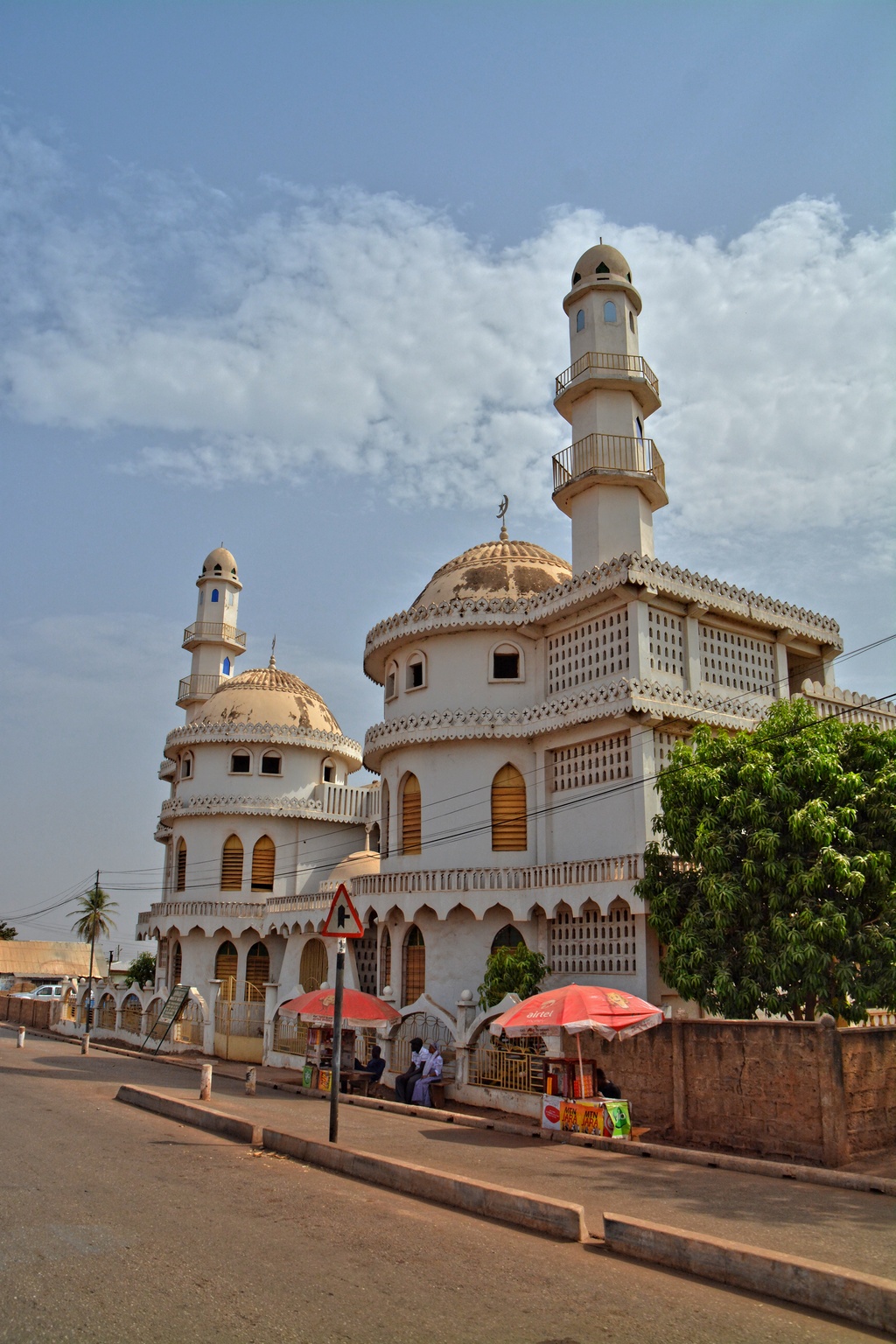
A Mosque in Tamale, Northern region (c) Remo Kurka, Ghana