
Fort Good Hope
Goedehoop, above the fishing town of Senya Beraku. One of the last Dutch forts built on this coast.
Header Photo - at Richter Fort Osu, Accra
Ghana-Net.com · Central Region · Winneba · Effutu
Winneba is one of the oldest trading towns on this coast, and it has no fort. It used to have one. In 1812 the Effutu killed its commandant, and the British answered by blowing the fort up and burning the town. What is left is an old drawing, a date, and a story most visitors to Winneba never hear.
Drive along the coast between Accra and Cape Coast and almost every old town has its fort: Senya Beraku, Apam, Abandze, Anomabo. Winneba, bigger and older than most of them, has none.
That is not an accident of time or weather. It is the result of a single decision in 1812. Winneba is the only major town on this stretch of coast that lost its fort to a punishment rather than to the sea.
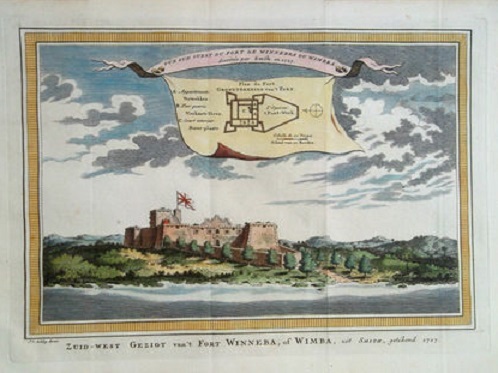
This is all there is to see. No walls of Winneba Fort survive above ground. Old drawings and prints like this one are the only way to know what it looked like.
Winneba is the town of the Effutu, and it traded with Europeans early. The English set up a trading post here in 1632 — what the Germans would call a Faktorei, a lodge rather than a fort. It did not last: it was abandoned no later than 1644.
In 1694 the English Royal African Company came back and built a proper fort. It traded in gold and in people, like every fort on this coast, and it was surveyed in 1727 by William Smith, the company's inspector of forts.
For more than a century it was a minor English post between the bigger forts, dependent — as all of them were — on the goodwill of the town around it.
That goodwill ran out in 1812, and the fort's commandant paid for it with his life.
In February 1812 the Effutu seized the commandant of Winneba Fort, Henry Meredith, and killed him. They accused him of withholding gold they had entrusted to the fort. Accounts of his death describe it as brutal: a forced march, beatings, and torture before he died.
The British response came in July 1812. A naval force under Commodore Irby destroyed the fort and burned Winneba. The Effutu were made to pay indemnities in gold and money. The British did not rebuild.
Read both sides. The British account is of a murdered officer and a justified reprisal. The Effutu grievance — gold handed to the fort and not returned — is recorded, but it reaches us only through British writers. What is certain is how it ended: a burnt town and a demolished fort, and a coastal town that has had no fort ever since.
West on the Accra–Cape Coast road, then off to Winneba. Roughly 60 kilometres — an hour to an hour and a half, depending on traffic leaving Accra.
Trotros and buses from Accra towards Cape Coast stop at Winneba Junction; take a shared taxi from there into town.
Ask older residents where the fort stood. There is nothing to visit, but the story is known in town, and the Effutu have their own version of 1812.
Fort Good Hope at Senya Beraku to the east, Fort Patience at Apam to the west.
Winneba is worth a stop for itself. It is the home of the Effutu Aboakyer festival, the deer hunt held in spring, and of a well-known fancy-dress masquerade tradition at the New Year. More on the coast: Central Region Beaches. Hotels on ghanahotels.biz.
No tour stops for Winneba's fort — there is none left to stop for. The tours below pass along this road on the way to Cape Coast and Elmina.
Bookings through this widget earn us a commission at no extra cost to you. No operator has paid to appear on this page.
Goedehoop, above the fishing town of Senya Beraku. One of the last Dutch forts built on this coast.
Fort Lijdzaamheid — the Dutch named it Patience because building it took so long.
Another small English company fort, now mostly below ground and being studied by archaeologists.
Built by the English as Fort Kormantin, taken by the Dutch in 1665. The origin of the name Coromantee.
All of them, in order: Forts and Castles of Ghana. The British side of this history: British Forts & Castles in Ghana.
You cannot visit Winneba Fort. You can understand why it is gone, and that is worth more than most restored ramparts: a European fort that existed only as long as the town around it allowed, and a colonial power that answered a local killing by destroying both.
Verified: 26 September 2026. The fort's construction by the Royal African Company in 1694, the killing of commandant Henry Meredith by the Effutu in February 1812, and the destruction of the fort and burning of Winneba by a British force under Commodore Irby in July 1812 follow published historical accounts. The trading post of 1632 and its abandonment by 1644 are from Ghana-Net's own records. Corrections welcome and will be published in full.