
Ghanas Inspiring History Unveiled
Discover Ghanas rich history, from ancient kingdoms to modern democracy, through vibrant festivals, stunning…
Ghana-Net.com · Savannah Region · Heritage
The market where the marches converged. Salaga was one of the largest slave markets in West Africa, the place captives from across the north were brought to be sold, and the point at which two separate slave trades met — one going south to the Atlantic, one going north across the Sahara. Until July 2024 the site was effectively a car park. This is where Ghana's slave history begins, and almost nobody goes.
Every year, tens of thousands of people from the diaspora travel to Ghana to stand in the dungeons at Cape Coast and Elmina. Almost none of them come here, and Salaga is where the people in those dungeons were sold.
Captives were taken across the northern savannah — from what is now Northern, Savannah, North East, Upper East and Upper West, and from beyond the borders into present-day Burkina Faso and Togo. They were walked to Salaga. They were held here, watered, washed, valued and sold. Then they were marched south, through Assin Manso, to the coast — or north, across the desert, to a destination the pilgrimage never mentions at all.
The pilgrimage runs backwards. It begins at the door and ends at the door, and the six hundred kilometres of road that brought people to it are not on any itinerary. Salaga is the missing first chapter of a story Ghana sells very well from chapter three onward.
And the arithmetic is uncomfortable. The coast has the castles, the UNESCO listings, the museums and a heritage economy worth a great deal of money. Cape Coast Castle alone draws well over a hundred thousand visitors a year. The Savannah, Northern, North East, Upper East and Upper West regions — which supplied the people — are the poorest in Ghana. The revenue from remembering this trade flows exactly where the profit flowed in 1850, along the same road, in the same direction.
Long before it sold people, Salaga was rich. From around the sixteenth century it was one of the leading market centres in West Africa — a junction on the routes running from the Sahel down to the forest, trading kola nuts, gold, salt, beads, textiles, animal hides and ostrich feathers. Hausa traders came south, Asante buyers came north, and Arab merchants came across the desert. It was a commercial town of real consequence, in a part of the country that most people today assume never had any.
Salaga sat under the authority of Gonja, and its traditional seat is at Kpembe nearby — the Kpembewura is still the paramount authority for this area. That matters, because it means the trade here was run by a northern kingdom, not only by outsiders arriving from the coast. There is no clean version of this history in which the north is purely a victim, and this website does not offer one.
Through the eighteenth and into the nineteenth century, the balance of what Salaga traded shifted. Kola and gold continued. But the commodity that made the town famous, and that it is remembered for now, was people — bought and sold for cowries, for kola, for gold, in a market beneath a baobab tree.
This is the detail that stays with people, and it is the reason Salaga deserves a page of its own rather than a paragraph on somebody else's.
Salaga was dry. Water was scarce and the market needed enormous quantities of it, because a captive who arrived filthy and exhausted after weeks of walking sold for less than one who arrived washed. So the town dug wells. More than a thousand of them, by the account of those working to protect the site — dug by community members who then sold that water to slave traders, so that the people being sold could be washed before sale.
An entire local economy grew up around supplying water to clean human beings for market. Not raiding, not selling — just water. And it was profitable enough that people kept digging.
There is a pond here still called Wonkan Bawa — Hausa, and it means the bathing place of slaves.
Now hold that next to Assin Manso. Six hundred kilometres south, at the end of the march, there is a river called Donkor Nsuo where the same people were washed again before they were put through the door. They were washed at both ends. Once to be sold, once to be shipped. Two bathing places, two languages, one commercial logic — and Ghanaian tourism has built a national pilgrimage around the second one and left the first as a car park.
The wells are being lost. Encroachment and building have taken many of them, and they are going faster than anyone is recording them.
Britain abolished its Atlantic slave trade in 1807 and abolished slavery in most of its empire in 1833. In the standard telling, that is roughly where the story ends and the castles become museums.
Scholarly work on Salaga places it among the leading slave markets in West Africa in the 1880s.
Seventy years after abolition, this market was still one of the biggest of its kind on the continent. It could be, because the Atlantic was never the only outlet. Captives from Salaga also went north — across the Sahara, on the trans-Saharan routes into North Africa and the Ottoman world, a trade that ran for over a thousand years and that no European parliament ever voted to end. And a great many never left the region at all: they were absorbed into households, farms and armies inside West Africa, in forms of servitude that abolition simply did not reach.
What eventually closed Salaga was not conscience. It was colonial administration arriving in force at the end of the nineteenth century, the collapse of Salaga's own political order in civil conflict, and the trade routes moving elsewhere.
Why we put this on a travel page. Because the Atlantic story, told alone, lets everyone off. It has a clear villain, a clear victim and a clear end date. Salaga has none of those. It ran on local demand as much as European, it kept running after the European trade stopped, and it was ended by conquest rather than by anyone's change of heart. That is the harder history and it is the one standing in the Savannah Region with no visitors.
Set your expectations. There is no castle, no dungeon and no great structure. Until very recently there was barely a site at all.
The Salaga Slave Market was, for decades, effectively abandoned — left to the town, used as a parking area and for ordinary commerce, with no interpretation, no protection and no programme. On 22 July 2024, a redeveloped Salaga Slave Market and Heritage Site was formally commissioned, timed to open that year's Emancipation Day celebrations, with the Kpembewura's traditional authority behind it.
It is a small site and a new one, and it will be better in ten years than it is now. It is also the only place in Ghana where you can stand at the beginning of the route rather than the end of it.
We do this on every heritage page, because a site you can trust on the flattering claims is a site you can trust on the rest.
That Salaga was a major market and one of the largest centres of the slave trade in West Africa is documented, and unusually well — the nineteenth-century town was described by a long list of travellers, officials, soldiers, merchants and missionaries, African and European, whose accounts historians have used to reconstruct who was brought here, by whom, and where they went.
The specific attributions are more mixed. The wells are associated with the trade in oral tradition, and some scholarship notes that Salaga's water management system predates the slave trade — so the wells served the town before they served the market, and the two uses overlap. The exact identification of individual sites rests substantially on local memory.
That memory is not a weaker source. It is the only source kept by the people this happened to, in a trade whose written records were kept almost entirely by the people doing the selling. But you should know which is which, and no other page about Salaga will tell you.
In Jamestown, in the middle of the capital, there is a market called Salaga Market. Thousands of people shop in it every day. Visitors walk through it on Jamestown photo tours and buy fish there.
It carries that name because people brought from the Salaga trade were sold there, six hundred kilometres from the town that named it.
The name survived the trade, survived colonisation, survived independence, and is currently painted on signboards above stalls selling tomatoes and secondhand clothes. Almost nobody in Accra knows why it is called that, and it is one of the most direct surviving links between the north and the coast that exists in Ghana.
Salaga is the capital of East Gonja Municipal, in the Savannah Region — one of the regions created in 2019, which is why older maps and older articles still place it in the Northern Region.
Go here first if you can, and the whole country rearranges itself. The march from Salaga to Assin Manso to the coast is roughly six hundred kilometres — a distance you will cover in a day in an air-conditioned vehicle and that they covered on foot, in chains, over weeks. Nothing on the coast prepares you for that number. Standing at the start of it does.
Details last verified . Site redevelopment and commissioning date from Ghana's Ministry of Tourism, Arts and Culture and contemporary Ghanaian press. Historical accounts of nineteenth-century Salaga from published scholarship. Well counts are estimates given by those working on the site. Access, opening arrangements and fees change — confirm locally before travelling.
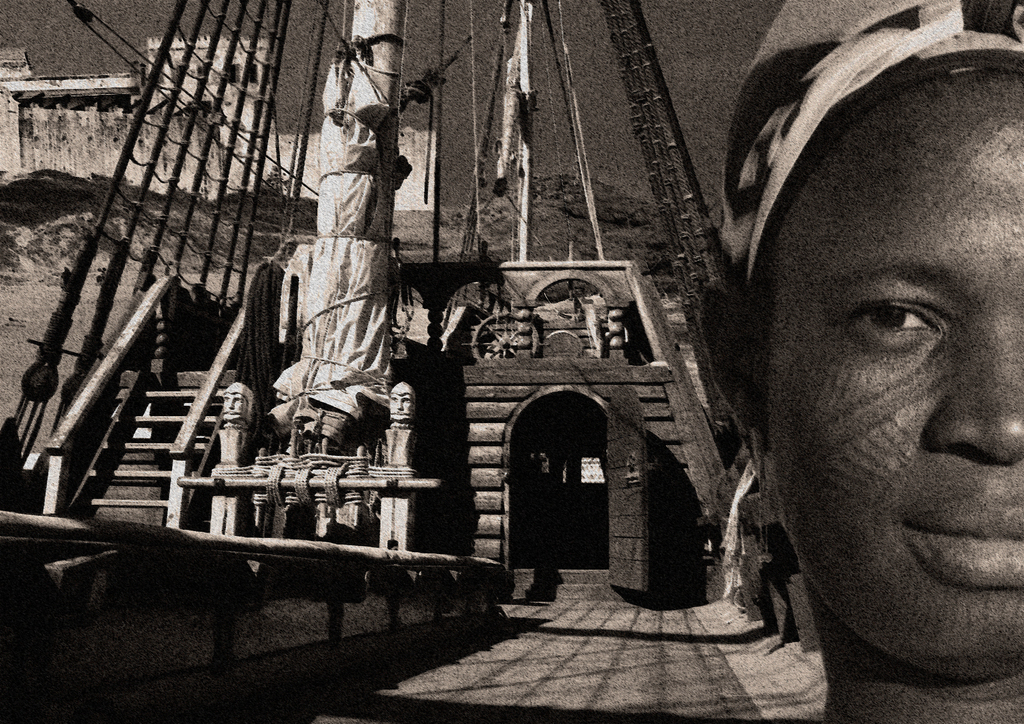
Transatlantic slave trade. Photo composite with Cape Coast Castle background by Remo Kurka, Ghana