
Ghanas Inspiring History Unveiled
Discover Ghanas rich history, from ancient kingdoms to modern democracy, through vibrant festivals, stunning…
Ghana-Net.com · Eastern Region · Akuapem Hills
Ghana's oldest and largest botanical garden, an hour above Accra in air that is ten degrees kinder. Everyone comes for the palm avenue and the cool. Almost nobody is told what the place was actually built to do — it was a colonial economic laboratory, and the cocoa that built modern Ghana was engineered here.
Sixty-five hectares — about 160 acres — of mature planted parkland on top of the Akuapem ridge, roughly 35 kilometres north of Accra and somewhere between 400 and 460 metres above it. Opened in March 1890. The oldest and by a wide margin the largest of Ghana's five botanical gardens.
The reason it works as a day trip has almost nothing to do with botany. It is the temperature. Accra in the afternoon is a physical imposition; Aburi is not. The drive up is thirty minutes of switchbacks, and you feel the air change on the way.
The image everybody photographs, and rightly. A long double file of royal palms running through the centre of the grounds, planted to a Victorian design and now well over a century into its intended effect. Best in the first hour after opening, before the light goes flat.
Silk cotton, mahogany, cedar, silver oak, a Talipot palm, an African baobab, and a large collection of exotics gathered from other colonial gardens. Some of the labelling is old, faded or missing — go with a guide if you want to know what you are looking at.
This is the honest description of what most visitors do here, and it is a perfectly good reason to come. Ghanaian families use it as a picnic ground at weekends. Weekdays it is close to empty.
It is not a wildlife site, not a research showcase in any visible sense, and not curated to the standard of a European or Asian botanical garden. Arrive expecting a beautiful and somewhat under-maintained historic park and you will be happy. Arrive expecting Kew and you will not.
The Akuapem Hills were among the first parts of the Gold Coast interior that Europeans settled, for one reason: malaria. The elevation made the hills survivable in a way the coast was not. Basel missionaries established stations at Aburi, Akropong and Abetifi in the mid-nineteenth century, and in 1875 the colonial administration built a sanatorium at Aburi, on the site of a former Basel mission, for government officials in Accra who needed somewhere to recover or die in cooler air.
In March 1890, the ground around that sanatorium became the botanical gardens. The founders were Governor Sir William Brandford-Griffith and Dr John Farrell Easmon — a Sierra Leonean physician, and a name that quietly disappears from most accounts of the place. The first curator was William Crowther, sent out from the Royal Botanic Gardens at Kew, who laid out the original design.
The idea was forty-eight years old by then. A House of Commons select committee had raised the notion of a model farm in the Gold Coast, to research which plants might be made profitable for the British market. That is what Aburi was: not a park, and not primarily a scientific institution. An experimental station for making a colony pay.
And it worked, spectacularly. Aburi supplied cheap cocoa seedlings and scientific farming instruction to Gold Coast farmers, and became a principal engine of the cocoa boom that made this country the world's leading producer within a generation. After Hevea brasiliensis arrived from Kew in 1893, it did the same for rubber. Ghana's modern agricultural economy — the thing that funded independence and still underwrites the currency — has a substantial part of its origin in these sixty-five hectares.
Both halves of that are true at once, and this is the part the brochures skip. The gardens were an instrument of colonial extraction, designed in London to serve British markets. They also handed Ghanaian smallholders a crop they took over, ran themselves, and built a nation on. Aburi is not a monument to either colonialism or to Ghanaian agriculture. It is the place where the two are inseparable.
The ground belongs to the Agona people, part of the Akuapem Traditional Area. The original clearing was carried out by Agona labour, under the direction of Alexander Worthy Clerk — a Jamaican-Moravian Basel missionary, one of the West Indian missionaries recruited to the Gold Coast in the 1840s, and another name that rarely survives the retelling.
The expansion is where it becomes uncomfortable. The garden began at around twenty hectares. By 1901 it was recorded at about 17.8. In 1902 it grew past forty hectares through new acquisitions — and the record is explicit that this last expansion met considerable resistance, and went through only by the application of governmental authority over state expropriation.
In plain terms: the land was taken. The people it was taken from are still there, and their descendants are the community around the gardens today.
Why this belongs on a visitor page. Because the alternative is the version you will read everywhere else — a charming colonial garden, founded by a governor, full of lovely trees. That version is not false. It is just missing the people who cleared it, the African doctor who co-founded it, and the compulsory acquisition that made it the size it is. You can enjoy a place and know what it cost.
This has nothing to do with the gardens and everything to do with why you should know the name of this town.
On 4 and 5 January 1967, at Peduase Lodge on the Aburi road, Ghana's head of state Lieutenant-General Joseph Arthur Ankrah hosted a meeting between the Nigerian Federal Military Government under Yakubu Gowon and the Eastern Region delegation led by Chukwuemeka Odumegwu Ojukwu. Ojukwu would not travel anywhere in Nigeria, saying he would not be safe; Lagos said the same of Gowon travelling east. Ghana offered neutral ground.
It was billed as the last chance to prevent all-out war. The Supreme Military Council collectively vowed not to use force to settle the crisis, and agreed a principle of collective responsibility vesting the Federal Military Government's powers in the Council, requiring unanimity.
Then both sides went home and described what had happened differently. Ojukwu's camp read Aburi as securing regional autonomy — near-confederation. Gowon's permanent secretaries in Lagos read the text, saw what it did to central authority, and it was not implemented as the East understood it. "On Aburi we stand" became the Eastern position. Biafra declared independence that May. The war began on 6 July 1967 and ran to January 1970.
The dispute over what was actually agreed at Aburi is still live. Gowon's 2026 memoir restates his account; Ojukwu maintained until his death that the transcripts supported his. Both cannot be right, and the tapes exist.
Peduase Lodge is a working presidential residence, not a museum, and is not open to visitors. But you drive past the turning on your way up. It is worth knowing that a hill town most guidebooks file under "nice gardens, cool air" is the place where the shape of modern Nigeria was argued over for two days — and where, depending on who you ask, it was either saved or lost.
Straightforward, cheap, and better early. Half a day is enough for the gardens themselves; a full day if you pair them with the carvers' market and lunch on the ridge.
Roughly 35 km north of Accra, in the Akuapim South Municipal District. The last stretch is a steep mountain road with tight switchbacks — slow, scenic, and not the place to be in a hurry or after dark.
Vehicles run to Aburi from Madina station in Accra through the day, and it is the cheapest way up by a wide margin. Ask to be dropped at the gardens rather than in the town centre. Trotros also connect Aburi with Mamfe, Adukrom and Mampong within the Akuapem ridge.
Uber and Bolt will take you up from Accra without difficulty. Arrange your return before you set off. Coverage thins considerably at the top, and being stranded at the gate at five o'clock is the most common way this day trip goes wrong.
The sensible option if there are two or more of you. A half-day car lets you add the carvers' market, the ridge viewpoints and lunch, and removes the return problem entirely. See our public transport page for how hiring works in practice.
Entirely manageable. The climb is steep with blind bends and heavy trotro traffic — take it slowly, do not overtake on the curves, and be off the mountain road before dark. Parking at the gardens is straightforward.
Aburi rewards a full day rather than a two-hour stop. These are within a short drive.
Aburi is a 135-year-old public garden run on a public budget, and it shows in places: faded labels, uneven path upkeep, facilities that have seen better decades. In May 2019 the chief of Aburi, Otoobour Djan Kwasi II, publicly called for the gardens to be privatised. Whatever you think of that as a solution, it is not the kind of call a traditional ruler makes about a well-funded institution.
Published sources put Aburi at anywhere from 396 to 460 metres. We have not found a survey figure that settles it, so we give the range rather than pick one and repeat it confidently. The same caution applies to visitor numbers, which are quoted widely and sourced nowhere.
Aburi is the oldest and largest. The others are the KNUST Botanic Garden in Kumasi, the University of Ghana Botanical Gardens at Legon, the University of Cape Coast Botanic Garden, and the Bunso Arboretum in the Eastern Region. Bunso in particular is under-visited and worth the detour if you are heading further north.
"Aburi" is generally given as a European rendering of Abude, worn down by missionary and trader usage into the form now on every signpost and map. As with most such etymologies, it is recorded tradition rather than settled linguistics.
Practical details last verified . Founding date, area and curatorship from Wikipedia, Encyclopaedia Africana and published historical accounts. Expansion and expropriation history from the recorded acquisition figures for 1901 and 1902. Aburi Accord dates, participants and venue from contemporary records and published accounts by both principals, whose versions of what was agreed differ and are presented here as differing. Elevation figures vary between sources and are given as a range. Admission fees, opening hours and transport arrangements change — confirm locally before travelling.
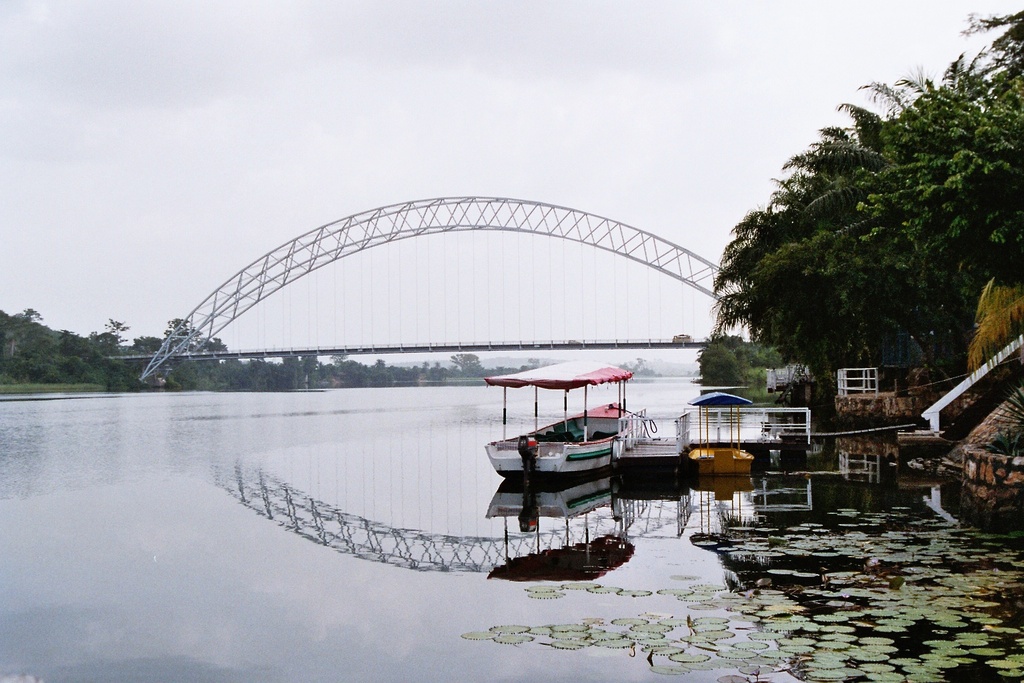
Adomi Bridge over the River Volta. Connecting eastern region and Volta region of Ghana