Upper East Region · Garu · near the Togo border
Wuriyanga Mosque
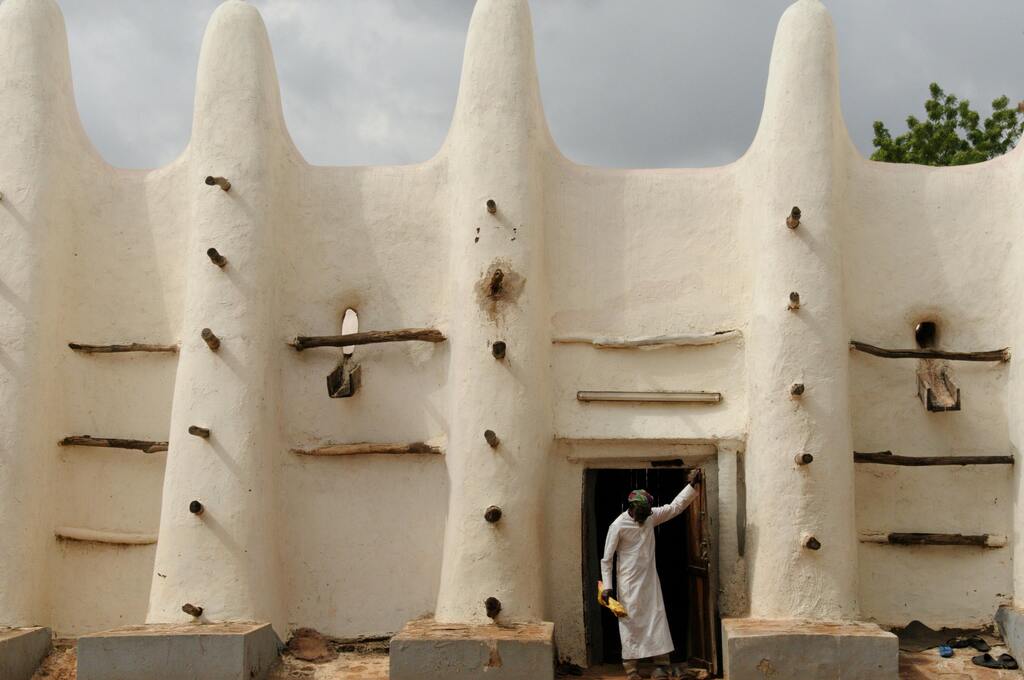
No whitewash, no buttresses, one tower, walls a metre thick. Wuriyanga, fourteen kilometres east of Garu, is the odd one out among Ghana's ancient mosques, and the only one that UNESCO's own nomination singles out as a mosque of the Djenné type. Almost nobody goes there. Right now, there are also good reasons to think carefully before you do.
- RegionUpper East
- Nearest townGaru, 14 km
- StyleDjenné type
- Age19th c. (by tradition)
- In useYes, daily prayers
- UNESCONamed, tentative list 2000
What you are looking at
Every other ancient mosque in Ghana follows the Sudanic pattern you know from Larabanga: whitewashed walls, conical buttresses bristling with timber ends, and two pyramidal towers. Wuriyanga breaks almost every one of those rules.
It is left in the natural colour of the earth. There are no exterior buttresses. The weight of the roof is carried instead by load-bearing walls about a metre thick and by more than a dozen massive earth columns inside. There is a single pyramid-shaped tower, over the mihrab, and the mihrab itself is not a niche in the wall but a small room with its own window and a door to the outside.
That is the Djenné type, named after the great mud-built city on the inland Niger delta in Mali. When the Ghana Museums and Monuments Board submitted the "Trade Pilgrimage Routes of North-Western Ghana" to UNESCO's tentative list on 17 January 2000, it described two kinds of mosque. As the example of the Sudanic type it named Larabanga. As the example of the Djenné type, "rectangular in plan, without buttresses, with load-bearing walls and a single tower over the mihrab", it named Wuriyanga, near Garu.
Who built it
The village tradition is clear on the builders even where it is vague on the date. Wuriyanga was founded by Mossi Muslims who came from the west, from the area around Bobo-Dioulasso in present-day Burkina Faso. The Kusasi, whose land this is, gave them space to settle, and the newcomers built their mosque the way mosques were built where they came from.
That is why Wuriyanga looks different. It was not modelled on Larabanga or on the Gonja mosques further west. It came with its builders from a different branch of the same West African tradition.
The mosque is generally dated to the nineteenth century. No excavation or scientific dating has been published, and visitors who asked locally in 2018 were told only that it is certainly more than a hundred years old. Treat any more precise date you read elsewhere with caution.
Even the name has a story. It is said to come from the Kusasi word widiyang, meaning "female horse", which changed over time into Wuriyanga.
A mosque that is still used
Unlike several of Ghana's ancient mosques, Wuriyanga has not been abandoned, replaced or pulled down. It is still used for daily prayers. On Fridays the congregation outgrows it: the men gather for the sermon, and the women pray in and around the old mud mosque.
An unwhitewashed earth building is still an earth building. Every rainy season takes part of the outer coat away, and it has to be renewed by the community. Wuriyanga's survival depends on the village, not on its mention in a UNESCO document that has not moved beyond the tentative list in twenty-six years.
Before you go: the Bawku situation
We will not pretend this is an easy trip at the moment. Wuriyanga lies east of Garu, and the usual road there runs through Bawku, the centre of a long-running chieftaincy conflict between Kusasi and Mamprusi that has turned violent again and again.
- A curfew has been in force in Bawku and its surroundings continuously since November 2021. It was most recently renewed from 24 November 2025, running from 8 pm to 5 am, together with a total ban on carrying arms or offensive weapons.
- The UK Foreign Office, in advice last updated on 2 July 2026, advises against all but essential travel to the Bawku Municipal area, and reports attacks on the Bolgatanga–Zebilla–Bawku road.
- Check the current situation before you plan anything. Read your own government's travel advice, ask people in Bolgatanga, and travel only in daylight and only with someone local who knows the road that week.
For many travellers, the honest answer for now will be: not this trip. The mosque has stood for well over a century. It will still be there when the road is safe again.
Visiting — what to expect
- Find the imam first. Ask him, or the person he sends, for permission to photograph and, if it is offered, to enter. Do not walk in on your own.
- Contribution. Visitors in 2018 were asked for GH¢10 per person. Expect that to be higher today, and bring cash in small notes. There is nothing to draw money from here.
- Where to find it. The mosque stands just south of the main road, by the village market.
- Avoid Friday midday prayers and prayer times generally. Dress modestly and ask before photographing people.
Getting there
From Garu
Wuriyanga is about 14 km east of Garu, towards the Togo border. Take a taxi or a motorbike taxi from Garu for the last stretch.
From Bolgatanga
Bolgatanga is the regional capital and the sensible base. See our pages on Bolgatanga's crafts and the Upper East Regional Museum. The road east runs via Zebilla and Bawku. Read the security note above first.
Where Garu sits
Garu is the only town in Ghana bordered by two other countries: Togo to the east and Burkina Faso to the north. Wuriyanga lies in that corner of the country.
By air
Fly Accra International Airport to Tamale and continue north by road. Current routes on ghanaflights.info. Accommodation on ghanahotels.biz.
Combine it with
- Bolgatanga — the regional capital, its baskets, leather and markets.
- Upper East Regional Museum — the region's history in one building in Bolgatanga.
- Paga crocodile ponds — sacred crocodiles on the Burkina Faso border.
- Pikworo slave camp — the northern end of the slave routes, near Paga.
- Larabanga and Nakore — the Sudanic type, to compare with Wuriyanga.
- The ancient mosques of the Savannah Region and of the Upper West.
- Burkina Faso — Bobo-Dioulasso, where Wuriyanga's founders came from.
Guided tours in Ghana
Wuriyanga cannot be booked in advance. Any visit is arranged locally, and only when the security situation allows. For the wider country, the tours below are bookable in advance.
The honest verdict
Architecturally, Wuriyanga is one of the most interesting buildings in northern Ghana: a living mosque of the Djenné type, brought here by Muslim settlers from Bobo-Dioulasso, and still in use every day. If you care about earth architecture, it is the one that completes the picture that Larabanga begins.
But it sits on the far side of Bawku, and the conflict there has not ended. Do not let a building, however remarkable, talk you into a road you have been advised against. Check first, go in daylight with someone local, or wait. Wuriyanga has waited more than a century for visitors. It can wait a little longer.