
Ghanas Inspiring History Unveiled
Discover Ghanas rich history, from ancient kingdoms to modern democracy, through vibrant festivals, stunning…
Ghana-Net.com · Greater Accra · Railways · Timetables checked October 2026
A hundred years ago you could board a train in Accra and ride it through the forest all the way to Kumasi. Today one train a day runs between Tema and Accra Central on a line built in 1954, with carriages made in Communist East Germany. Beside it, a brand-new line built for nearly half a billion dollars runs Polish trains on a few shuttles that do not reach their own terminus. This is the honest state of the railway in Greater Accra: what still runs, what it costs, and what has been left to rust.
Ghana has three passenger services running. Two of them are in Greater Accra. None of them runs often, and none goes anywhere near Kumasi. Always confirm times at the station: published timetables exist, but trains are cancelled at short notice.
Running · Mon–Sat
The old narrow-gauge line: the 1954 branch from Tema to Achimota, then the original main line into Accra Central. Stations: Community 1, Tema, Asoprochona, Batchona, Alajo, Achimota, Odaw (Circle), Accra Central, with some reports also listing Avenor.
One train each way: Community 1 at 06:00, Accra Central about 07:24. Back from Accra Central at 17:40, Community 1 about 19:14.
Fare: about 5 to 7 cedis, unconfirmed. Confirm at the counter.
Running · daily
The new standard-gauge Tema–Mpakadan line, with new track and new Polish trains, run as two shuttles that meet at Afienya. Stations: Tema Harbour, Tema Industrial Area, Ashaiman, Afienya, Shai Hills, Doryumu, Akuse Halt, Kpong, Senchi Halt, Adomi.
Tema Harbour → Afienya: 06:00, 07:00, 15:45, 17:30. Afienya → Adomi: 06:30, 15:00. Back to Tema: 07:00, 08:00, 16:20, 18:15, 18:30. Adomi → Afienya: 08:00, 17:15.
Fares: Tema Harbour–Afienya 15 cedis (child 7), Afienya–Doryumu 10, Afienya–Adomi 25, Tema Harbour–Adomi 40.
Not running
Partly rebuilt. In May 2026 the railway authority said it would take about 17 months to finish once funding was in place. No passenger trains.
No passenger trains
The historic main line from Accra to Kumasi carries no passengers. New standard-gauge lines to Kumasi and on to Paga in the north are planned, led by freight.
Tested in practice: the 15-cedi fare from Ashaiman eastwards on the new line is what we paid ourselves in 2026. Outside Greater Accra, the only other passenger service is the short Sekondi–Kojokrom–Takoradi shuttle in the Western Region, back in service since April 2026 at 5 to 7 cedis.
The Gold Coast's first railway did not start in Accra at all. It ran inland from Sekondi to the gold mines at Tarkwa from 1901 and reached Kumasi in 1903. Accra's own line, the "cocoa line", was begun in 1908, reached Mangoase in 1912 and Tafo in 1918, and finally arrived in Kumasi in 1923.
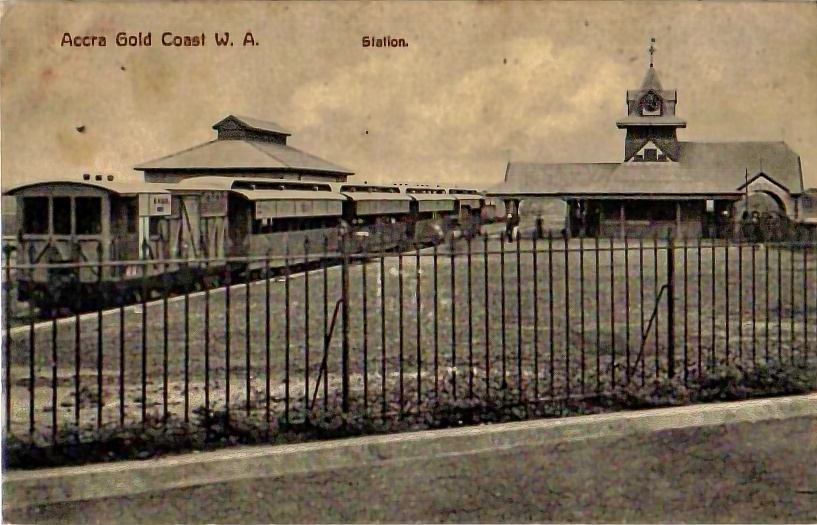
For decades, Accra station on the edge of the old business district, close to the busy Kantamanto market area, was where cocoa, timber and people came in from the interior. The postcard at the top of this page shows it in its early years.
When we photographed the station around 2001 and 2002, trains still squeezed through the densely built streets around it on very old track, with a watchman at the front of the locomotive. Cars parked in front, traders on the line, and a station that was already showing its age.
Through the 1990s and 2000s, the network ran down: old locomotives, worn track, few spare parts. One by one the long-distance services stopped. The night train between Kumasi and Takoradi via Obuasi, and the line from Accra to Kumasi, faded out of the timetable.
Accra Central is now the end of a single commuter service from Tema, one train in the morning and one back in the evening. The building still stands; the trains that made it important do not.
Asoprochona lies on the branch from Achimota to Tema, opened in 1954 to link the capital with the new port town. By the 2000s the branch had fallen out of use. In December 2004 work began to rebuild it, and on 20 December 2007 President John Agyekum Kufuor inaugurated the new commuter service between Accra and Asoprochona, at Asoprochona itself.
We photographed Asoprochona on 22 December 2007, just two days after the inauguration: the fresh station sign, the two tracks, and a train at the platform behind an old diesel locomotive still painted in its old colours.
The last stretch to Tema followed afterwards; President Atta Mills later opened the extended line. Around 2018 the Ghana Railway Company rehabilitated the narrow-gauge lines from Accra to Tema and Nsawam again, with its own workforce.
The photos in the photo viewer show the station as it was in that first week.
Greater Accra's railways tell the story of Ghana's foreign friendships in rolling stock: East German carriages from the Rawlings years, Chinese trains in the 2010s, and Polish trains on the new line.
The carriages at Asoprochona carry maker's plates from Bautzen, East Germany, 1986. Rail enthusiasts who rode the line report that its coaching stock was built in East Germany between 1985 and 1990. Bautzen, in Saxony, was home to the German Democratic Republic's big railway-carriage works, which supplied trains to friendly countries across Africa and Asia.
The Bautzen carriages came to Ghana under Rawlings' PNDC government, in the last years of the Cold War. The GDR disappeared in 1990; its carriages went on carrying commuters between Tema and Accra for decades. The Bautzen works itself passed through several owners after reunification and is now part of the French group Alstom.
By 2019 the Accra–Tema service was being run with diesel multiple units from China's CRRC. Which of the trains, East German or Chinese, you will ride today depends on what is serviceable on the day.
The new standard-gauge line uses two-car Regio160 diesel trains built by Pesa in Bydgoszcz, Poland. Ordered in September 2023, the first was unveiled in Bydgoszcz in February 2024 and travelled to Ghana by sea via Hamburg. Each carries up to 220 passengers at up to 120 km/h. Ghana holds an option for ten more.
The 97.7-kilometre standard-gauge railway from Tema to Mpakadan, on Lake Volta near Akosombo, was built from 2018 by the Indian company Afcons with credit from India's Export-Import Bank, at a cost of 447 million US dollars. Everything about it is new: the wider track, the bridge over the Volta, the stations and the trains.
President Akufo-Addo formally opened it on 22 November 2024, two weeks before the general election, with the two Polish trains. Passenger service was promised within days.
Six months later, the line was still idle. A test train had crashed in April 2024, and track components had been vandalised. Regular passenger trains only started in October 2025.
Even now, passengers cannot ride to Mpakadan, which is a freight terminal, and there is no Akosombo station. The last passenger stop is Adomi. To get there, change at Afienya.
On 30 July 2026 a train struck goats on the line and one of the two trains was taken in for repairs. When half your fleet is in the workshop, services shrink. On the old line, a train came off the rails after hitting cattle near Avenor in May 2026.
In all my years in Ghana, I never managed to travel by train. I was in Kumasi at a time when trains still ran from there to Takoradi. I was in Takoradi when the night train still left for Kumasi, all through the dark, by way of Obuasi. Each time, it did not work out. And then the trains were gone.
Somewhere in the forest between Koforidua and Nsawam, old steam locomotives were parked and left to stand. In Takoradi I photographed a carriage from the 1910s or 1920s, waiting, it seemed, for the scrap dealers. These are not museum pieces in a hall. They are a railway heritage rotting in the open.
— Remo Kurka
Imagine a fully restored colonial-era carriage, breakfast on board, a guide telling the story of the cocoa and the gold, running from Accra or Takoradi into the forest towards Kumasi.
Every December, thousands of diaspora visitors spend serious money on experiences in Ghana. A heritage journey by train to Kumasi would be among the most sought-after trips in West Africa. People would pay a great deal for it.
Old carriages and locomotives still exist, scattered, unprotected and decaying. Every year that passes, there are fewer of them.
Ghana's tourism authorities have never taken up the idea. Plenty of countries in Africa and elsewhere earn money from heritage railways. Ghana is letting its own heritage go for scrap.
The country spends hundreds of millions on new lines that barely run, while the old railway, which could pay its way as heritage, is being lost for nothing.
Tap any photo to open it large. Use the arrows or swipe to move through them.
On the new line you buy a rechargeable train card at the station, listed at 10 cedis for adults and 5 for children, and pay your fare with it.
Trains are few and do not wait. Be on the platform at least 10 minutes before departure, and ask at the station the day before if you can: times change, and breakdowns or animals on the line cancel services.
On the Tema–Mpakadan line, the trains run as two shuttles. If you are going beyond Afienya, towards Kpong or Adomi, you change trains there.
Never walk, sit or trade on the line. Report anyone throwing stones at trains or placing objects on the rails. Ghana Railway Development Authority: +233 30 273 2534.
The railway will not show you much of Accra. A guided tour will. Entrance fees are included in the tour price; tips are not included but are always welcome.
Updated and fact-checked: 15 October 2026. Timetables and fares from the Ghana Railway Development Authority and Ghana Railway Company websites, as collected by the commuter app Troski (checked 14 October 2026); Railway Technology on the Accra–Tema project and the 2007 inauguration; International Steam Pages; Railway Gazette International (2019, 2024); Rolling Stock World and Railmarket on the Pesa trains; Graphic Online and Adom Online on the Tema–Mpakadan line (2024–2025). Times change: always confirm at the station. Photographs and postcard: Remo Kurka.