Bono East Region · Techiman Municipality
Buoyem Caves
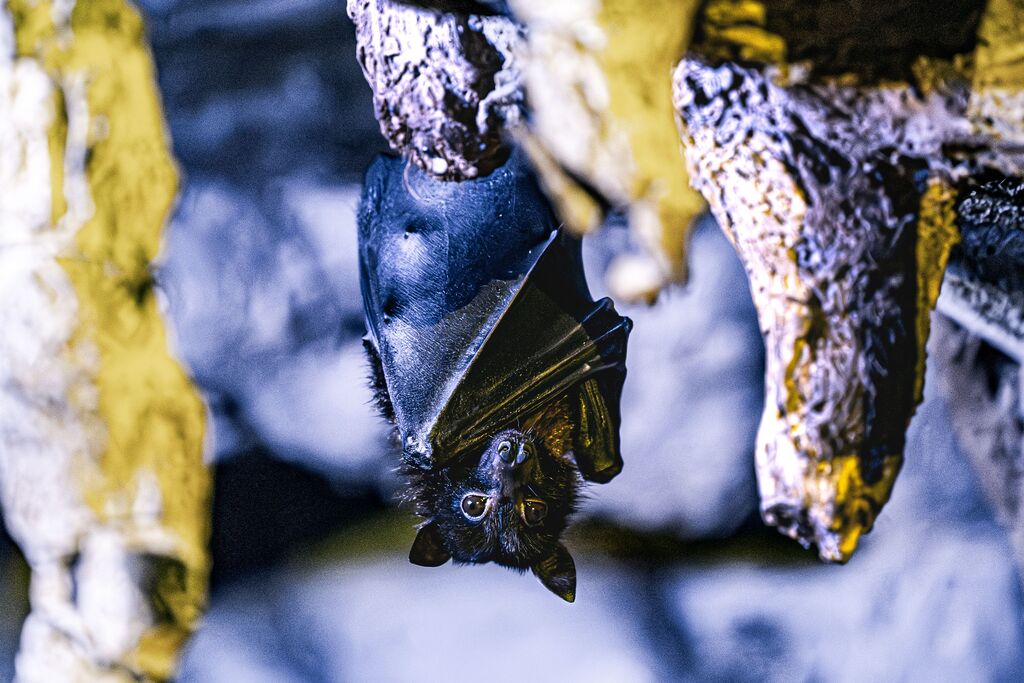
A village at the bottom of a sandstone canyon, walled in on three sides. Its name means "inside the stone". Three caves, a fruit bat colony that darkens the evening sky, two waterfalls, a sacred forest — and almost no visitors.
- RegionBono East
- From Techimanapprox. 13 km
- Sacred groveMprisi, approx. 350 ha
- Full hike4 – 5 hours
- WaterfallsBibiri, Ohemaa
- Name meansInside the stone
A canyon nobody expects in Bono East
Most travellers know Bono East as the long flat stretch of highway between Kumasi and Tamale. Buoyem is the correction. The road out of Techiman runs through farmland and then drops, and the village appears at the foot of layered sandstone cliffs rising on three sides. You come down into Buoyem rather than arriving at it.
The rock is soft and full of holes. Wind and water have cut overhangs, tunnels and chambers into it, and three of those chambers are large enough to be called caves in the full sense — dark, high and occupied. Along the trails the guides show you a rock shaped remarkably like the outline of the African continent, another like an open umbrella, and a sheltering overhang the community calls Canopy Rock, under which you can camp.
Around the canyon lies the Mprisi Sacred Grove, some 350 hectares of dry semi-deciduous forest. That precision matters, because older descriptions of Buoyem call it rainforest. It is not. It is the drier, more open forest of Ghana's transition zone, where the southern forest begins to give way to savannah — and it is protected not by a reserve boundary but by the fact that it is sacred. Below the cliffs runs the Bibiri River, with two falls on it: Bibiri Falls, and Ohemaa Falls, the Queen Mother's falls.
A refuge from the Asante wars
To understand why a community lives inside a canyon, you need the Bono. Their state, with its capital at Bono Manso north of Techiman, was the first great Akan kingdom — older than Asante, and rich on gold and kola long before Kumasi rose. In the early eighteenth century the expanding Asante kingdom conquered it.
What happened next is told at Buoyem the way oral history is always told: by the people whose ancestors lived it. According to the guides, the caves became a place of retreat after the defeat — somewhere people could withdraw into the rock, hidden, defensible, with water close by. Over time the caves took on the character of sacred places, and the forest around them with it.
The details vary with the teller, and no written record from the time settles them. The outline is consistent, and it is the reason the grove is still standing when so much forest around Techiman is not. People do not cut trees in a place where their ancestors were saved.
The hike
The full circuit · 4 to 5 hours
A proper walk, not a stroll. The paths climb and drop over the sandstone, and in places you scramble with your hands or squeeze through narrow gaps between boulders. Nothing requires climbing skill. Everything requires shoes with grip. The usual route takes in the caves, Africa Rock and Umbrella Rock, the viewpoints above the canyon, and the walk down through the Mprisi forest to Bibiri Falls.
Shorter, or overnight
Ask for a shorter version and the guides will tailor it — the caves alone are worth the trip. Or go the other way: a two-day walk with a night camped under Canopy Rock. That is the way to see the bats leave the cliffs at dusk and come back before dawn.
Be realistic about the falls. Like almost every waterfall in the middle belt, Bibiri depends on the rain. In the wet months it runs properly. At the height of the dry season it can shrink to a thin stream over the rock. Go for the canyon and the caves, and treat a full waterfall as a bonus.
The bats — and the rules that go with them
The bats of Buoyem are fruit bats of the genus Rousettus — written locally, and on almost every Ghanaian tourism site, as "Rosetta". They roost in the caves in enormous numbers. Walk into the largest chamber and the ceiling moves. Stand outside at dusk and they pour out of the rock over the canyon for many minutes. It is one of the great wildlife spectacles of Ghana, and almost nobody has heard of it.
It is also a place to behave carefully, and that is said here because other guides will not say it at all. The genus Rousettus includes the Egyptian fruit bat, which the World Health Organization identifies as the natural host of Marburg virus. Ghana confirmed its first Marburg cases in 2022, in the Ashanti Region. None of this means the Buoyem colony is infected or that a visit is dangerous. It means bat caves anywhere in West Africa call for a few simple rules:
- Do not touch bats, living or dead, and do not handle droppings.
- Wear a hat inside the caves. A light face mask is sensible in the largest chamber.
- Do not go in with open cuts or grazes on your hands or arms.
- Do not eat or drink inside the caves, and wash your hands well when you come out.
- If you develop a sudden high fever within three weeks, tell a doctor you were in a bat cave.
Follow those rules and Buoyem is no more risky than any other cave. Ignore them, and you are relying on luck.
Getting to Buoyem
From Techiman
From the Wenchi roundabout or the Shell station in central Techiman, take the Wenchi road north for about 2 km and turn right at the Buoyem signpost. After about 2 km keep right at the Y junction, pass through Mesidan, and Buoyem is about 9 km further. Older texts give the distance as 8 km. It is 8 miles — roughly 13 km.
Without a car
Taxi or trotro from the Techiman lorry station. A taxi can be asked to come back at an agreed time — settle the price for both legs before you set off, and do not pay the return fare in advance.
From Kumasi and Accra
Techiman is around 120 km north-west of Kumasi on the main road north, two to three hours depending on traffic leaving the city. From Accra it is a long day, and almost everyone breaks it at Kumasi.
By air
Fly from Accra International Airport to Kumasi and continue by road. Current routes and airlines are on ghanaflights.info.
Where to stay
Buoyem has a small community guesthouse: five simple rooms with one bed each, mosquito netting, electricity, shower and flush toilet. Sheets are provided; towels are not. Camping is possible and the guesthouse can supply a tent. Home stays in the village can be arranged at the visitor centre. There is no restaurant — meals are cooked to order by women in the village, so ask early if you arrive late in the day.
For more comfort, sleep in Techiman and come out for the day.
When to come
Dry season · roughly December to February
Easier underfoot and better for the scrambling sections. Hotter, hazier with harmattan, and the waterfall at its weakest.
The two rainy seasons
Buoyem gets rain from March to July and again from September to November. The falls run, the forest is green — and the rock is slippery, so take the scrambling slowly and bring rain gear.
Buoyem celebrates a two-week Yam Festival at some point between September and December: the chief carried in a palanquin, the stools of the chief and queen mother ritually anointed at the stream, drumming and dancing. Dates change each year — contact the community before planning around it.
Worth combining
- Techiman — the regional capital, heir to the Bono state, and one of the largest food markets in West Africa.
- Tanoboase Sacred Grove — the origin place of the Bono, a rock shrine with a hideout and a watchtower used in the same wars that sent people into Buoyem's caves.
- Bono Manso — the old Bono capital, and a sorting station where captives were graded before being sent to the coast.
- Forikrom — the Boten shrine and caves, remembered as a refuge for women and children in the wars with Asante.
- Boabeng-Fiema Monkey Sanctuary — north of Nkoranza, monkeys protected by taboo and given funerals when they die.
- Kintampo — the falls, and the marker for the geographical centre of Ghana.
Practical notes, no sugar-coating
- Go with a guide. The routes are unmarked, the caves are dark, and the sacred sites carry rules you will not know. Everything is arranged at the community visitor centre.
- Fees are paid at the visitor centre. Ask for the current rate and a receipt.
- Cash. There is nothing to draw money from in Buoyem. Bring small notes from Techiman.
- Bring shoes with grip, a hat for the caves, a torch, water, and rain gear in the wet seasons.
- Photography at the sacred sites — ask first, and accept the answer.
- Time. A full day at minimum. Overnight if you want the bats at dusk.
Checked September 2026. The history of the caves is oral tradition and is given as such. Fees, festival dates and facilities change; confirm with the community before travelling.
The honest verdict
Go. Buoyem is one of the most underrated places in Ghana: a real landscape, a real history, a community that runs its own tourism, and a wildlife spectacle that would be on every itinerary if it were near the coast.
Go knowing what it is. The facilities are basic, the walk is physical, the waterfall may be a trickle and the bats demand a little discipline. None of those are reasons to stay away. They are the reasons the place still feels like itself.