Upper West Region · Wa · Wa West
The Ancient Mud Mosques of the Upper West: Wechiau and Dondoli
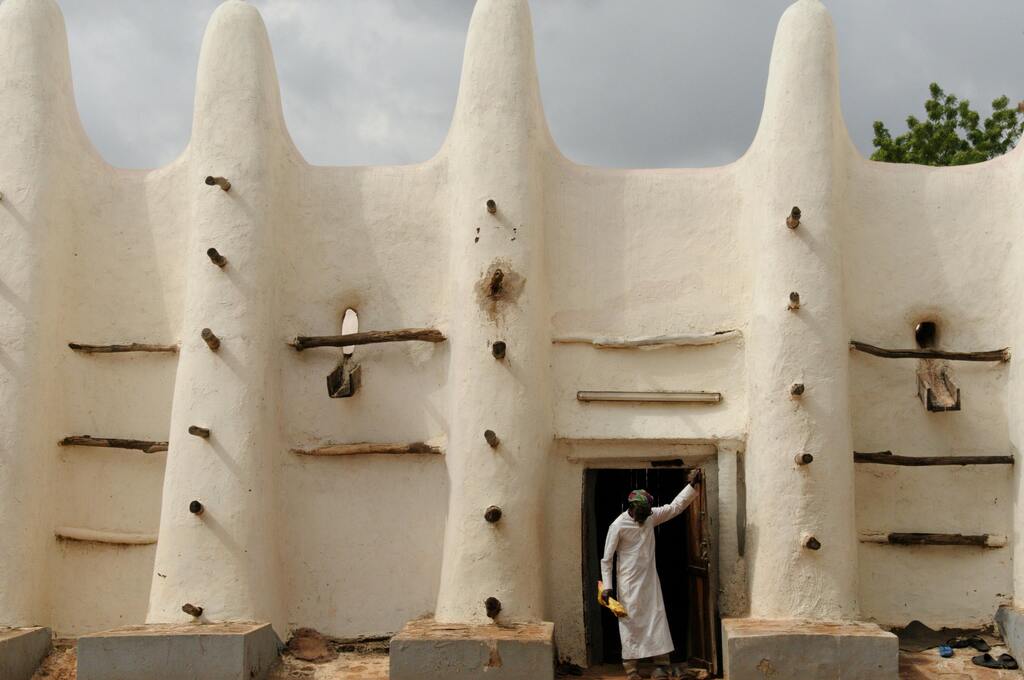
Around Wa stand the earth mosques of the old Waala kingdom. Nakore is the one visitors see. Wechiau and Dondoli are the ones that were nearly lost: one abandoned in the 1990s, the other left to crumble in the middle of town. Both were taken into a restoration project in 2023 and 2024. This is what is known about them, and what is only claimed.
- RegionUpper West
- Regional capitalWa
- On this pageWechiau · Dondoli
- StyleSudanic, earth-built
- Dateslate 18th–19th c.
- Restoration2023–24 project
The mosques of the Waala kingdom
Wa was never only a chief's town. Power in the old Waala state rested on three pillars: the Wa-Na in his palace, the Imam at the Friday Mosque, and the custodian of the earth shrine. Islam arrived here with Mande traders and scholars from the north and west, from the world of Mali, Kong and Bobo-Dioulasso, and the mosques they built are the most visible trace of that history.
Dr Mahmoud Malik Saako, an archaeologist with the Ghana Museums and Monuments Board, names four earth mosques of the former Waala kingdom: Nakore, Wechiau, Dondoli and Nyouli Paani. The last of these barely appears in any published source. Nakore, a few kilometres south-west of Wa, is the one that has been kept in use and in good order, and it has a page of its own. This page is about the other two.
An earth mosque survives only as long as people keep re-plastering it. Each rainy season washes part of the outer coat away. When the community stops renewing it, or covers the walls in cement, which traps moisture inside, the building is lost within a few years. Wechiau and Dondoli are what happens when that work stops.
Wechiau — abandoned for thirty years
Wechiau lies west of Wa, towards the Black Volta and the Burkina Faso border. Most visitors who come here come for the hippo sanctuary and never notice the mosque.
According to Dr Saako's research, the mosque was founded by Imam Fali, son of Mallam Umar Baro, most probably in the late eighteenth century. That date comes from counting generations in the family's genealogy, not from excavation or scientific dating. The building has six earth pillars carrying a flat earthen roof, a minaret, a mihrab, and four entrances separating the spaces for men and women. Its style mixes the Sudanic buttressed wall with a single tower closer to the Djenné type.
The mosque was abandoned in the 1990s, when a new mosque was built beside it. Visitors in 2018 found the roof long since collapsed, a temporary zinc roof itself abandoned, the tower gone and the walls eroding, with cement plaster peeling away from the earth beneath. They thought it beyond repair.
It was not. In early 2024 the mosque was restored under a project funded by the Mellon Foundation, hosted by the Heritage Management Organization and implemented with the Ghana Museums and Monuments Board. The work used the old materials: sun-dried earth bricks, the local plaster ingredient known as vuolung, and shea butter residue as a waterproof finish, following UNESCO guidance for earthen architecture.
Dondoli — the ruin in the middle of Wa
Dondoli is a quarter on the edge of Wa, and its old mosque was for years a ruin that even some residents struggled to find, hidden among houses, with a modern block mosque built to take its place. The Nubuke Foundation photographed it in 2021 as "a crumbling legacy".
There are two accounts of who built it, and both deserve a hearing:
- The family tradition. Malaam Fuseini of Dondoli told visitors in 2018 that his great-grandfather Karimafa, a migrant from Mali, built the mosque, and that it was once called the Karimafa Mosque. He added that his grandfather walked to Mecca and back, a journey of twenty-two years, and returned with a complete Qur'an for the community.
- The researcher's account. Dr Saako records that construction was supervised in the later nineteenth century by Alhajj Mohammed, with the building designed by Karamoko Siddiq, also known as Abdullahi Watara.
The two need not contradict each other. Oral tradition often names the founding ancestor, while a written study names the men who actually raised the walls. What both agree on is a nineteenth-century mosque, built in the Sudanic manner with direct links to Mali and to Kong in present-day Côte d'Ivoire.
How a repair finished it off. According to Dr Saako, a community restoration in 2005 used materials that were incompatible with the earth structure, and the mosque deteriorated sharply afterwards. It is the clearest example on this page of the cement problem: done with good intentions, and more damaging than doing nothing.
Dondoli was the second mosque in the same 2023–24 Mellon Foundation project, restored with earthen materials and with the community involved.
What we do not know yet
The project's stated aims were to restore both mosques, open them to the public, put up signposts, and set up mosque management committees to take care of maintenance afterwards. The research booklets on Wechiau and Dondoli were published in 2024.
What we could not find, as of September 2026, is any public report on how the finished work has held up through two rainy seasons, whether the committees are working, or whether visitors are actually being received. That is the test of any earth restoration: not the day it is handed over, but the third wet season after it.
If you have been to Wechiau or Dondoli since 2024, we would like to hear what you found. The Monuments Board's own list still describes these mosques under the heading "Northern Region", although the Upper West has been a separate region since 1983.
Visiting — what to expect
- Start at Nakore. It is the easiest of the three to visit, the best kept, and it shows you what Wechiau and Dondoli looked like when they were in use.
- Ask the imam or elders first. These are community buildings, not museums. Explain why you have come and ask before photographing anything.
- Assume you will not go inside unless you are clearly invited. Interior access at the old mosques is normally for Muslims only.
- No fixed fees. Bring cash in small notes for a contribution. It goes into the maintenance these buildings depend on.
- Dress modestly, avoid prayer times, and ask before photographing people.
- Guides can be arranged through the regional tourism office in Wa.
Getting there
Dondoli
On the edge of Wa itself. Take a local guide or a taxi driver who knows the quarter. The old mosque is hidden among houses and easy to miss.
Wechiau
West of Wa, on the way to the Black Volta. Combine it with the Wechiau hippo sanctuary and make a full day of it. A vehicle of your own makes this far easier.
From the south and from Larabanga
Wa is a long drive from Kumasi. If you are coming from Larabanga and Mole, the mosques of the Upper West are the natural next stage of the same journey.
By air
Check current flights to Wa and Tamale from Accra International Airport on ghanaflights.info. Accommodation for the region on ghanahotels.biz.
Combine it with
- Nakore Mosque — the best-preserved earth mosque of the Upper West, just outside Wa.
- Wa — the regional capital, seat of the Wa-Na, and the base for everything on this page.
- Wechiau Hippo Sanctuary — the Black Volta, and another project run by the community.
- Gbele Resource Reserve — the Upper West's wild side.
- Larabanga Mosque — the oldest of them all, in the Savannah Region.
- The ancient mosques of the Savannah Region — Bole, Banda Nkwanta, Maluwe and the demolished Dakrupe.
- Burkina Faso — across the border, where many of the builders' families came from.
Guided tours in Ghana
The mosques of the Upper West are visited independently and arranged locally in Wa. For the wider country, the tours below are bookable in advance.
The honest verdict
Unlike the Savannah Region, the Upper West has a story of rescue, not only of loss. Two mosques that visitors in 2018 thought beyond saving were rebuilt in earth, with foreign money, a Monuments Board archaeologist, and the communities involved. That deserves credit.
But it deserves checking too. Dondoli was already "restored" once, in 2005, and that repair helped destroy it. An earth mosque is not saved by a grant. It is saved by whoever re-plasters it in the next dry season, and the one after that. Go to Nakore first, then see Wechiau and Dondoli with your own eyes, and judge for yourself whether the work is holding.