Savannah Region · Bole · West Gonja
The Ancient Mud Mosques of the Savannah Region
Everybody stops at Larabanga. Almost nobody drives on to Bole, Banda Nkwanta or Maluwe, three more earth-built mosques in the same tradition, all still in use. A fourth, at Dakrupe, no longer exists: it was pulled down in 2010 to make room for a cement building, and there is not a single photograph of it online. This page is about all four.
- RegionSavannah
- Regional capitalDamongo
- Mosques3 standing · 1 demolished
- StyleSudanic
- Dates17th–19th c. (by tradition)
- UNESCOTentative list since 2000
One tradition, strung along the old roads
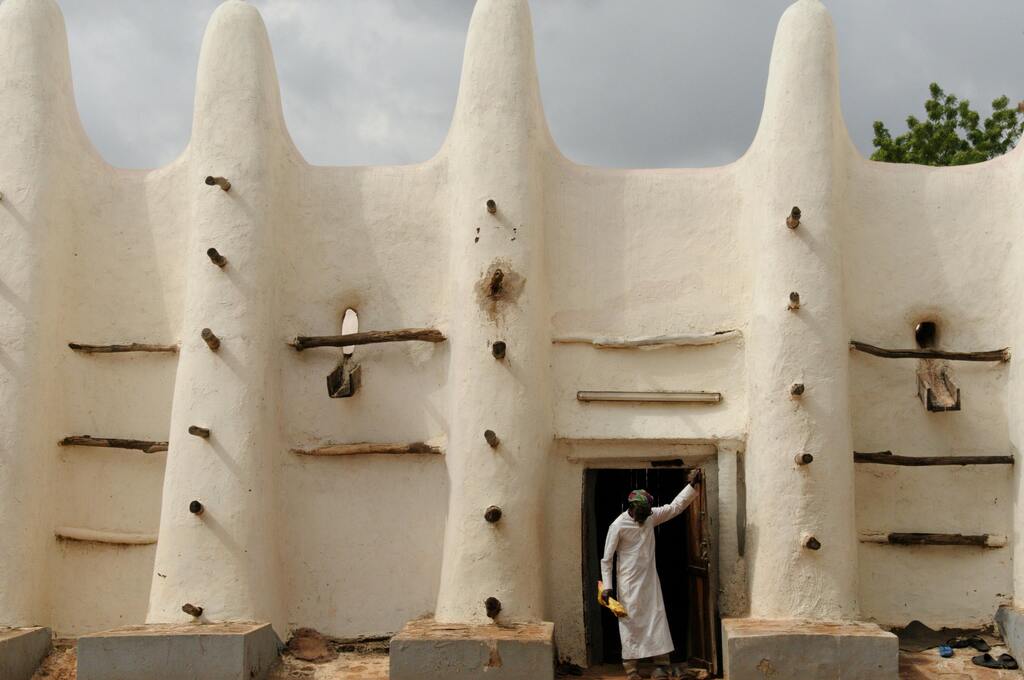
These mosques were not built as monuments. They were built by Muslim traders, scholars and migrants moving south from the old Sudanic states of the Niger bend, along the routes that carried gold, kola and salt between the forest and the Sahel. Where a community settled, it raised a mosque in the building language it knew: sun-dried earth over a timber frame, a flat mud roof, walls braced by conical buttresses, and two pyramidal towers, one over the mihrab facing Mecca and one as the minaret.
Larabanga is the best known of them and the one every tour bus stops at on the way to Mole National Park. But in the Savannah Region alone the Ghana Museums and Monuments Board lists four more: Bole, Banda Nkwanta, Maluwe and Dakrupe. Together with Larabanga they form the densest cluster of ancient mosques in the country.
Earth buildings only survive if people keep re-plastering them. Every rainy season washes part of the outer coat away, and every dry season the community climbs the projecting timbers to renew it. When that work stops, or when the walls are rendered in cement, which traps moisture inside, an earth mosque can be lost within a few years. Everything on this page comes down to that one fact.
Bole — the mosque that fell and was rebuilt by its own people
Bole's old mosque stands in Nyimange, a quarter of Bole town. The community says it was built by their ancestors roughly four hundred years ago, shortly after Larabanga and closely modelled on it: whitewashed earth, buttresses, two towers. As with Larabanga, that age is tradition rather than a scientifically tested date, but it is the tradition of the people who have maintained the building for generations.
On Sunday, 17 September 2023, after days of heavy rain that also washed away the Doli bridge in the Bole District, part of the mosque collapsed. For a few hours social media reported that Larabanga had fallen. It had not. It was Bole.
What happened next is the part worth knowing. The sons and daughters of Bole raised the money themselves and rebuilt the mosque the old way, with no cement: earth from anthills, which is known to stand up to torrential rain, mixed with cow dung, oil and tree starch. By February 2024 the first phase was complete and the building was back to its original form, with painting and finishing still to come.
And the Monuments Board? According to the community, officials of the Ghana Museums and Monuments Board came after the collapse and pledged support for a reconstruction to preservation standards. When the Daily Graphic visited in February 2024, the community said it was "yet to hear from them". The mosque is standing again because Bole rebuilt it, not because the state did.
Banda Nkwanta — the tallest towers
Banda Nkwanta's mosque is generally dated to the eighteenth century and is attributed to Muslims who came south from the western Sudan. Its two pyramidal minarets are the reason to come: the eastern tower rises to about 13 metres, which makes them, by most accounts, the tallest of any earth mosque in Ghana. The Monuments Board's own entry describes it simply as having "very tall parapets", which undersells it considerably.
The mosque is in use. Photographs taken by visitors in recent years show it whitewashed and maintained, but the same rule applies here as everywhere else on this page: its survival depends on the community, year after year.
Maluwe — the missionary's mosque on the Bole road
Maluwe lies on the Bole road in the West Gonja area, east of Bui National Park. Local tradition credits the mosque to a Muslim missionary from Mali who, on his way through the region, is said to have built five earth mosques along his route. No reliable construction date has been published.
The building has two pyramid-shaped minarets, heavy parapets and box-shaped buttresses on its western side, a slightly different profile from the conical buttresses of Larabanga. It is in use, and among the least visited historic buildings in the whole country.
Dakrupe — the one that is gone
Dakrupe lies between Bole and Larabanga. Its nineteenth-century mosque was built in the same style as Larabanga, smaller but clearly of the same family, and it appears on the Ghana Museums and Monuments Board's list of ancient mosques to this day.
It does not exist. The mud mosque at Dakrupe was torn down around 2010 to make room for a larger modern building in cement blocks. The imam of Maluwe confirmed the demolition to researchers who went looking for it in 2018. They could find no photograph of the old mosque anywhere online, and neither could we.
Nobody should be quick to judge the village for that. A growing congregation needed a bigger building, and nobody offered them a way to keep the old one. But it means that an official list of Ghana's protected ancient mosques still carries a building that has not stood for roughly sixteen years. If you have a photograph of the old Dakrupe mosque, it may be the only one there is.
What UNESCO and the Monuments Board say — and when they said it
On 17 January 2000 the Ghana Museums and Monuments Board submitted these mosques to UNESCO's World Heritage tentative list as part of the "Trade Pilgrimage Routes of North-Western Ghana". The nomination describes the Sudanic type exactly as you find it at Bole, Banda Nkwanta and Maluwe: timber-frame structures with flat mud roofs, buttresses crowned with pinnacles, and usually two pointed towers.
That was twenty-six years ago. The entry has never gone further than the tentative list. Its text still speaks of "Brong Ahafo", a region that was split up in 2019, and the Monuments Board's own page is still titled Ancient Mosques of the Northern Region, although since 2019 not one of these four has been in the Northern Region. They are in the Savannah Region.
Of the nine ancient mosques on that list, one (Dakrupe) has been demolished, one (Bole) collapsed and was rebuilt by its community, and two in the Upper West stand partly in ruins. The list has not been updated to say so.
Visiting — what to expect
- These are working mosques, not museums. There is no ticket office, no guide booth and no published fee. Go to the imam or the elders first, explain why you have come, and ask permission before you photograph anything.
- Assume you will not go inside. At Larabanga non-Muslims are not admitted, and you should expect the same here unless you are clearly invited.
- Bring cash in small notes for a contribution to the mosque. It goes into exactly the maintenance that keeps these buildings standing. There are no ATMs in the villages.
- Dress modestly, avoid prayer times, and ask before photographing people.
- Hire a driver who knows the area. Public transport runs on the main roads, but the villages are easier to reach with your own vehicle and someone who can ask the way in Gonja.
- Dry season only, realistically. The same rains that brought down Bole's mosque in September 2023 also took out a bridge in the district.
Getting there
From Larabanga and Mole
The obvious way to see these mosques is as an extension of a Larabanga and Mole trip. Dakrupe lies between Larabanga and Bole, and Maluwe is on the Bole road. Give it a full extra day.
From Damongo
Damongo, the regional capital, is the practical base for this whole corner of the country: fuel, cash and somewhere to sleep.
From Tamale
Most travellers come in through Tamale and drive west via Damongo. Allow a long day if you want to reach Bole and back.
By air
Fly Accra International Airport to Tamale and continue by road. Current routes on ghanaflights.info. Accommodation for the region on ghanahotels.biz.
Combine it with
- Larabanga Mosque — the oldest and best known of them all, and the model the others were built on.
- Mole National Park — minutes from Larabanga, and the reason most people are in this region at all.
- Damongo — the regional capital and base for the area.
- Nakore Mosque — the same architecture in the Upper West, near Wa.
- Salaga — the other side of the same trade routes, and a far harder place to visit.
- All sixteen regions and their capitals
Guided tours in Ghana
The mosques of the Savannah Region are visited independently and arranged locally. For the wider country, the tours below are bookable in advance.
The honest verdict
If you have come as far as Larabanga, go on to Bole. It is a longer day, there is nothing organised about it, and nobody will sell you a ticket. What you get instead is a four-hundred-year tradition of earth building that a small town saved with its own money and its own hands, while the institution responsible for it was still making promises.
And remember Dakrupe. It is still on the official list, and it has been gone for sixteen years. These buildings are not protected by being listed. They are protected by the people who re-plaster them every dry season, and by visitors who come, ask permission, and leave something behind for the work.