Savannah Region · Regional capital
Damongo
Everyone drives through Damongo. Almost nobody stops. That is a mistake — and once you understand what this dusty little town actually is, you will not make it.
- RegionSavannah
- Capital since12 Feb 2019
- To Mole parkapprox. 24 km
- To Tamaleapprox. 150 km
- Best monthsNov – Mar
- Also known asGonja capital
A capital that most visitors treat as a petrol stop
Here is the thing tour operators do not tell you. Damongo is the capital of the largest region in Ghana — the Savannah Region covers around 34,790 square kilometres, bigger than Belgium — and it is also the emptiest. Roughly 650,000 people are spread across all of that space. You feel it the moment you leave the main road: distance opens up, the bush takes over, and the horizon stops being interrupted.
Most travellers experience Damongo as a fuel stop and a junction sign on the way to the elephants. They pass the market, glance at the cathedral, and keep driving. Fair enough — Mole is the reason people come north. But Damongo is not just a waypoint. It is the seat of the Gonja Kingdom, one of the oldest and most consequential states in northern Ghana, and the town where the Yagbonwura, the Gonja overlord, holds court.
Be honest with yourself about what you are getting: this is a small, hot, low-rise town with red dust on everything and limited tourist infrastructure. It is not Cape Coast. What it offers instead is a base — and a genuine northern Ghanaian town going about its business, which is increasingly hard to find.
The Gonja story, in short
The Gonja trace their origins to the Songhai Empire, arriving in what is now Ghana in the sixteenth century. The kingdom as it exists today is credited to Ndewura Jakpa, the warrior-founder whose name still carries weight across the whole north. When six new regions were created after the December 2018 referendum, the petition that produced the Savannah Region came from the Gonja Traditional Council itself. This region exists because the Gonja asked for it.
That history sits in the middle of town at Jakpa Palace, the Yagbonwura's official seat, built in a Malian architectural style that tells you exactly which way the old trade and cultural routes ran — north and east across the Sahel, not south to the coast. A rebuild was commissioned in 2024, so check what stage the work has reached before you plan a visit. As with any palace in Ghana: arrange your visit through the appropriate channels, dress respectfully, and always ask before photographing.
Getting to Damongo
By road from Tamale
The usual approach. Around 150 km, and realistically three to four hours depending on the state of the road and how often you stop. Ignore anyone who quotes you two. The route runs via the Fufulso junction, then west.
From Accra or Kumasi
Roughly 670 km from Accra, 430 km from Kumasi. This is a full day of driving and then some. Nearly everyone breaks the journey at Kumasi or Tamale — do the same. Arriving in the north after dark on unfamiliar roads is not worth it.
By air
Fly Accra to Tamale, then drive. There is also an airstrip at Mole itself, used mainly by charters and lodge transfers rather than scheduled flights.
Without your own vehicle
Buses and shared transport run from Tamale, but departures thin out badly in the afternoon. Travel in the morning. Once you are in Damongo, getting the final stretch to the park gate means a taxi or a lodge transfer — arrange it in advance, not on arrival.
Mole National Park — the reason you came
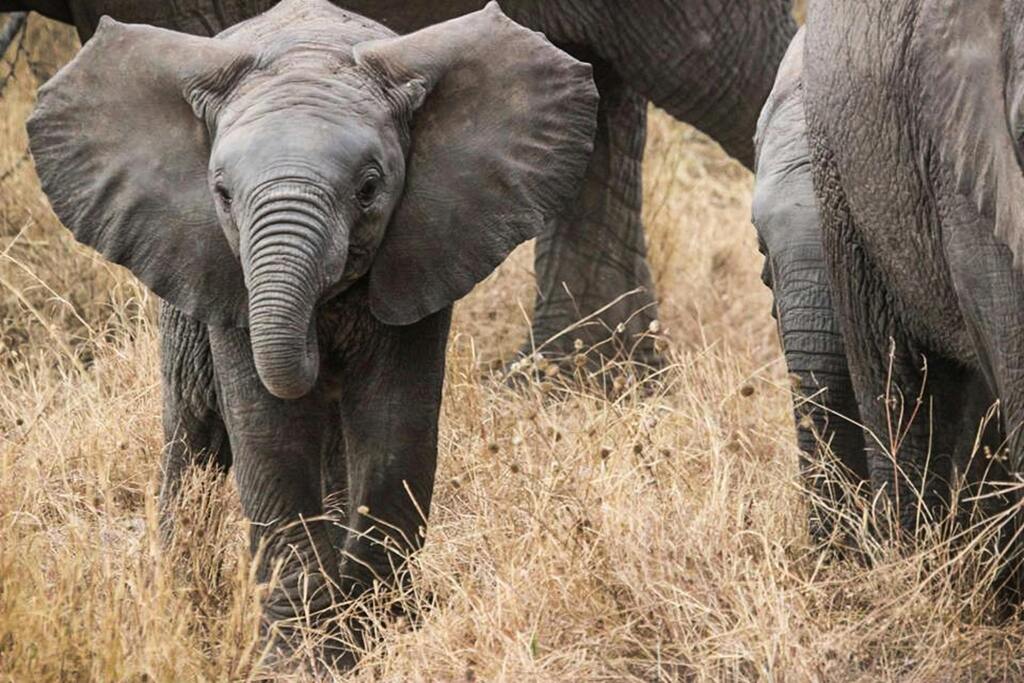
About 24 km from town, reached through the village of Larabanga, is Ghana's largest protected area: roughly 4,840 square kilometres of Guinea savannah holding the country's biggest elephant population, along with buffalo, kob, warthog, baboon, antelope, hundreds of bird species and, rarely seen, leopard.
What makes Mole genuinely unusual in Africa is the walking safari. You go out on foot with an armed ranger. Not in a vehicle, not behind glass — on the ground, at the animals' level, close enough that you will remember it properly. In the dry season the elephants come to the waterholes below the escarpment and you can watch them from the viewing platform with a cold drink in your hand.
Larabanga Mosque — stop, do not just drive past
The road to the park gate takes you straight through Larabanga, home to one of the oldest mosques in West Africa. Whitewashed mud and timber, buttressed walls, protruding support beams — the Sudanese-Sahelian style built the same way for centuries. Local tradition dates it to 1421.
It is small. Photographs make it look larger than it is, and some visitors are briefly disappointed. Give it ten minutes and that passes: you are standing in front of a building that has been maintained continuously by the same community for roughly six hundred years, in mud, in a climate that destroys mud. That is the achievement.
A practical note, stated plainly because you would rather hear it from us: guiding at Larabanga is informal and the request for payment can be pushy. Agree a figure before anyone starts explaining anything, and non-Muslims should expect to view the exterior only.
Mognori Eco Village
Roughly 10 km from the park, Mognori is a community-run project rather than a resort — and it is the antidote to a purely wildlife trip. A canoe safari along the river, guided bush walks, drumming, and a chance to see how a village on the edge of a national park actually lives, including the uncomfortable part: elephants raid crops here. Conservation looks very different when you farm next to it.
Money spent here stays here. If you have half a day spare, this is the better use of it.
Where to stay
Most visitors sleep at the park rather than in Damongo. Inside Mole you will find the long-standing motel by the escarpment — basic rooms, chalets, camping, a restaurant and a pool with the best view in northern Ghana — and, at the higher end, a purpose-built luxury lodge. In Damongo town itself, accommodation is simple guesthouse standard: clean enough, cheap, fine for a night, not somewhere you will linger.
Book ahead between November and February. This is not a formality. Peak season fills the limited beds at Mole, and turning up on spec after four hours of driving is a genuinely bad evening. Confirm by phone; email is not always answered.
When to come
Dry season · November to March
The right answer for almost everyone. Water is scarce, so animals concentrate at the waterholes and sightings are far more reliable. Roads are passable. Expect harmattan haze in December and January — dry, dusty air and softened light. Hard on the throat, excellent for photographs.
Wet season · April to October
Green, dramatic and almost empty of other visitors. But the wildlife disperses because water is everywhere, sightings drop off, and some tracks turn difficult. Come now for landscape and solitude, not for a guaranteed elephant.
Watch also for Damba, the major festival of the Gonja and other northern peoples, with drumming, dancing and horsemanship. It follows the Islamic calendar, so the date moves every year — check before you build a trip around it.
Worth the detour nearby
- Salaga — a name that should be far better known. Salaga was a major market of the trans-Saharan slave trade, and the slave market site and wells are still there. Heavy, essential, and almost entirely absent from the standard tourist circuit.
- Daboya — the centre of fugu smock weaving, the striped cloth worn across the north. Watch it being made on narrow-strip looms.
- Bole — a substantial western town, and the home town of President John Dramani Mahama.
- Buipe — trading settlement on the Volta, and the northern end of the lake transport route.
Practical notes, no sugar-coating
- Cash. Bring it. ATMs exist in Damongo but do not depend on one working the day you need it. There is nothing at the park gate.
- Fuel. Fill up in Damongo or Tamale. Do not plan on finding fuel further west.
- Heat. March and April are punishing. Early morning and late afternoon are the only comfortable hours, which happens to be when the animals move anyway.
- Malaria. Northern Ghana, year-round. Take the precautions seriously.
- Roads. Improved considerably in recent years, but conditions change. Ask locally rather than trusting a mapping app.
- Time. Give the north three nights minimum. Driving eight hours for a single game walk is a waste of your money and the journey.
The honest verdict
Damongo will not win you over with charm. It is a working administrative town, and it is dusty for half the year. Come here for what surrounds it: Ghana's greatest wildlife park twenty-odd kilometres away, a six-hundred-year-old mosque on the road in, the seat of the Gonja Kingdom in the middle of town, and a region so large and so lightly populated that it still feels genuinely remote.
Give it two or three nights instead of the usual overnight dash, and northern Ghana stops being a detour and starts being the reason you came.