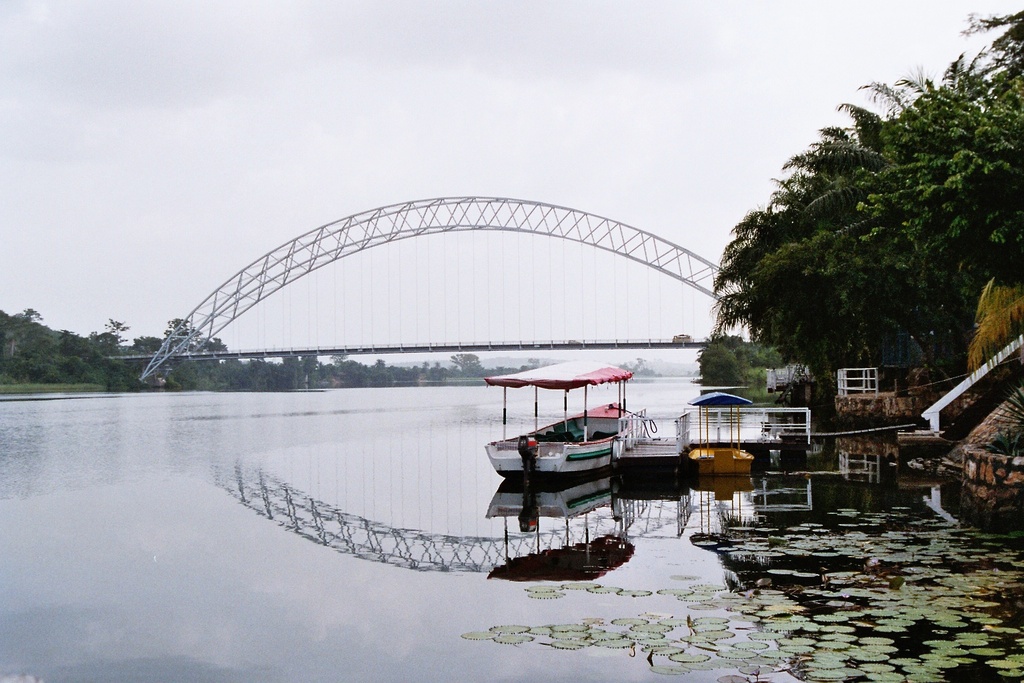
Eastern Region · Regional capital
Koforidua
Every tour bus from Accra gives Koforidua forty minutes. Buy beads, take a photo, back on the coach. It is the most under-used town in southern Ghana — and the best base you are not using.
- RegionEastern
- Capital since1959
- To Boti Fallsapprox. 30 km
- To Accraapprox. 85 km
- Best monthsNov – Mar
- Also known asKoftown
A capital that everyone visits and nobody sees
Open any Accra tour listing and you will find the same package sold by a dozen operators: Boti Falls, Koforidua bead market, Aburi Gardens, home before dark. Three hours in a minibus, forty minutes at the stalls, and that is the Eastern Region dealt with. It works as a product. It is a poor way to see the place.
Look at where Koforidua actually sits. It is in hill country roughly ninety kilometres north of Accra, and almost everything the day-trippers spend their day racing between — the falls, the rock formations, the arboretum, the botanical gardens, the farm where Ghanaian cocoa began, the Volta at Akosombo — lies within an easy radius of this one town. The tour operators drive past the sensible base camp in order to return to an expensive one.
Be honest about what Koforidua is and is not. There is no single monument here, no castle, no headline sight inside the town limits. What there is: a comfortable, green, unhurried regional capital that is cooler than Accra, calmer than Kumasi and considerably cheaper than both — where you will meet far more Ghanaians than travellers. Some visitors want exactly that. Others find it quiet. Know which one you are before you book.
New Juaben — a town built by people starting over
Koforidua's older, formal identity is New Juaben, and the word "new" is the whole story. In the nineteenth century, after conflict within the Asante state, people from Juaben migrated south and resettled here on Akyem land under their own leadership. They named the new settlement after the one they had left. Most Ghanaian towns are founded on conquest, trade or a river crossing. This one was founded on starting again.
What made it grow was what surrounded it. This is cocoa country, and the colonial railway that carried the crop turned Koforidua into the commercial clearing house for the whole region. Money, traders and administration followed, and when the Eastern Region was constituted in 1959 the capital went where the business already was.
The result is a town with an unusually layered identity: Akyem land, an Asante-descended stool, a colonial trading centre, and a modern administrative capital, all at once. It is why the chieftaincy here rewards more than a photograph, and why the local festivals are taken seriously by people who have three different histories to observe.
Getting to Koforidua
By road from Accra
Around 85 km, and realistically ninety minutes to two and a half hours. The entire spread is Accra traffic, not the road itself. Leaving the city before 7am can save you a full hour, and that is not an exaggeration.
By trotro and coach
One of the easiest public-transport runs in the country. Shared transport leaves Accra frequently through the day and drops you centrally. If you are travelling Ghana without a car, this is a route you can do on impulse.
From Kumasi and the north
A straightforward drive south-east, and a far better first night out of Kumasi than pushing all the way into Accra traffic. Treat Koforidua as the buffer between the two big cities rather than a there-and-back from the coast.
Reaching the sights
The falls and forests are scattered and public transport to them is awkward. Hire a driver for the day from Koforidua — substantially cheaper than the same arrangement out of Accra, and you gain back the two hours the day-trippers spend in the car.
The bead market — get the day right or do not bother
This is the largest bead market in Ghana, and it deserves better than the souvenir-stop treatment it usually gets. Beads here are not decoration. Powder-glass beads made by the Krobo, older bodom beads, recycled bottle glass fired into new colour — these are worn at naming ceremonies, at Dipo initiation, at marriages and at funerals, and particular beads say particular things. Traders come from across the region and from outside Ghana's borders to buy here.
Now the part that decides your whole trip. The market runs on a market-day cycle, traditionally Thursday. Arrive on a Tuesday and you will find a scatter of stalls and quietly conclude that the famous bead market is overrated. Arrive on the day and it is one of the best markets in West Africa, street after street of it. Confirm the current day locally before you build an itinerary around it — schedules do shift, and no tour listing will warn you.
Bargaining is expected and entirely good-natured. One piece of advice worth more than any haggling technique: ask what a bead is before you ask what it costs. Antique powder glass, freshly recycled glass and imported plastic sit side by side on the same table at wildly different values, and only some of it is worth carrying home.
Boti Falls and Umbrella Rock — time this properly
About 30 km out, near Huhunya, Boti Falls drops in two separate streams that local tradition names male and female. When the water runs high enough the two meet at the base, and the rainbow that forms there is understood locally as considerably more than a trick of the light. Around 250 steps take you down to the pool. They also, and this is the part no tour brochure mentions, take you back up.
Roughly seven kilometres further, reached on foot through the forest, Umbrella Rock is a broad slab of stone balanced on a narrow stem — wide enough to shelter a dozen people underneath, and genuinely odd to stand beneath. The view across the hills from the top is the best in the region. On the same walk you will be shown a three-headed palm and a stone seat said to bring twins to whoever sits on it. Believe what you like. The walk earns itself either way.
Come in the wet season if you want an actual waterfall. This reverses the standard advice for Ghana, and it is the single most useful thing on this page. Boti runs hard from roughly June to October and can be reduced to a disappointing trickle by a dry January. Visitors who follow generic "best time to visit Ghana" guidance arrive to find almost no water, and then blame the falls.
Tetteh Quarshie Cocoa Farm — where the whole industry starts
At Mampong-Akuapem, an easy run from Koforidua, is a small and modest site that changed the economy of a country. In the 1870s Tetteh Quarshie returned from Fernando Po carrying cocoa pods, and planted them here. Ghana went on to become one of the largest cocoa producers on earth, and a very large share of the trees in this country descend from that one act of agricultural smuggling.
Do not expect a museum. It is a farm with old trees, a caretaker, and a story — and that is precisely the point. Standing among cocoa trees that trace back to the original planting gives you a sense of scale that no visitor centre could manufacture. Pair it with the road up to Aburi and you have the best half-day in the Eastern Region.
Where to stay
Koforidua runs on business travellers, government visitors and traders, which produces exactly the kind of accommodation that suits an independent traveller: a decent spread of mid-range hotels and guesthouses, reasonable standards, and prices well below anything comparable in Accra. Nothing here is luxury. Most of it is clean, functional and unpretentious, and outside festival periods you will not need to book far in advance.
Eat at the chop bars rather than the hotel restaurants. This region takes its kenkey, fufu and palm-nut soup seriously, and the evening kelewele is as good as anywhere in the country. The reliable method everywhere in Ghana applies here: eat where people are queuing.
Two nights, not one. Koforidua only pays off if you actually sleep here. A single night turns it back into the day trip you were trying to escape — you will arrive late, see the falls in a rush, and leave before the market opens.
When to come
Dry season · November to March
Easier travelling: comfortable roads, reliable forest walks, less humidity, and the steps at Boti are dry rather than slick. This is the right choice if your priority is the town, the market and moving around the region without weather deciding your day. The trade-off is that the waterfalls will be at their weakest.
Wet season · June to October
The falls run properly, the hills are spectacularly green, and there are far fewer visitors at every site. The cost is mud, sudden heavy rain and forest paths that turn slippery. Come now if the water is what you came for — and accept that some days will be rearranged for you.
Watch also for the Kwahu Easter festival on the plateau to the north, when the whole area fills up and Ghana's paragliding festival runs off the escarpment at Odweanoma. If you are anywhere near the Eastern Region at Easter, reroute — and book accommodation well ahead, because Koforidua fills too.
Worth the detour nearby
- Akaa Falls — smaller and quieter than Boti, close by, and usually almost empty. The better stop when the main falls are crowded with school groups.
- Bunso Arboretum — a serious botanical collection with a canopy walk and outstanding birdlife, and a fraction of the crowds you will meet at Kakum.
- Obuotabiri — the hill standing over Koforidua, of real spiritual significance locally, and the reason the town has a horizon worth looking at.
- Kwahu plateau — cool highland air, long views and the Easter paragliding. Worth a night in its own right if you have the time.
- Akosombo and Lake Volta — an easy run east to the dam that reshaped Ghana, and the largest man-made lake on earth by surface area. Read the full Akosombo Dam story.
Practical notes, no sugar-coating
- Market day governs everything. Build the trip around it. Getting this one detail wrong is the single most common Koforidua disappointment.
- Falls need rain. Dry season for comfort, wet season for water. You cannot have both — decide which matters more before you book.
- Footwear. The steps at Boti are steep and get genuinely slippery after rain. Proper shoes, not sandals, and take the descent slowly.
- Guides. Guiding at the falls and the rock is informal and fees are negotiable. Agree the amount before you set off, not once you are at the top.
- Cash. ATMs are reliable in town. The falls, the arboretum and the cocoa farm are cash only — draw before you leave Koforidua.
- It really does rain here. This is one of the wetter corners of Ghana, which is exactly why it is so green. Carry something waterproof from May to October.
The honest verdict
Koforidua has no single sight that will define your trip to Ghana, and any guide claiming otherwise is selling you something. What it has is position: hill country an easy drive from the capital, with waterfalls, forest, the country's finest bead market and the birthplace of Ghanaian cocoa all inside an hour — and a real, working town to come back to at the end of the day.
Two nights here replaces two exhausting day trips out of Accra, costs less than one of them, and shows you more. That is the entire argument, and it is a good one.