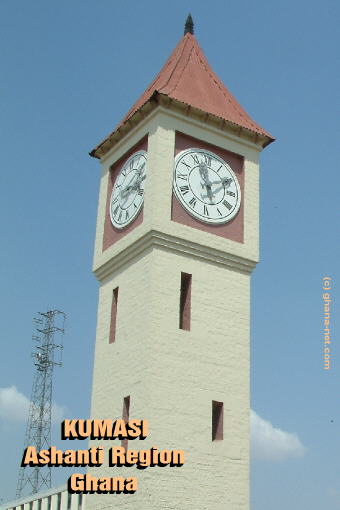
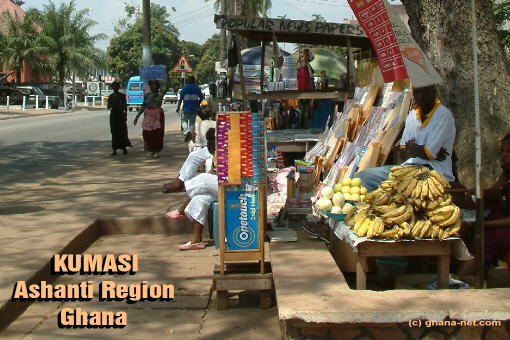
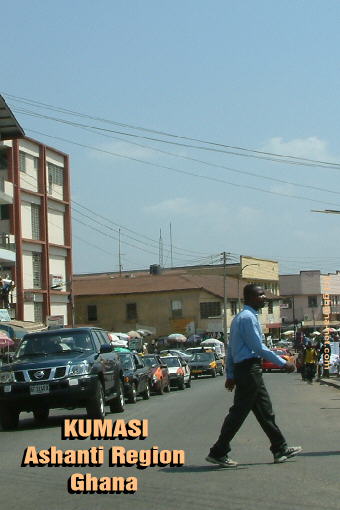
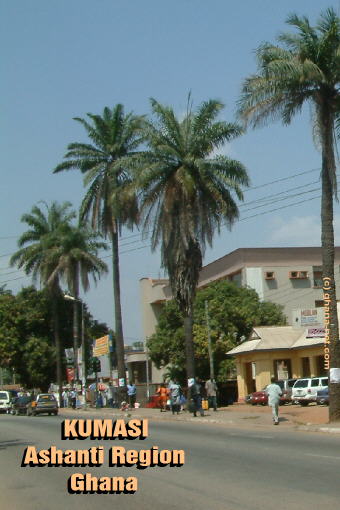
Kumasi, capital of the Ashanti region of Ghana.
|
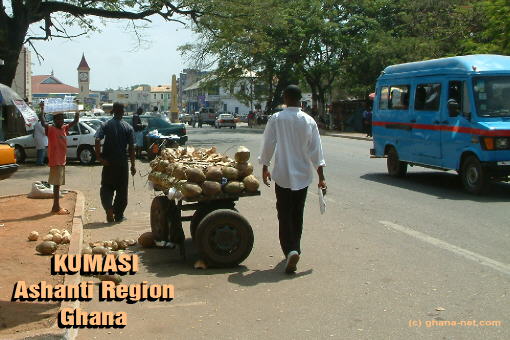
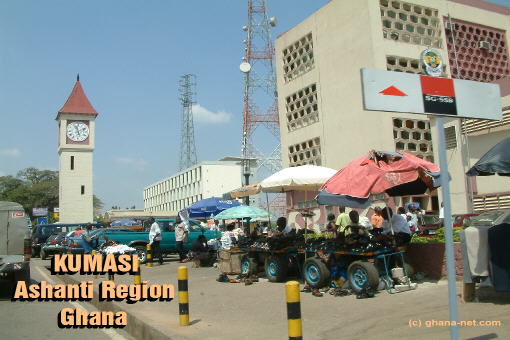
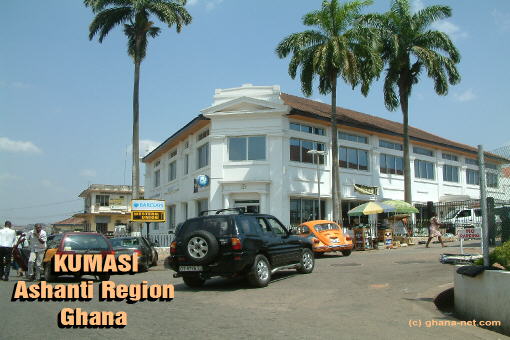
Kumasi, Ashanti region of Ghana.
Kumasi is the capital city of the Ashanti region of Ghana. Because of the varied plant life in the area, it is known as "The Garden City." Kumasi ist die Hauptstadt der Ashanti Region in Ghana. Aufgrund der vielfaeltigen Pflanzen und Baeume ist Kumasi auch die "Garten Stadt" bekannt. |
The city of Kumasi was founded in the 1680’s by King Osei Tutu I to serve as the capital of the Asante State (Fynn, 1971). Given its strategic location and political dominance, Kumasi as a matter of course, developed into a major commercial centre with all major trade routes converging on it.
The unique centrality of the city as a traversing point from all parts of the country makes it a special place for many to migrate to. The metropolitan area shares boundaries with Kwabre East District to the north, Atwima District to the west, Ejisu-Juaben Municipal to the east and Bosomtwe to the south.
Kumasi is located in the south-central part of the country, about 250 km (by road) northwest of Accra.
Lake Bosumtwi, the largest natural lake in Ghana, is located approximately 32 km south of Kumasi.
Downtown Kumasi with a population of 1,517,000 (2005, source: United Nations Population Division), Kumasi is the second-largest city in the country. The largest ethnic group is the Ashanti, but other ethnic groups are growing in size. Approximately 80% Christians and 20% Muslims, with a smaller number of adherents to traditional beliefs. It is an Anglican diocesan and Roman Catholic archdiocesan see.
The city exists in the forest region of West Africa, but there is evidence that the area around Kumasi has been kept cleared since the Neolithic. The city rose to prominence in 1695 when it became capital of the Ashanti Confederacy due to the activities of its ruler Osei Tutu. The ruler of Kumasi, known as the Kumasehene, also served as ruler of the Confederacy. Parts of the city, including the -
Royal Palace - where destroyed by British troops in the Fourth Anglo-Ashanti War of 1874. It remains a royal city, although since all of Ghana was declared independent in 1957, the role of king has been mainly symbolic. The city holds an important place in the history of the Ashanti people, as legend claims that it was here Okomfo Anokye received the Golden stool, an embodiment of the soul of the Ashanti nation.
Due to large gold deposits that have been mined in the area, Kumasi has been among the wealthier cities in Ghana. Today's major exports are hardwood and cocoa. Kumasi has 50% of the timber industry in Ghana, with more than 4,000 employed in the business.
Features of the city include the large Kumasi Central Market,
Fort Kumasi (built by the British in 1896 to replace an Asante fort and now a museum), and the Kumasi Hat Museum. Royal Asante attractions include the Palace Museum.
The unique centrality of the city as a traversing point from all parts of the country makes it a special place for many to migrate to. The metropolitan area shares boundaries with Kwabre East District to the north, Atwima District to the west, Ejisu-Juaben Municipal to the east and Bosomtwe to the south.
Kumasi is located in the south-central part of the country, about 250 km (by road) northwest of Accra.
Lake Bosumtwi, the largest natural lake in Ghana, is located approximately 32 km south of Kumasi.
Downtown Kumasi with a population of 1,517,000 (2005, source: United Nations Population Division), Kumasi is the second-largest city in the country. The largest ethnic group is the Ashanti, but other ethnic groups are growing in size. Approximately 80% Christians and 20% Muslims, with a smaller number of adherents to traditional beliefs. It is an Anglican diocesan and Roman Catholic archdiocesan see.
The city exists in the forest region of West Africa, but there is evidence that the area around Kumasi has been kept cleared since the Neolithic. The city rose to prominence in 1695 when it became capital of the Ashanti Confederacy due to the activities of its ruler Osei Tutu. The ruler of Kumasi, known as the Kumasehene, also served as ruler of the Confederacy. Parts of the city, including the -
Royal Palace - where destroyed by British troops in the Fourth Anglo-Ashanti War of 1874. It remains a royal city, although since all of Ghana was declared independent in 1957, the role of king has been mainly symbolic. The city holds an important place in the history of the Ashanti people, as legend claims that it was here Okomfo Anokye received the Golden stool, an embodiment of the soul of the Ashanti nation.
Due to large gold deposits that have been mined in the area, Kumasi has been among the wealthier cities in Ghana. Today's major exports are hardwood and cocoa. Kumasi has 50% of the timber industry in Ghana, with more than 4,000 employed in the business.
Features of the city include the large Kumasi Central Market,
Fort Kumasi (built by the British in 1896 to replace an Asante fort and now a museum), and the Kumasi Hat Museum. Royal Asante attractions include the Palace Museum.
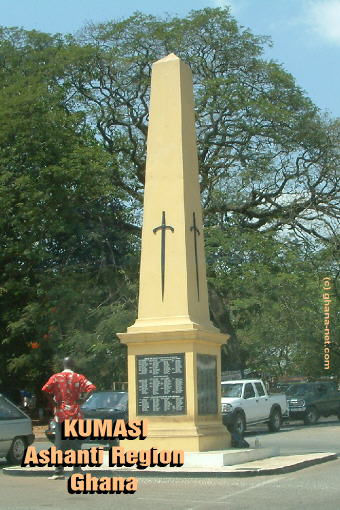
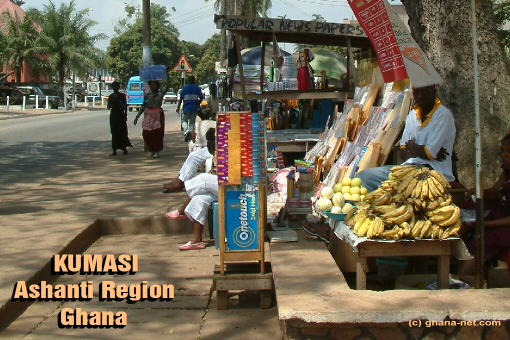
|
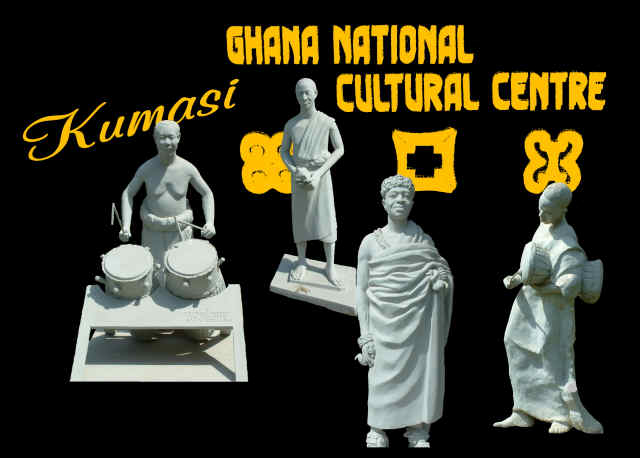
National Cultural Centre
(including the Prempeh II Jubilee Museum with various Asante regalia including a reproduction of the golden stool), the Okomfo Anokye Sword, the Asantehene's Palace (built in 1972), and the Mahniya Palace, dating from 1925, now a museum. Kumasi is also home to a zoo, and to the Kwame Nkrumah University of Science and Technology of Ghana (formerly the Kumasi College of Technology). |
|
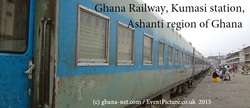
Kumasi is served by Kumasi Airport and railway lines to Accra ( Accra-Service does not work, at the moment)
and Sekondi-Takoradi, via Obuasi the Gold Mining city.
Because of the barrier mountain range just to the north, the rail-system does not yet go further to the north.
and Sekondi-Takoradi, via Obuasi the Gold Mining city.
Because of the barrier mountain range just to the north, the rail-system does not yet go further to the north.
|
The Kumasi area has one public hospital (Komfo Anokye Teaching Hospital, 736 beds), five public clinics and 57 private clinics (1992 figures).
The city's most famous son is the former Secretary-General of the United Nations, Kofi Annan. The local football (soccer) team, the Kumasi Asante Kotoko has won several national and continental awards. Their stadium was built in 1959 and renovated in 1978, and with a seating capacity of 100,000, it's the largest in the country. Wikipedia, the free encyclopedia Some of the Schools in Kumasi :
|
Kumasi & Ashanti region Links:
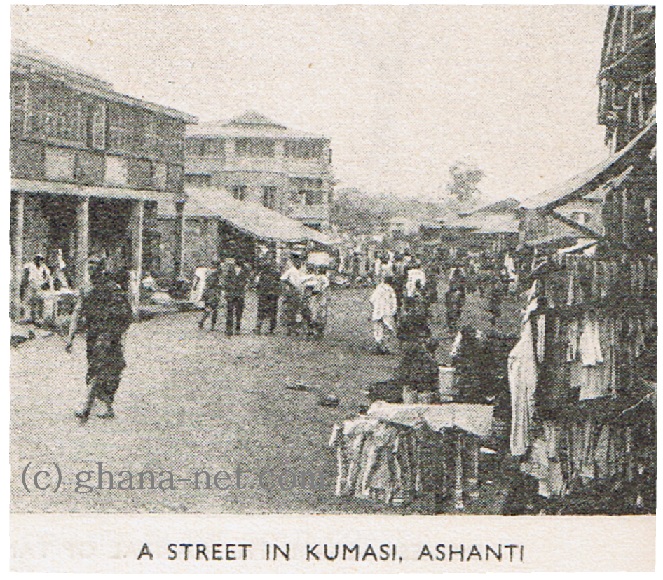
Old photograph of a shopping street, in Kumasi by 1920. British Gold Coast.
|
To discover the traditional heartland of Ghana, a visit to Ashanti is a must.
Attractions and Excursions in the Ashanti Region, Kumasi and the Asante heritage
Kumasi is the capital of the Asante Kingdom and the local highlights are:
Manhyia Palace Museum
Centre for National Culture
The Prempeh II Jubilee Museum
Kumasi Fort and Military Museum
Okomfo Anokye Sword
The Akwasidae Ceremony
Kejetia Market
Kumasi Zoo
Traditional street sculptures
University of Science and Technology
The Crafts of the Asante
The crafts villages surrounding Kumasi include:
Bonwire - 18km NE of Kumasi - Kente weaving
Pankronu - 3km N of Kumasi - pottery
Ahwiaa - 6km N of Kumasi - wood carvings
Ntonsu - Adinkra cloth making
Asuofia/Asamang - Barakese road - beadmaking
Ampabame Krofrom - 10km from Ahodwo - brass smiths Goldsmiths and silversmiths can be seen in Kumasi.
The Natural Attractions of Ashanti
The Ashanti Region is a great area in which to explore unspoilt natural attractions. For birds and butterflies the forests are the place to go, while wildlife can be spotted around the lakes and in the nature reserves. The following locations are great for trekking, or just rewarding forest walks:
Lake Bosomtwi - 35km S of Kumasi
Bobiri Forest Reserve 35km SE of Kumasi
Owabi wildlife sanctuary - 23km NW of Kumasi
Bomfobiri Wildlife Sanctuary - 50km from Kumasi
Digya National Park - From Kumawu to Atebubu
Atwia Rock Formations - 40km from Kumasi
Mframabuom Caves - Kwamang, 55km from Kumasi
Obuasi Gold Mines
For details of visits to the Ashanti Gold Mine- available on Tuesdays- Thursdays- contact the P.R. Manager on (0582- 494)
The Cultural Attractions of the Asante
The traditional culture of the people is one of the attractions of the Ashanti Region. Important illustrations can be discovered at:
Asantemanso Village
Kumawu Town
Kentinkronu Shrine
Adarko Jachie Shrine
Ejisu Besease Shrine
Statues of Kumasi
Patakro Shrine
Attractions and Excursions in the Ashanti Region, Kumasi and the Asante heritage
Kumasi is the capital of the Asante Kingdom and the local highlights are:
Manhyia Palace Museum
Centre for National Culture
The Prempeh II Jubilee Museum
Kumasi Fort and Military Museum
Okomfo Anokye Sword
The Akwasidae Ceremony
Kejetia Market
Kumasi Zoo
Traditional street sculptures
University of Science and Technology
The Crafts of the Asante
The crafts villages surrounding Kumasi include:
Bonwire - 18km NE of Kumasi - Kente weaving
Pankronu - 3km N of Kumasi - pottery
Ahwiaa - 6km N of Kumasi - wood carvings
Ntonsu - Adinkra cloth making
Asuofia/Asamang - Barakese road - beadmaking
Ampabame Krofrom - 10km from Ahodwo - brass smiths Goldsmiths and silversmiths can be seen in Kumasi.
The Natural Attractions of Ashanti
The Ashanti Region is a great area in which to explore unspoilt natural attractions. For birds and butterflies the forests are the place to go, while wildlife can be spotted around the lakes and in the nature reserves. The following locations are great for trekking, or just rewarding forest walks:
Lake Bosomtwi - 35km S of Kumasi
Bobiri Forest Reserve 35km SE of Kumasi
Owabi wildlife sanctuary - 23km NW of Kumasi
Bomfobiri Wildlife Sanctuary - 50km from Kumasi
Digya National Park - From Kumawu to Atebubu
Atwia Rock Formations - 40km from Kumasi
Mframabuom Caves - Kwamang, 55km from Kumasi
Obuasi Gold Mines
For details of visits to the Ashanti Gold Mine- available on Tuesdays- Thursdays- contact the P.R. Manager on (0582- 494)
The Cultural Attractions of the Asante
The traditional culture of the people is one of the attractions of the Ashanti Region. Important illustrations can be discovered at:
Asantemanso Village
Kumawu Town
Kentinkronu Shrine
Adarko Jachie Shrine
Ejisu Besease Shrine
Statues of Kumasi
Patakro Shrine
Search 3 of our sites: ghana-net.com, ghananet.co.uk and ghanawebnews.online
|
Search ghana-net.com OR ghanaweb-news.com (ONLY)
Radio Live Pages |
Ghana Info Pages |

More Ghana Links
British Gold Coast (Many pictures shown!)
Fort Batenstein (full info website) Logbuch.Ghana-net.net (Deutsch) GhanaHotels.biz (400 + Hotels) All Towns of Ghana, by Region A - Z Preventive child health inequality 1283 private health institutions in Ghana |
Welcome to Ghana! Akwaaba!
Ghana-Net.com is one of Ghana`s oldest websites, with tourism information`s about Ghana, Live Radio, life and culture of of all Ghana Nation`s, and tribes - like Ga people, Fante, Ewe, Ashanti, Dagbani, Frafra, Krobo and many other tribes and kingdoms of Ghana.
Ghana-Net.com 1st time online late December 2000, and updated since 2001 !
Ghana-Net.com is one of Ghana`s oldest websites, with tourism information`s about Ghana, Live Radio, life and culture of of all Ghana Nation`s, and tribes - like Ga people, Fante, Ewe, Ashanti, Dagbani, Frafra, Krobo and many other tribes and kingdoms of Ghana.
Ghana-Net.com 1st time online late December 2000, and updated since 2001 !
Ghana-Net.com - connected with; GhanaRadio.online /
GhanaMirror.com / GhanaWeb-News.com / GhanaMirror.uk / GhanaHotels.biz / GhanaFlights.info /
GhanaMirror.com / GhanaWeb-News.com / GhanaMirror.uk / GhanaHotels.biz / GhanaFlights.info /
Privacy Policy, Terms & Conditions and Disclaimer / Services / Contact Us / (c) by ghana-net.com 2000- 2019